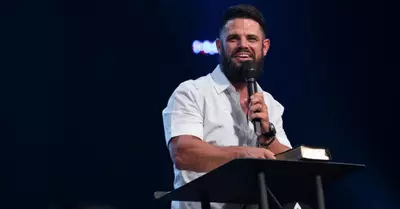

In high school, Andy Marin admits he was a Bible-banging homophobe who had a habit of calling people "fag." All that changed in the space of three months, when his three best friends came out to him, leaving him reeling. Those revelations began an all-or-nothing pursuit to find a way to connect with his friends living the gay lifestyle while retaining the strength of his faith.
His pursuit took him to the heart of Boystown, Chicago's gay community, where he and his wife live today. Immersed in the community, Marin formed relationships with gays, lesbians, transgendered and bisexual people that showed him the face of those who wouldn't darken the door of most churches. Those friendships led Marin, the self-proclaimed homophobe, to a dynamic exploration of how the evangelical church and the gay community could better interact. It was time to elevate the conversation beyond the roadblock questions into something more authentic.
Marin's book, "Love Is an Orientation," is almost as much of a narrative as social handbook. Marin includes stories from gay friends, friends struggling with same-sex attraction, and his own experiences as a straight, white Christian in Boystown while sharing ways to build bridges to reach the gay community for Christ. Along the way, he deals with the inevitable questions of whether sexual orientation can change, how "speaking the truth in love" looks, and a host of other hotbed topics. His answers, however, go far beyond "yes" or "no" responses.
Here, Marin shares his experiences and concerns as a straight, white evangelical with a heart for the LGBT community.
CW: It sounds like your primary goal in writing the book was almost to rehumanize the gay community.
Marin: It's very true. In the book I say it's like both communities are working off a false model of the ideal situation. So it's like, not only is the gay community trying to convince Christians that gay folks are right, and Christians folks are trying to convince gay folks that they're right, not only are we just talking past each other.
We both—and this is within the broader culture war—we both have a like evil little caricature of each other that are in the back of our heads. So when we move forward in this, or see people, or see things on the news that don't align with exactly where we're at or what we're trying to do, all of the sudden it becomes bad tension. And it becomes not constructive. And it becomes political hotbeds and it becomes us vs. them. What I'm trying to say with this is, we really need to take a chill pill when it comes to the automatic generalizations.
The neat thing is, I'm not trying to convince you to believe in something that you don't believe. I'm just trying to reclaim what it is to be a "come as you are" culture. The same "come as you are" culture as we are with everyone else.
CW: What would you say are the top mistakes Christians make when addressing the issue of homosexuality - or even more personally, addressing somebody from the gay community?
Marin: I think the one thing where we kind of get it wrong right off the bat is, we think we understand. And what has traditionally happened with this, just like anything else, is someone will come up to us and say, "I have this or I'm that" and we will respond by saying, "Oh, I understand because…" and then we give a nice analogy to that that somehow relates we're coming off on a level playing field. We're all starting at the same place.
But when it comes to same-sex attraction, we have to understand that we can't understand what that is like. If you think about it, when someone has a same-sex attraction, whether they act on that attraction or they don't act on that attraction, they are automatically passive deviants to mainline Christianity. And I, as a straight, white conservative male, have absolutely zero idea of what it is like to be inherently passive deviant to mainline Christianity for any reason.
And I think this is the part that we're missing - it's the human component. It's the soul component. We're just looking at it from a heaven-and-hell context. Instead of looking at it as, what did God do to conform us to his image? How did God in his transformational power work within our everyday lives? And that is just getting stifled so much because we automatically think we understand.
I have this little slogan that says, "Right from the gate, you can't relate."
CW: Go ahead and explain that a little.
Marin: We have to understand that right from the start, we cannot - never, never, never - understand what it is to have and live with a same-sex attraction. You cannot understand what it's like to be inherently passive deviant to mainline Christianity. And because of those two specific things, what we in the Christian community have to do - what has to be our first movement every time - is we have to start understanding the gay community through their filtration system, through their perspective. And until we humbly do that, without knowing what's going to happen down the road, my belief is that nothing significant can happen from this point forward.
One of the things that I try to communicate that I think is so, so important is that, God doesn't only work when we know what the outcome is going to be. And when it comes to homosexuality, that just doesn't fit our paradigm! Because we think we have to know what the outcome is going to be.
CW: Somewhere along the way they're going to change their orientation, is that we think we have to know?
Marin: Nowhere in Scripture does it say that God is going to tell us what's going to happen at the end of the day in someone's specific life. … God doesn't always work when we know what the outcome is going to be, and that is just as applicable to the gay and lesbian community as it is for anybody else.
CW: In your book you talk a lot about how it's not your job to go talk to somebody and try to convict them. You say it's our job to try to introduce them to God and then let God do the convicting.
Marin: First thing is, this Billy Graham quote. He was at a rally for Clinton after Clinton's sex scandal and a member of the media said, "Billy Graham, why are you here?" And Billy Graham says, "Because it's the Holy Spirit's job to convict, God's job to judge, and it's my job to love. And that's what I'm here doing." And that was the first time that I ever truly understood my kingdom job description.
Until that point, for whatever reason, I was always like, "Oh man, I have to do the convicting. I have to do the judging. I have to drag someone on my power from A to Z. A is where I'm at and Z is what I think is best for their life." Well, what I think is best for their life might not necessarily match up with the journey that God thinks is best for their life.
I think bridge-building, from a straight, Christian perspective, isn't about the gay or lesbian person in and of themselves. I believe it is about the Lord counter-cultural call for us to live in relationship to and relationship with. If we can only be faithful enough to our kingdom job description, is God not big enough to be faithful to his kingdom job description, whether or not we think it comes true?
We have taken [the attitude that we must change someone from gay to straight] about ourselves as our main job description when it is not. The moment I try to do the convicting, and the judging, while I have not earned any amount of respect in that person's eyes to be able to speak into their life, I'm trying to do God. And I'm saying, "God, you're not worthwhile enough for me to trust you. I just gotta do it myself."
CW: We have a hard time figuring out what high fidelity to Scripture - and all of Scripture - looks like while we also want to demonstrate a welcome heart to everybody who is a sinner just like us, whether gay or straight. Any advice on how to walk that tension?
Marin: One of the questions I get quite a bit is, "How do I live out the truth in love? Now, there's actually two underlying questions to that one. The first thing it could be is, "When do I get to tell them it's a sin and how soon? And how quickly can that happen?" And the second portion to that is, "I am literally just trying to figure out how to live, and how to learn, and how to love. And I don't know." And for me, there is no better place than to come to somebody in the gay or lesbian community that we love and we say, "I am trying to learn how to live and how to love and I don't know and I don't have the answers. And unless you let me into your life, and we do this thing together, nothing is ever going to change."
I never want to sit here and say that I have all the answers. I never want to know what every step along the journey is. That's not my job. For people looking for that, the only thing I can give them - and I know this is not satisfying for a lot of people but it's just the dead honest truth - is that I don't know and they don't know either. And the only way we're going to figure either one of things out is if we do it together in conjunction with someone in the gay or lesbian community.
Just because we validate someone's life and experience as legitimate to them does not mean that we believe in a pro-gay theological belief system. And yet when people in the broader church look at myself or people like me who live with the gay community, who have friends in the gay community, they say, "Whoa, wait a second, you're flying off the handle! You believe in a pro-gay theology!" And I say, "Hey, I've never, not one time said that in my life. I just live it out differently."
There was a large Christian magazine that recently asked me, "Let's say, Andrew, that everyone buys into what you say. Let's say every church buys into what you say. What's going to happen 40 years down the road? Tell us, why should we believe you?"
I said, "Here's the exciting part and the scary part - I don't know what it's going to look like 40 years down the road."
Everybody has been so concerned with X, Y, and Z, that no one has ever done A, B, and C in the right way so we can figure out what X, Y and Z will look like! So I'm trying to encourage the [church] body to do it and if you want to talk to me in 40 years, when I'm 68, I'll look back and say, "Here's where culture shifted. Here's where the church shifted. Here's where the gay community shifted."
I'm just trying to encourage people to do the exact same thing because we have thought we have had everything figured out for so long. But you know what we figured out? We found a gigantic disconnect, a gigantic chasm between us and the gay community. That's what we've won. That's what we've gotten.
CW: We did a lot of stuff about the Day of Silence when that happened in the schools. What do you say to parents who are afraid of their kids accepting the gay lifestyle as something normal and desirable?
Marin: I've never met any gay or lesbian person - and once again, I live here - I've never met one person who's said, "You know, I never really felt gay, I never had an attraction to people of the same sex, but when I was in school, and gay became normalized, then I thought, hey, this was something I'm totally going to give a shot to." I've never heard that happen - not one time. It's just such a false expectation that just keeps the fear perpetuating over and over and over.
I understand when parents get upset about my kindergartner has to read a book where there are two men kissing at the end with a heart in between. I understand those things. But once again, I try and say to the parents, no matter what the school system does, no matter what books your kids have to read for whatever curriculum - you can go to the evolution thing, it's the same thing - you are the parent. Are you going to let school and curriculum dictate your kids' theological belief system? Are you so far removed from their life that they're just going to buy into whatever they hear at school? I think that's just a general reminder to parents that your kid is your job, not the teacher's or the school's … the gay issue is just a tiny, tiny little piece of that that we have latched onto and taken to ridiculously extreme levels from my perspective.
CW: What advice to you give to individuals who want to start building bridges but may not know how?
Marin: There's two types of ways. There's the type of person who already knows someone who's gay and then there's the type of person who doesn't know anyone who's gay - or they don't think they know anyone.
I'll start with the later. For someone who doesn't think they know anyone who's gay or they legitimately might not, that's the wonderful thing about Google. You type in your town and you type in "gay" and pretty much any town in the country or a town close to yours is going to pop up a gay group of some type, whether that is a gay-straight alliance at your highschool, whether that is an equality rights organization, an HIV/AIDS organization, there is bound to be some type of gay group or organization close to you…
Go find that gay group and then go. Go! Take yourself out of anything that you know that is comfortable and you go and you place it right smack dab in the middle of somewhere where you don't belong and watch what happens.
The first time that I ever went to a gay club with my best friend after they came out to me, like 30 seconds after I walked into this place and everyone's head is turning right at me. And I'm like, "What's going on?" And my friends are like, "You ooze alpha-male, maybe you can turn that down a couple notches." Thirty seconds later a guy walks up to me, taps me on the shoulder and says, "You're not gay, are you?" And I said, "No, no, I'm not gay." So he turns around to his friends and says, "See I told you! He's not gay! Pay up!" They had made a bet. So he goes and gets his money, sticks it in his pocket, comes back, walks right up to my face and says, "Then what are you doing here?" And I was like, I didn't know what to do I didn't know what to say. It was a really stressful thing for me. And so we started talking.
By the end of the night, me and that guy and his five or six friends were sitting on couches in the back of this club - now this is the largest gay club in the city of Chicago; there are stripper poles around, porn on the TV, all this stuff is going on - and these guys and me are sitting on these couches and they are crying their eyes out in the middle of this club talking to me about their experiences with God and with faith and with religion and with their families and with all this stuff. I never expected that! That is the exact opposite of what I ever, in my wildest dreams, expected to happen. And it was only because - and this was when the big light bulb went off in my head - which was I became the most unique icebreaker by doing nothing other than going somewhere that I didn't belong. And sticking out like a sore thumb is a brilliant, brilliant thing that the Lord has given us an opportunity to do.
It doesn't matter who kicks us out or what they say to us because, just when we are known as Christians or conservatives or evangelicals or whatever, we are going to be placed on us all the baggage that comes with it. And until we're ready to claim that and work through it, how do we expect things to actually happen? We need to go back and back and back and prove that we are who we say we are. And I think that is the one thing that we have not done - we have not proven it. We keep saying it, but we haven't yet proven it and the only way we can prove it is by being intentional and committed.
CW: How about for somebody who already has that contact [with someone who is gay] but isn't sure how to proceed?
Marin: I know this is going to sound like a shameless plug, but one of the reasons I did write the book was so I could impact the last almost-decade of my life to a person who reads that. They can know my experiences and go through the main questions—the last section of my book is about how to answer the tough questions on homosexuality, what I call the five litmus questions, like "do you think it's a sin" and "can you change someone," etc. Those are all yes or no questions, but you can never answer yes or no to those questions. I use the model to give alternative conversation starters. That's a wonderful, wonderful tool for people to have because it releases them and the puts it back on the author, saying, "Hey I was reading this book and here's his perspective on how to elevate this conversation." And here's where the key is. "Because I don't know what to say and I don't know what to do and I don't know how to figure this out."
CW: So the first step is just being honest?
Marin: The first thing to do, without a doubt, is get back to "right from the gate, you can't relate." I tell people all the time, use that! Use that language, claim it as your own. Say "right from the gate, I can't relate. I can never understand what it's like to have a same-sex attraction because I don't have one. And so unless you let me into your life, and we do this thing together, I'll never know and I'll never figure this out because I don't know what to say, I don't know what to do, I don't know how to understand." The moment we start putting ourselves as the humble learner is the moment that we're already leap years ahead of so many others who think they know the answer or have the answer. The more we can do that, the more the defense systems and the walls that separate start to come down on both ends, because it's authentic and it's real.
One of the other things I talk about is the two T's - truthfulness and transparency. I'm not asking anyone from either side or either community to be something that they're not. I just want authentic relationships. And authentic relationships rooted in Christ are the only way this so divisive and complete culture war is going to end. And we in the Christian community have to be the first ones to take that step.
Why don't we be the first ones to take that first scary step of faith? That's the great wonder of faith - it's the things that we hope for but it's the things that we are certain that we do not see. We are certain of certain things even though we can't see it and so we hope for them to happen. One of the greatest things of God's system that he put forth is that he just doesn't give us answers. He just doesn't give us things, he gives us opportunities to figure it out with him.
CW: That's great for individuals. There's a whole other side to being an evangelical, and that's being part of the church. Corporately, can you lay out something for pastors and congregations as a whole to start working on?
Marin: I don't think the annual sermon on homosexuality ever works. I think it does more harm than good. And I'll tell you why. It's because churches will bring the topic to the forefront and then it'll just end. A sermon is 30 or 40 minutes tops, you can't even start to get into any depth or crevasses on homosexuality or the culture wars.
After someone does the annual talk on homosexuality, there are so many questions. There are so many things that people wonder about, there are so many people who come out of the woodwork to be like, "Hey, I'm gay" or "I have a same-sex attraction" and the problem is that churches never give a framework for follow-up and follow-through. They think the annual sermon on homosexuality—they've done their job, it releases them from their responsibility. It's like, "Okay, now that's done and I don't have to deal with it for another two years." But there's never a framework for follow-up and follow-through, which is why the Marin foundation exists. We work with so many churches around the country who want to provide that framework so that when you bring it up, it's not going to be another dead issue that you've just conquered and can wait another two years to hear again.
I don't believe it's difficult to get gay and lesbian people to come to our churches, yet it's a whole different ball game to actually keep them in the fold. And why that is, is what tends to happen is, they come to our churches and the heads turn, the whispers begin and they never come back. They never come back. We've just spit on that opportunity to do something for the Kingdom in that person's life because we whispered and we looked at them funny and they've never going to come back.
[W]hat happens when you have a gay couple who has a kid and they come to church? Are you going to kick them out or are you going to try to serve them as best as you can, serve their child as best you can? For me, this isn't a topic that has to be talked about fifty-two weeks a year for ten years consecutive. It's just a topic that needs to be understood and formulated in such a way that when gay or lesbian people do come to our churches, everyone is on the same page.
The hard part is, how do we live out our theological beliefs in such a way that we are able to serve our community that's on the outside?
CW: You have been working with churches over the past few years. Do you have anything exciting that you can share about what's been going on in some of them?
Marin: A couple years ago, I couldn't have talked to you and said, "Hey, Katherine, I'll give you all these exciting things happening in churches." It was still a dream at that point. But today I can literally sit here and say there are churches all over the country that are doing great things for the Kingdom within their own local gay and lesbian communities that have never happened previously. For instance, we can even look at the church that I attend. We're located in a predominately lesbian neighborhood in Chicago.
I had another church in San Diego recently and they were looking for a new building. And they said the Lord just kept impressing on them that they needed to reach their large gay community here in San Diego so they moved their church right into the middle of the gay community in San Diego and they have started involving a team of people who now - each one has a different gay organization that they go to on a regular basis and they go and they go back and they go back, and they keep saying, "This is the church I'm from. This is what I'm doing." In essence, they've recreating my original immersion experience and all of the sudden gay and lesbian people are starting to come to their church and starting to involve themselves in conservative, evangelical Bible-believing churches. People look at them and say, "Why in the world would you go to that church?" and they say, "Because that church has finally figured out how to serve the community that's been looked at on the outside for so long." It doesn't start or stop with just these little churches. There are some very large megachurches that have done significant things, Willow Creek being one of them. They've brought me in and let me teach week after week, starting group after group. New Song Church, their youth group started doing stuff with the local Gay-Straight Alliance at the high school.
It's just amazing the different things that have actually happened. I don't like to name drop churches because I don't think my work is set in a Willow Creek or New Song or anything like that, because ultimately the Marin Foundation, our goal is to systemically build a bridge between the broader gay and lesbian community and the church. And the only way for that to happen is for these small local churches all across the country to rise up and start living in a different way. Then bam, the movement has taken off.