Falling Into The Bible: The Garden Tomb
- Eva Marie Everson Author & Speaker
- Published Nov 06, 2002
Matthew's gospel records Jesus as saying that "it is easier for a camel to go through the eye of a needle than for a rich man to enter the kingdom of God." After our day of walking around the Old City of Jerusalem (As I later told my mother, "I climbed Mount Zion. I mean, I literally climbed Mount Zion!") I decided that Jesus should have added that it is also easier for a man to enter the kingdom of God than to get through the Damascus Gate.
Though, truthfully, the Damascus Gate is quite a large opening, it shrinks considerably when hundreds of people are trying to both enter it and exit it at the same time. Of course that is exactly what we were attempting to do-the seven of us-following Miriam, our tour guide, through narrow roads filled with a cacophony of Arab traders and old peasant women selling their produce, all of whom were dressed in long-established costumes and playing traditional music.
It was extremely hot as we moved among the people -- shuffling rather than walking -- toward the gate that would lead us outside the Old City's northern wall and toward The Garden Tomb.
The Garden Tomb is one of the two sites in Jerusalem that claims to be the vacated burial tomb of Joseph of Arimathea, used temporarily by Jesus of Nazareth. The other is located within the Church of the Holy Sepulcher. The Garden Tomb and a hillside quarry with a strange resemblance of a skull, often called Gordon's Calvary, were discovered in the 1880's by Christian explorer, General Charles Gordon. The quarry has also been linked to the site of Stephen's stoning and martyrdom. (See Acts 7.)
Biblical History
What do we really know about the death, burial and resurrection of Jesus? According to Scripture, He was led to a place called "The Skull" (Golgotha in Hebrew/Aramaic or Calvary in Latin). “So the soldiers took charge of Jesus. Carrying his own cross, he went out to the place of the Skull.” ~~John 19:17
We know that He was crucified in a place where those who witnessed it would be acutely aware of His "crime." “Pilate had a notice prepared and fastened to the cross. It read: JESUS OF NAZARETH, THE KING OF THE JEWS. Many of the Jews read this sign, for the place where Jesus was crucified was near the city, and the sign was written in Aramaic, Latin and Greek.” ~~John 19: 19-20
It was the custom of the Romans to carry out their crucifixions alongside those roads that would be considered the busiest, where the highest number of people could view them, and thereby be deterred from committing the same crimes or types of crimes.
If Gordon's Calvary is the correct site of the execution of Jesus, it would have been at the intersection of the routes to Damascus and Jericho, specifically trade routes. Therefore, plenty of people would have seen Jesus' crucifixion and would have read the sign placed above His head.
We know that after the death of Jesus, a man named Joseph of Arimathea asked Pilate for His body, was granted it, and that he took the body to a new tomb, which was both close by and near a garden.
“Later, Joseph of Arimathea asked Pilate for the body of Jesus. Now Joseph was a disciple of Jesus, but secretly because he feared the Jews. With Pilate's permission, he came and took the body away...At the place where Jesus was crucified, there was a garden, and in the garden a new tomb, in which no one had ever been laid. Because it was the Jewish day of Preparation and since the tomb was nearby, they laid Jesus there.” ~~John 19:38-42
We know that the tomb belonged specifically to Joseph, that it was carved out of rock, that it had a stone rolled across its entrance and that Mary Magdalene and "the other Mary" (as there were just so many of them!) sat in a place opposite the tomb, witnessing all of this.
“Joseph took the body, wrapped it in a clean linen cloth, and placed it in his own new tomb that he had cut out of the rock. He rolled a big stone in front of the entrance to the tomb and went away. Mary Magdalene and the other Mary were sitting there opposite the tomb.” ~~Matthew 27:59-61
We know that three days later, the women went back to the tomb to complete the body's preparation for burial, found that the body was gone, and then had a conversation with an angel. "Don't be alarmed," he said. "You are looking for Jesus the Nazarene, who was crucified. He has risen! He is not here. See the place where they laid him. But go, tell his disciples and Peter, 'He is going ahead of you into Galilee. There you will see him, just as he told you.'" ~~Mark 16: 6-7
From what we can piece together from Scripture, what happened next was this: the women seemed to separate, with Mary Magdalene heading out to alert Peter and John and the other women being met by Jesus along the way. "Do not be afraid," He told them. "Go and tell my brothers to go to Galilee; there they will see me." (See Matthew 28:9)
Having received the news from Mary Magdalene, John and Peter took off in a race to the finish line. Though John arrived at the tomb first, he didn't go in, but stopped and peered inside. Our Impetuous Pete, however, plowed right in and was then joined by John. (See John 20:3-9)
Mary Magdalene could not have seen Jesus with the other women because, distraught, she stayed at the tomb after Peter and John left and wept (Gk. "klaio," which mean: mourn, lament, wailing in pain and grief). Jesus then appeared to her, but she mistook Him for the gardener. She asked Him if He had any idea as to where the body of her Lord might be, and if so, to please tell her and she would go get the body and she would take care of it.
Jesus said to her, "Mary." She turned toward him and cried out in Aramaic, "Rabboni!" (which means Teacher) ... Mary Magdalene went to the disciples with the news: "I have seen the Lord!" ~~John 20:16,18
Falling In
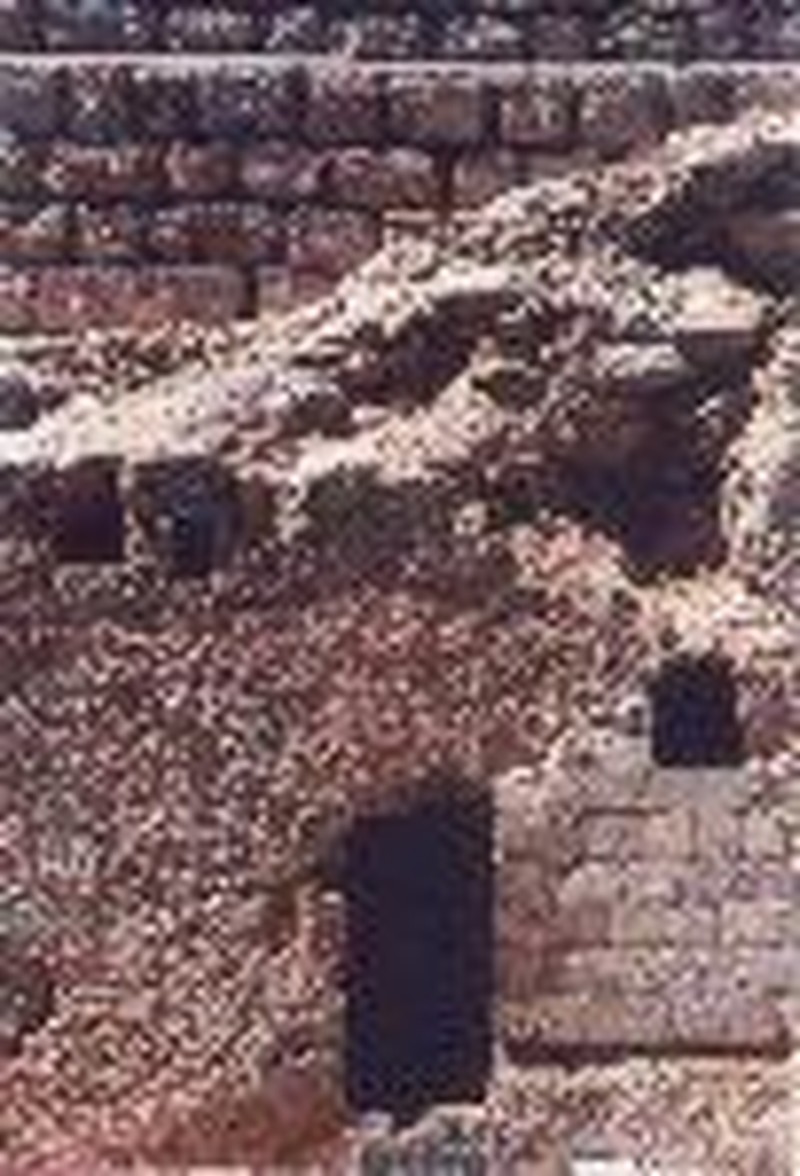
As the tour group walked around the grounds of The Garden Tomb, as we stopped at an overlook platform and viewed the skull-like image of Gordon's Calvary, as we walked through the lush and colorful gardens, as we passed the winepress (excavated in 1924 and thought to be of pre-Christian origin) and the water cistern (confirmed to be of pre-Christian origin and giving credence that this was a place of a working garden or vineyard at the time of Jesus), and as we stepped into the tomb (cut out of the rock and complete with a groove cut across the outside door, perfect for a rolling stone) I could not help but be filled with the awe at what might have taken place here.
One of our members, Christin, stepped out of the tomb with tears streaming down her face. Perhaps this was out of love for God's mercy, that He would allow His Son to have come to this earth to live, die, and be resurrected again. Or perhaps she was struck by the magnificent power that must have pushed itself through the power of death in order that the tomb be empty. Perhaps, like Mary, she just couldn't take it all in ... for the things of God are so much bigger than we have the ability to comprehend.
Our tour director, Dana, took us to the benches directly in front of the tomb's door and asked us a simple question: “Why do you think Jesus had such a ministry to women?” It was a perfect place for such a question, for this may have been the spot where the two Marys sat, watching and weeping as Joseph and Nicodemus placed Jesus' body to rest.
We spoke for a while, sometimes passionately, about the women whom Jesus loved and who loved Him, knowing we are among their numbers. It was women, we said, who stood at the base of the cross (quite a number according to the Gospels), who came three days later to take care of Him, and who first saw Him in resurrected form.
Mary Magdalene called Him "Rabboni!" Teacher. Previously, Martha and Mary of Bethany had referred to Him in the same way (John 11). In those days, for a woman to be taught of a man was indeed something!
Like those women, I am a student of Jesus. I want to be -- desire passionately to be -- taught by Him. I want to understand and "see" the totality of what happened at Calvary, and to minister to Him and for Him as long as I have breath. And I believe -- no matter where the site of the tomb of Jesus -- that He is the risen Son of God. Unlike Mary, I have not literally seen the Lord, but I have seen the things of the Lord. And like Mary, I find that something to shout about.
And this is part of what I learned when I fell into the Bible.
Photo by Eva Marie Everson. Eva Marie Everson is the author of Shadow of Dreams & Summon the Shadows and an award-winning national speaker. She can be contacted for comments or for speaking engagement bookings at Bridegroomsbride@aol.com
Other Articles in This Series:
The Chapel At The Fifth Station
The Sea of Galilee
Ruth: Gleaning in the the Fields of Jesus
Mt. Tabor; Above All, Jesus!
Mary's Well
The Ancient City of Hazor