Homeowner's Insurance: Is Your Coverage Adequate?



Over the years I’ve counseled with a lot of people about money issues. I’ve presented the No Debt No Sweat! Christian Money Management Seminar in about 200 churches and colleges nationwide. Almost without exception, the biggest investment most of the people I speak with will ever have are their homes. We’ve all seen people on television after a fire, earthquake, or other natural disaster has destroyed their homes. Some of them are saddened by the loss—but comforted to have good homeowner's coverage. Others, without adequate coverage, felt desperate.
The Insurance Information Institute tells us that the main purposes of insuring your home are twofold: To protect the structure of your house, and your personal belongings. Many homeowner policies in the United States include coverage for direct losses due to lightning, fire, tornadoes, hail, explosions, smoke, theft, and vandalism. Generally covered are losses from liability claims, such as someone coming onto your property—who slips and falls. However, there are limits and exceptions that you need to be aware of. Additionally, be aware that most basic policies do not cover loss from flood damage or earthquakes.
Pertaining to the structure, the Insurance Information Institute explains that there are three main types of coverage available:
1) Replacement Cost Coverage usually pays the insured the cost of replacing the destroyed or damaged property without reducing the sum for depreciation, up to an agreed upon maximum amount. This type of coverage has become harder to find.
2) Extended Replacement Cost Coverage is designed to pay for losses up to a certain percentage over the limit. This is probably the most common type of homeowners coverage sold today.
3) Actual Cash Value Coverage usually permits the insured to get payment for the damaged or destroyed property in the amount that equals the replacement value minus an allowance for depreciation. Beware!!! Unless your policy says that your assets have replacement value coverage—the coverage is probably just for actual cash value!
My personal preference, if you can get it at a reasonable price, is Replacement Cost Coverage. This way, if the worst happens, you should have enough insurance to take care of most of the losses. I also believe in the Inflation Guard feature that is designed to automatically raise coverage (and, its cost) periodically to keep pace with current building costs.
The experts also point to two ways to insure personal belongings:
1) Replacement Cost Coverage is often designed to pay what is required to replace missing, damaged, or destroyed property with comparable assets without depreciation deductions.
2) Actual Cash Value Coverage pays the insured the amount of the replacement value of the property after deducting for depreciation.
Preparing for the WorstI encourage people to do a few basic things to reduce their risk of loss—or, at least minimize the havoc it causes:
1) Keep a detailed, accurate, and current inventory of all his or her assets. I remember taking several days to prepare an exhaustive list of all our possessions. When I was through, I had two rung-bound notebooks full of information. I went through every room of the house and inventoried each item. I included a photograph of each significant piece along with pertinent information: price, place and date of purchase, identifying data (serial number, model, etc.), and current value. In the cases of more expensive items, I included appraisals. Then, I went through the house and video taped everything. Last, I took the videos and catalogs off the premises—talk about a real bummer, could you imagine having your house burn, and losing your inventory lists in the same fire!
2) Read and review your policy and your inventory at least every year. Stay familiar with its provisions and exclusions.
3) Call your agent occasionally—maintain good contact. It’s helpful to have a personal and friendly relationship if you ever have to file a claim.
4) Stay generally aware of rebuilding costs in your area. Also, check the latest building codes. Be sure that your coverage is adequate to rebuild your home to current code requirements.
5) Your mortgage company may only require you to carry enough homeowners insurance to cover the outstanding mortgage. Be sure that it is enough to cover the cost of rebuilding, too.
6) Check your policy limits on things like jewelry and computers. You may need to add some extra coverage for such items.
A Word to RentersIf you’re a renter, there are two really bad things that can happen to you: One, you can come home one evening to find that someone has broken in to your place and ripped off all of your stuff. All those things—your TV, workout equipment, furniture, bike, even your computer—all gone. That’s bad. But, what comes next makes it even worse. That happens when you go to your landlord for help, and all he does is shrug his shoulders and say, “Sorry.” That’s right, the guy doesn’t have coverage for your loss—and he isn’t going to give you a dime! That’s when you finally sit down and read the lease contract—you know, it’s that boring-looking document you should have read when you first moved in. And, sure enough, he’s right—you’re hung!
Within the agreed upon limits, renters insurance can protect you from losses caused by lightning, vandalism, theft, fire, etc. It can also give you liability coverage for other people injured at your home.
My advice: Get it! Of course, as with any other types of coverage, renter’s policies vary. Shop for the coverage and prices that fit you best. Read your policy thoroughly.
Steve Diggs presents the No Debt No Sweat! Christian Money Management Seminar at churches and other venues nationwide. Visit Steve on the Web at www.stevediggs.com or call 615-834-3063. The author of several books, today Steve serves as a minister for the Antioch Church of Christ in Nashville. For 25 years he was President of the Franklin Group, Inc. Steve and Bonnie have four children whom they have home schooled. The family lives in Brentwood, Tennessee.
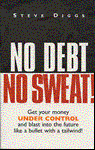
• What you can do today to get out of debt and kill the Debt Monster
• A,B,C's of handling your money God's way
• How to save, invest, and retire wisely
• How mutual funds work
• How to stop fighting over money
• What to teach your kids about money
• Learn how home & car buying, college financing and insurance work.
• How to develop a budget that works -- forever!
• Features simple charts, graphs, and easy-to-use forms.
Click here to learn more or to order..
Originally published April 13, 2007.