Not All Insurance Companies are Created Equal



People often ask me how to know if their insurance is trustworthy.
We all accept the fact that not every restaurant chain is equally well capitalized. For instance, with thousands of locations worldwide, it’s obvious that McDonalds has far deeper pockets than the single-location, hometown hamburger stand. When you hire a major, national homebuilder to construct a new home, it’s expected that the company will have greater resources than a guy working out of the back of his pickup.
But things are not so clear and easy to see when it comes to insurance companies. After all, you are buying an intangible product, the description of which is usually reduced to a few pieces of paper. You may or may not know the agent. And, you probably have never been to the company’s home office, reviewed their books, or studied their claim-paying capabilities. Yet, you are about to invest money (maybe a lot) with this company based on its promise that it will be able to pay future claims you make. Wow! That’s a lot of trust.
Something you need to know here is: All insurance companies are not equally strong financially. It doesn’t happen often, but there have been policyholders who couldn’t collect on their claims. This is why it behooves anyone buying insurance to research the company.
Fortunately, there are some ways to get helpful insights into an insurance company’s financial strength and ability to pay claims:
1) One is by contacting your state’s department of insurance. Often these governmental agencies can be helpful in assessing a company’s operations within your state.
2) For more information, there are several insurance research and rating organizations. Some of the better known are: Standard & Poor’s; Duff & Phelps Credit Rating Co., Moody’s Investor Service, and A.M. Best.
3) Don’t forget about your friends. There’s a lot to be said for word-of-month advertising. Ask around about their experiences with the companies you’re considering.
4) Check out consumer-oriented publications and internet sites. Notice that I said consumer-oriented. There are sales-based internet sites that present themselves as unbiased authorities — beware.
Look Before You Leap
That’s always good advice, but especially when dealing with insurance. Before you make any major coverage change — consider the implications of your decision. Never cancel one policy before you are certain that you have another policy to take its place.
As I’ve told you, I believe in term life insurance. I think it makes the best sense in most cases. However, I bought whole life coverage more than fifteen years ago — before I had developed a serious heart problem. Today, if I wanted to drop my whole life coverage and buy term — I couldn’t do it. (Because of my health, term life insurance probably isn’t an option.) Can you imagine the problems I would have if I had dropped my whole life coverage before checking the availability of term? Always be sure your new coverage (whether it’s life, health, auto, homeowners, or whatever) is in place before you drop what you already have.
So Many Confusing OptionsWhen it comes to insurance there are a million types. Most people in our society should at least consider life, health, homeowners/rental, disability, and auto protection.
Your lifestyle and individual circumstances will determine your particular insurance needs. For instance, I recommend disability and umbrella coverage for many people. These types of insurance are designed to protect you from inability to work and from lawsuits that exceed the limits on some of your other coverages. Many experts recommend that people in their mid-fifties buy long-term care insurance to provide for future nursing home, or similar, care. Obviously, if you own a business, there will be other insurance needs to consider.
The options are endless. Don’t forget, insurance companies are in the business of marketing their products. Some coverages have broad appeal and others have more specialized applications. Still others seemingly make no sense at all to me. For instance, who really needs pet insurance? And, with proper life coverage, credit life (insurance that pays off a debt at your death) almost never makes good sense.
My advice is threefold:
- First, become an informed consumer. Read and study. Learn about insurance—because it will be a lifelong issue. One good source for general insurance information is the Insurance Information Institute. Its on the web at https://www.iii.org.
- Second, read your policy and ask all the questions necessary to fully understand what it covers, and what it doesn’t cover. I have learned from hard experience that, while insurance companies are great at collecting premiums, sometimes it isn’t as easy to get claims paid.
- Third, find someone in the business you can trust — someone who is more missionary minded than marketing minded. Then build a relationship of trust and good communication. What I’ve shared with you here are only broad, general principles that may, or may not, prove correct in your experience. Find a true “friend in the business.” Someday you’ll be glad you did.
Steve Diggs presents the No Debt No Sweat! Christian Money Management Seminar at churches and other venues nationwide. Visit Steve on the Web at www.stevediggs.com or call 615-834-3063. The author of several books, today Steve serves as a minister for the Antioch Church of Christ in Nashville. For 25 years he was President of the Franklin Group, Inc. Steve and Bonnie have four children whom they have home schooled. The family lives in Brentwood, Tennessee.
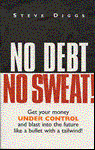
• What you can do today to get out of debt and kill the Debt Monster
• A,B,C's of handling your money God's way
• How to save, invest, and retire wisely
• How mutual funds work
• How to stop fighting over money
• What to teach your kids about money
• Learn how home & car buying, college financing and insurance work.
• How to develop a budget that works -- forever!
• Features simple charts, graphs, and easy-to-use forms.
Click here to learn more or to order..
Originally published May 14, 2007.