Why We Hate Budgeting - But Shouldn't



Editor's Note: This article is adapted from materials used in the No Debt, No Sweat! Christian Money Management Seminar.
Marketing people learned a long time ago that names mean a lot. They affect how we perceive the world around us. A while back the network news reported that federal nuclear energy officials want to put a high level nuclear waste dump in the Yucca Mountains just north of Las Vegas, Nevada. As you might suspect, the good citizens of that area aren’t very enthusiastic about the plan. But, not to worry, the government boys aren’t going to call it a nuclear waste dump—they’re calling it a "repository." Ah, that makes it seem so much better, doesn’t it?
Everywhere I go, I run into people who hate the very thought of doing a budget. As I mentioned in part I of this series, I try not to even use the word "budget" because of the negative connotation. If you know me well, you know that I prefer the phrase, Personal Financial Freedom Plan to the word "budget."
Why We Don’t Budget
So why does the word "budget" inspire such negative feelings? There are about as many reasons for not budgeting as there are people without budgets. But understanding some of the most common reasons will help us overcome our aversion to it so we can move on to the next step. Here are three broad categories:
1) "I don’t know where to start!" These are the folks who feel overwhelmed by life and the money pressures they are facing, and one more straw will be enough to break the camel’s back. They want less stress and confusion. From their perspective, doing a budget is just one more complication they don’t need! What these people fail to realize is that a budget is the first step towards relieving their pain. Just as it’s painful to lance a boil—it’s the only way true healing can begin.
The good news is that a budget is simple and not very time consuming. A few minutes spent in the budgeting process just before the month begins can bring financial balance and tranquility for the month ahead.
2) "I’m not a geek—money stuff confuses me!" This is like saying, "I’m not a chef—so I’m not going to eat food." Properly handling your income doesn’t require any special classes or degrees. All it requires is a little basic knowledge and a willingness to change one’s behavior. And, remember, it’s not a question of whether or not your income is going to be spent. The only question is: Are you going to control the spending, or is the spending going to control you?
3) "Budgeting is such a downer—it’s such a negative thing to do!" I take special exception to this complaint. Remember, the source of stress in all of our lives comes from the feeling that we don’t have control over our environment. As long as the steering wheel in your car functions properly and allows you to turn it as you wish—you’re relaxed. But how would you feel if the steering wheel suddenly stopped responding as you are driving down a mountain road? That loss of control would lead to a lot of stress wouldn’t it? It’s the same with budgeting. When a person seizes control and begins taking charge of their money, something wonderful happens. There is a rightful sense of power and control—a sense that one has control over what happens in his life. All in all, it’s a pretty good feeling.
Another Way to Look at a Budget
Now, other than simply changing the name, allow me to present the other side of the case for budgeting. The following list of budget benefits is only a beginning. You could probably add other points to the list but, for starters, here are some of the pluses of having a Personal Financial Freedom Plan:
• No more creditors calling the house at all hours;
• Never having the waiter come back to the table to inform you that your credit card "is over its limit and didn’t clear;"
• Using cash in the bank to pay for a Hawaiian vacation;
• Never having to stall one creditor to pay another;
• Never regretting the gifts you bought for Christmas when the January bills arrive;
• Always having money on hand when a worthy need comes along;
• Never having another fight with your spouse over money issues.
Feeling motivated? Great! Strike while the iron is hot. Clear the kitchen table, grab a sheet of paper and a calculator and get started!
Steve Diggs presents the No Debt No Sweat! Christian Money Management Seminarat churches and other venues nationwide. Visit Steve on the Web at www.stevediggs.com or call 615-834-3063. The author of several books, today Steve serves as a minister for the Antioch Church of Christ in Nashville. For 25 years he was President of the Franklin Group, Inc. Steve and Bonnie have four children whom they have home schooled. The family lives in Brentwood, Tennessee.
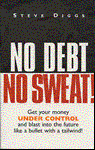
• What you can do today to get out of debt and kill the Debt Monster
• A,B,C's of handling your money God's way
• How to save, invest, and retire wisely
• How mutual funds work
• How to stop fighting over money
• What to teach your kids about money
• Learn how home & car buying, college financing and insurance work.
• How to develop a budget that works -- forever!
• Features simple charts, graphs, and easy-to-use forms.
Click here to learn more or to order.
Originally published March 13, 2006.