Avoid the "Budget-Busters" that Kill Us Financially



As I tell audiences across the country in my No Debt No Sweat! Christian Money Management Seminars: "If you don’t control your money—your money will control you."
Some of us have forgotten a couple of vital principles:
1) Bank withdrawals must be preceded by deposits!
2) When your outgo exceeds your income, then your upkeep will be your downfall!
As we've been discussing in this series, a family budget is the single best way to prevent our financial downfall. When we discuss how to develop a family budget (or as I prefer to call it, a Personal Financial Freedom Plan) I tell folks not to worry—a little experience and some trial-&-error goes a long way here.
But to help you through some of the landmines, the following thoughts may be beneficial:
1) Don’t be overly optimistic. Remember, things often cost more than we expect. Murphy’s Law has a way of kicking in at the worst moment. I always prefer to err on the side of caution. Instead of underestimating an expense, learn to overestimate your expenses. This is a good way to avoid unpleasant surprises.
2) Be kind to yourself. Doing a budget is a little like starting a diet. How many times have you known someone who began a diet with such strict limitations that she simply gave up? The same can happen with a budget. If you start on a budget that allows no fun or play money—it probably won’t last very long. Be reasonable, enjoy life. Just remember the importance of moderation.
3) Don’t forget the "set aside" items. Most of us have what I call "set aside" items. These are expenses that don’t occur every month. Items like car insurance and vacations may come around only once or twice a year. Others, like buying a car, may only occur every several years. Still others may pop their heads up every few months. If you don’t force yourself to follow a monthly "set aside" discipline, these expenses will catch you unprepared.
4) It’s important to distinguish between what is essential and what is optional. I’ll never forget a young divorced mother of two who came to me for some help with her finances. Despite a good job, she seemed to stay in financial distress. There were a number of behaviors that she needed to change, but the one I remember most was her cable television. She just could understand that cable TV was an unnecessary expenditure. The idea of getting only the local channels (which was all most of us had as kids) wasn’t an acceptable compromise. She was happier dealing with debts and creditors, than living without cable!
Many of us are convinced that what we need is exactly what we already have—plus about 20% more. The truth is: Our needs are clothing, food, and shelter. Everything else is negotiable. To correctly develop a Personal Financial Freedom Plan we have to learn the difference between wants and needs.
5) Keep your spending ratios balanced. Knowing how much to spend on what is an important part of a successful financial equation.
The following suggested maximum spending levels are presented as just that: Suggestions. I have developed these percentages based on the thoughts of other financial advisors as well as my own real life experiences. While they may not all fit in your particular situation, maybe they will encourage thought and conversation as you plan your budget. These numbers are presented in a "broad brush" fashion and will apply best to average income families. If your income is higher or lower than the average, these percentages may need to be adjusted. Also, unusual circumstances (i.e., unavoidable medical bills) can skew some of these percentages significantly higher or lower.
• Housing (including mortgage, insurance, taxes, utilities, repairs/maintenance, and related expenses) is at its best if it doesn’t exceed 25-33% of your "true net income."
• Food: 10-15%
• Clothing: 5%
• Transportation (including cost of the vehicle, maintenance, insurance, fuels, and legal fees): 15%
• Entertainment & Goofing-Off: 5%
• Debt Service: 5-8% (or less if possible)
• Saving/Investing: 5-15%
• Medical/Health/Dental: 5-8% (Obviously, this may not be as easily controlled as some of the other items.)
6) Finally, do it with prayer. Bring God into the equation. After all, it’s His money we’re talking about here! Ask Him to help you see money from His vantage point. Realize that money is temporal—not eternal. When all is said and done here, all that will really matter is our faithfulness to God and who we loved.
For previous articles in this series:
A Budget that Could Change Your Life
Why We Hate Budgeting - But Shouldn't
Five Keys to Developing a Successful Budget
Steve Diggs presents the No Debt No Sweat! Christian Money Management Seminarat churches and other venues nationwide. Visit Steve on the Web at www.stevediggs.com or call 615-834-3063. The author of several books, today Steve serves as a minister for the Antioch Church of Christ in Nashville. For 25 years he was President of the Franklin Group, Inc. Steve and Bonnie have four children whom they have home schooled. The family lives in Brentwood, Tennessee.
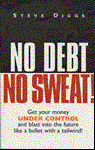
• What you can do today to get out of debt and kill the Debt Monster
• A,B,C's of handling your money God's way
• How to save, invest, and retire wisely
• How mutual funds work
• How to stop fighting over money
• What to teach your kids about money
• Learn how home & car buying, college financing and insurance work.
• How to develop a budget that works -- forever!
• Features simple charts, graphs, and easy-to-use forms.
Click here to learn more or to order.
Originally published April 10, 2006.