Buying the Best Car Insurance



As many of you know, today I serve as a minister at the Antioch Church of Christ in Nashville. However, I have an unusual ministry. I spend my full time traveling around the country presenting the No Debt No sweat! Christian Money Management Seminar at churches and colleges.
But it hasn’t always been this way. For over twenty years I owned a business that was located on Nashville’s famous Music Row. What a place to work! It’s a great area of town. Everywhere you go there are creative people working with the various record labels and creative shops. I love most every thing about the Row, except the driving. Since this is where the country music stars work—it’s also where the tourists come. They’re everywhere. (Some of the locals call Music Row the Plaid Shorts District.) As much as we appreciate the tourist business in Nashville, driving can be a real problem. Especially when you throw in the homegrown folks who make their share of driving gaffes, too. Over the years, I have had a couple of fender-benders in the area when someone wasn’t paying enough attention. Through these regrettable experiences, I’ve grown to appreciate the value of good car insurance.
One thing I have learned is the essential nature of car insurance coverage. I’ve learned the hard way that, even if I do everything right, I can still be faced with thousands of dollars of repair bills. And, if I ever should make a major mistake on the road, my insurance may be the only thing standing between us and bankruptcy! So with this as my introduction to the subject, let’s talk about what car insurance covers and a little about how it works.
Six Basic Parts of an Auto Policy
A typical car insurance policy may include all, or some, of the following six types of coverage. Usually, each coverage is priced individually. They include:
1) Bodily Injury Liability. This is designed to help protect the policyholder from claims and defense costs if he kills or injures someone.
2) Property Damage Liability. This helps cover damage the policyholder may do to someone else’s property. However, this coverage does not cover the policyholder’s own property or car.
3) Medical Payments or Personal Injury Protection. Pays on the medical expenses for injuries to the driver and passengers of the insured’s car. It may also pay if the insured is injured while riding in someone else’s car or while walking.
4) Collision. Designed to cover costs for damage to the policyholder’s car if it is in a collision with another vehicle or some other object.
5) Comprehensive Physical Damage. For damage to the insured’s car resulting from theft, vandalism, fire, hail, etc.
6) Uninsured or Underinsured Motorist Coverage. For cost related to property damage and injury to the insured by an uninsured or underinsured motorist. This is frequently the coverage that comes into play after a hit-and-run accident.
Of course, read your policy and ask questions, as these are only broad explanations and will vary from policy to policy.
A Few Money Saving Pointers
No matter how I prune and fertilize them, the trees in my backyard simply will not grow money. Without such a “cash crop,” saving money has become very important in my life. Following are some money saving tips from experts in the field, as well as some of my personal experiences:
1) Check the Competition. Remember, there are lots of companies selling this stuff. Check around. Compare the prices from four or five companies. You’ll find that rates and prices vary quite a lot.
Remember, not all companies are equally good. As is the case with any form of insurance, the cheapest price isn’t always the best buy. Ask your friends about the experiences they have had with their companies and check the rating services.
2) Drive Like You Know You Should. One thing that will raise your car insurance costs the fastest is a bad-driving record. This is something you can control—do it!
3) Arrange for Higher Deductibles. A deductible is the money you have to pay before the insurance company fulfills your claim. You can reduce the cost of your insurance drastically by raising the deductible (the amount you’re responsible for) on collision and comprehensive coverage.
4) You Might Opt Out of Comprehensive and/or Collision Coverage If You Drive An Older/Cheaper Car. Assuming your agent is trustworthy, this is might be worth discussing.
5) Inform Your Agent If You’re A Low Mileage Driver. Some companies determine their rates based on the amount of annual driving a policyholder does.
6) Tell Your Agent About Any Safety Features and Anti-Theft Systems On Your Car. Some companies reduce their costs to people who drive cars with automatic seat belts, airbags, and other safety and theft devices. It’s worth asking about.
7) Pay Your Premium in One Lump Sum. Some companies charge less if you pay your premiums annually or semi-annually. This can avoid some of the service charges associated with monthly payments.
8) Check and See if Your Insurer Discounts Car Coverage When You Buy Other Insurance from Him. Some insurers give price reductions to clients who buy their homeowners, umbrella, and other coverages from them.
Here's a Little Grief-Saver
A while back I reevaluated my own insurance coverage. Of course, every agent I talked with presented a convincing case for his product and the companies he represented. So, how can people like us really know which company does the best job settling claims? Do we simply have to buy the coverage on blind faith—and, wait until we have an accident to find out?
Let me tell you what I did. I collected the names of all the companies I was considering and went to visit the manager of the body shop that I would take my car to. I said, “Stewart, here are the companies I’m looking at—what kind of results have you had working with these outfits?”
It took about five minutes for Stewart to illuminate me. I left with a much better picture of the “real world” of car insurance companies as seen through the eyes of a guy who works with them every day.
Steve Diggs presents the No Debt No Sweat! Christian Money Management Seminar at churches and other venues nationwide. Visit Steve on the Web at www.stevediggs.com or call 615-834-3063. The author of several books, today Steve serves as a minister for the Antioch Church of Christ in Nashville. For 25 years he was President of the Franklin Group, Inc. Steve and Bonnie have four children whom they have home schooled. The family lives in Brentwood, Tennessee.
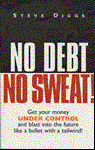
• What you can do today to get out of debt and kill the Debt Monster
• A,B,C's of handling your money God's way
• How to save, invest, and retire wisely
• How mutual funds work
• How to stop fighting over money
• What to teach your kids about money
• Learn how home & car buying, college financing and insurance work.
• How to develop a budget that works -- forever!
• Features simple charts, graphs, and easy-to-use forms.
Click here to learn more or to order..
Originally published April 27, 2007.