Why Home Ownership May be Unwise



For decades, the common wisdom has been that home ownership is good, even ideal. This is one thing that both the government and I have agreed on. In one of my books, No Debt No Sweat!, I made the case for home ownership. I’ve spoken to hundreds of live audiences and on numerous TV and radio programs in favor of home ownership. Tax laws have been structured to encourage home buying. (Owners get tax deductions on their mortgage interest.)
The net result of all this? By 2004 about 70 percent of Americans owned their own homes.
But, wait, back the “everybody-gets-a-house truck” up! There is such a thing as turning virtue into vice.
This strategy worked as long as sane people realized that while home ownership is a good thing — it does not follow that home ownership is good for everybody.
Unfortunately, by the time we awoke from the orgy of excess and rotten mortgage products it was too late. For about 5 years now, I and other financial voices have been screaming about the horrible mortgage products that flooded the market as lenders (and buyers) got greedier and greedier.
At first, it was just the adjustable rate mortgages (ARM’s) that were in my crosshairs. These loans teased buyers with introductory rates that tempted prospects to buy more home than they could afford. The “logic” went that either the borrower’s salary would increase to allow for a higher interest rate, or they could re-finance the mortgage, or if worse came to worst, the house could be sold.
Based on the theory that you can't have too much of a good thing, lenders continued developing dumber and dumber products. Next came the “interest only” mortgage. This was a product clearly focused on removing the last shreds of fiscal responsibility. By allowing people to pay only the interest for the first few years, American’s bought bigger houses and hoped for the best — while never paying a dime of principle.
Then came the cherry on the sundae of lousy mortgages: the “liar’s loan.” With these, all caution was thrown to the wind, and lenders made loans to people without even verifying the income they claimed on the loan documents.
Finally, mid-2008 rolled around. Everyone stood around, looking dumb and asking, “What happened?”
Well, duh! The house of cards fell in on itself.
The success of all of these dubious loan products was premised on one belief: housing prices would always go up. Any first-year economics student knows that all investments (including real estate) are cyclical. The faster an investment goes up, the greater chance it has of going south in a New York minute!
So where does this leave us today? Let me share three take-aways:
1. The primary reason for buying a home is to have somewhere to live. The investment potential should run a distant second.
2. If you are currently a first-time home buyer with no debt, and cash on hand, this might prove to be one of the best long-term buying opportunities in history. Both home prices and mortgage rates are down.
3. If you can’t afford a home — don’t buy one! The case against home ownership today is strong. When maintenance and other costs are factored in, owning frequently costs more than renting. It prevents people from easily moving when they lose their jobs. And according to Grace Wong Bucchianeri at Wharton School of Business, home owners are no happier than renters, and they experience more stress.
Before we conclude, let me revisit the first sentence above: “For decades, the common wisdom has been that home ownership is good, even ideal.” This points to the true heart of the problem. Many of us have incorrectly defined the concept of “home." We have been conditioned to believe that a home is a house that we hold the title to. That’s simply not true.
A home is wherever you live and love. It’s where you hang the pictures of the kids. It’s where you collapse at the end of the day into the arms of your spouse. A house doesn’t equal happiness. A home equals happiness.
It’s difficult to see the eternal through the temporal. But, as Christians, we must. As the old hymn goes, "This world is not my home, I’m simply passing through. My treasures are laid up somewhere beyond the blue. The angels beckon me from heaven’s open door, and I won’t be at home in this world anymore."
Published April 6, 2009.
Steve Diggs presents the No Debt No Sweat! Christian Money Management Seminar at churches and other venues nationwide. Visit Steve on the Web at www.stevediggs.com or call 615-834-3063. The author of several books, today Steve serves as a minister for the Antioch Church of Christ in Nashville. For 25 years he was President of the Franklin Group, Inc. Steve and Bonnie have four children whom they have home schooled. The family lives in Brentwood, Tennessee.
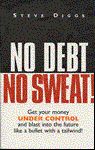
• What you can do today to get out of debt and kill the Debt Monster
• A,B,C's of handling your money God's way
• How to save, invest, and retire wisely
• How mutual funds work
• How to stop fighting over money
• What to teach your kids about money
• Learn how home & car buying, college financing and insurance work.
• How to develop a budget that works -- forever!
• Features simple charts, graphs, and easy-to-use forms.
Originally published April 06, 2009.