



Declare Your Faith - Sign the "I Am a Christian" Pledge
E-MAIL NEWSLETTERS


There was an error processing this request. We cannot subscribe you to newsletters at this time. Please contact technical support with details.
Featured Sponsors
HOMESCHOOL Sponsorship

AVERAGE USER RATING

RATE THIS ARTICLE

  • Email
  • Print
  • Discuss
Search The Bible   
Advanced Search
Making History Sticky

Making History Sticky

Carmen Rockett

Home School Enrichment


“You shook his hand?” asked Jesse, wide-eyed.

“Yes,” Ethan replied with a shrug.

“Chuck Yeager? You shook Chuck Yeager’s hand?”

“Yes, Dad and I met him when we went to Edwards Air Force Base last year.”

“Wow!” responded Jesse, who had been studying Bernoulli’s principle (movement of fluid through a pressure difference) and building airplanes with his younger siblings. Ethan’s stature had just grown visibly in his brother’s eyes. “We just watched a documentary on him! He was the first man to break the sound barrier.”

Yes! I thought. They’re getting it! History is beginning to stick. My children grasped more about Chuck Yeager, Charles Lindbergh, and Amelia Earhart at ages 6, 10, and 13 than I understood at 44. For that, I can thank the vehicle by which their history is being delivered.

Discover

Cathy Duffy, in her book 100 Top Picks for Homeschool Curriculum, tells us to “Approach social studies as a newspaper reporter. Reporters look for the answers to the questions: Who did what? When did they do it? Where did they do it? and Why did they do it? . . . Our social studies should be like a good newspaper article, combining all the necessary ingredients.” Duffy defines “social studies” as “a comprehensive term that includes history, geography, and cultural studies.” For the purpose of this article, I’ll use the word history, but the ideas apply beyond the discipline of history.

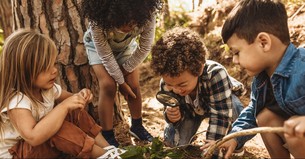
I interviewed Jessica Hulcy, author of the popular KONOS curriculum, to better understand how to compose the newspaper article that is to be our children’s history experience. She tells us we must use a multi-sensory approach, because when we involve the five senses, our children experience history from many perspectives, rounding out and solidifying their grasp of the concepts.

According to Endangered Minds by Jane Healey, brain cells have many protruding connectors. These can hook up and make “pathways” in the brain similar to paths in the forest. God designed our brains so that we will develop particular pathways at given stages of life that coincide with normal growth and family interaction. Just as in a forest, we establish the paths we use most while the little-used paths will be lost. Learning through discovery—thinking, dialoguing, dramatizing, and parental interaction—strengthens important connections and causes the brain to actually grow in size.

Related research shows that the brains of roughly half the population tend toward more traveled paths in the left hemisphere and the other half of the population in the right hemisphere. To simplify further, roughly half of the population learns better through hands-on involvement, and the other half tends to respond better to lectures and book learning. According to Hulcy, using the discovery learning method covers the bases for all learning styles, while it also stretches children to improve their ability to learn through methods they find more challenging.

1 | 2 | 3 | 4 | 5 | Next | All
Most Recent User Comments
Be the first to comment on this article!
Sign up to post your comments

It's quick and easy to register with Crosswalk.com! Just fill out the short form below. You'll have the opportunity to post comments, and be more involved in our community and forums. Plus, with this one account, you can sign in anywhere in our network of sites displaying the Salem All-Pass logo, including Oneplace.com, Christianity.com, Lightsource.com, Crosscards.com, and more!