Profiles in Christianity & Science: Wernher von Braun


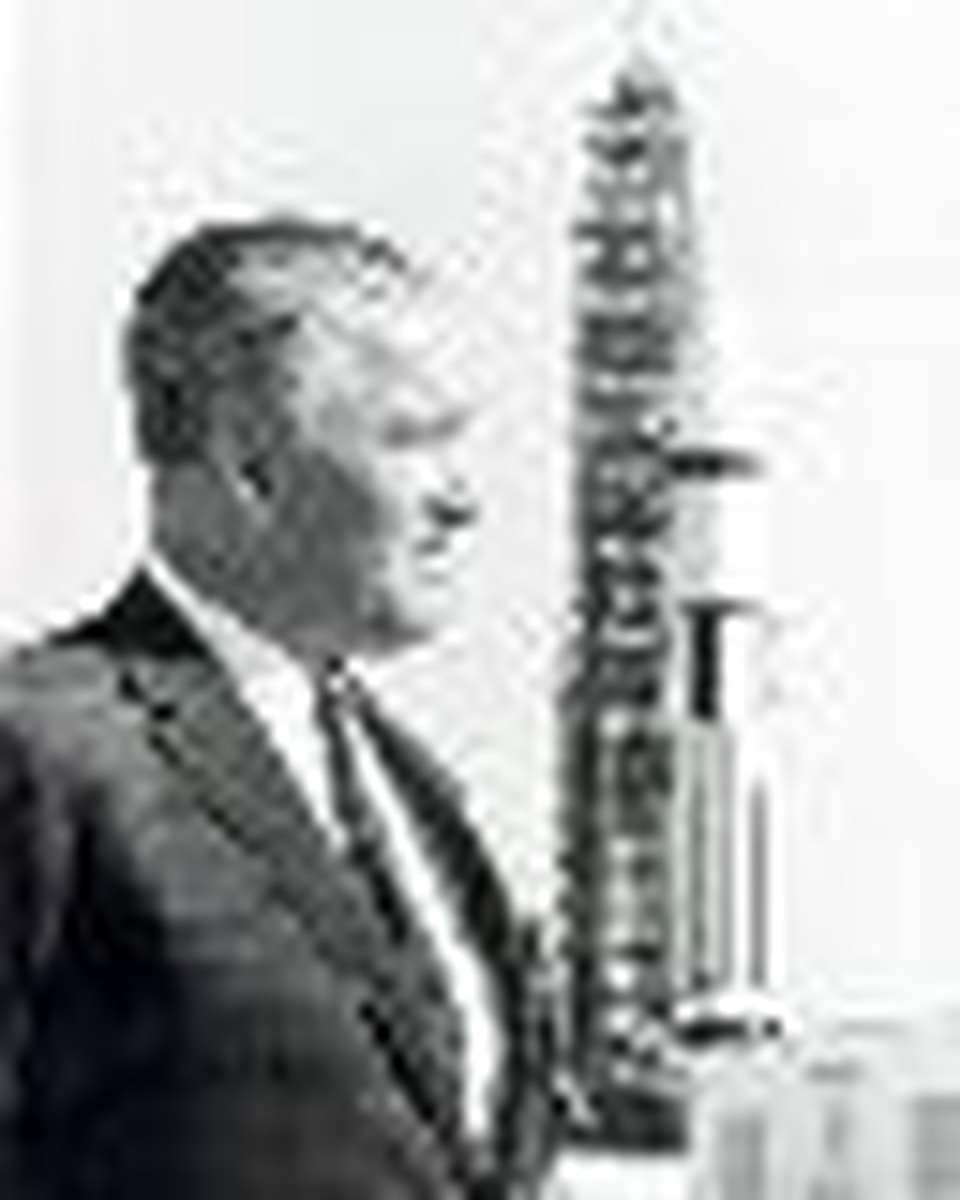
Von Braun: The Man
Wernher Magnus Maximillian von Braun was born on March 23, 1912 in what was once Wirsitz, Germany (now the Polish province of Poznan). His father, Baron Magnus Von Braun, was an aristocratic businessman, banker and politician. His mother, Baroness Emmy von Quistorp, cultivated Wernher's interests in math and science when she gave him a telescope for his confirmation into the Lutheran church. She encouraged all of her sons to share her interest in the arts and sciences. Always the visionary, young Wernher set his goal in life to "help turn the wheel of time."
He began his formal education at the French Gymnasium in Berlin. It was there that Wernher did very well in subjects such as music and languages, but poorly in mathematics and physics. In 1925 he read a book by Hermann Oberth entitled, The Rocket into Interplanetary Space. The concept of space travel really captured his attention but there was a problem: his weakness in mathematics limited his ability to understand the concepts and theories. Rather than give up, he attacked his studies vigorously and was soon tutoring other students.
Von Braun's interest in mechanics, especially rockets, led to some experiments that did not go off quite like he had planned. As a youth, von Braun decided to build a car using recycled parts from old cars. He had spent so much time on the project, and so little on his schooling, that he failed both mathematics and physics. When he was 16, he tried to construct a rocket-propelled toy wagon using firecrackers as the motor. In addition to creating quite a disturbance in his neighborhood, the local police picked him up and held him until his father could come and get him. In yet another experiment, he launched a rocket that landed (or, more accurately, crashed!) through his parents' greenhouse at their home in Berlin.
A natural leader, he both encouraged and inspired those around him. At the age of 16 he assembled a volunteer construction team that built a complete observatory! They dug the ditches, laid the brick, and erected the structure in their spare time.
He continued his education at the Berlin Institute of Technology and received his bachelor's degree in mechanical engineering at the age of 20. Following his college degree, he received a grant to study and develop liquid-fueled rocket engines. At the age of 22 he received his Ph.D in physics from the University of Berlin. Not bad for someone who started out so poorly in math and science!
He began his career in Germany and had many successes, but Hitler's order to have him build rockets for war led to his surrender to the Americans. Once in the U.S., von Braun was able to pursue his dreams of space flight. He became the first director of NASA in 1960 and retired in 1972 to become vice president of Fairchild Industries, where he worked to promote the National Space Institute.
At the peak of his work at Fairchild, he learned that he had cancer. Surgeries and treatments did not halt its progression, forcing him to retire from Fairchild in December, 1976. He died in Alexandria, Virginia on June 16, 1977 leaving behind his wife, 3 children, and a legacy as the first space pioneer.
Von Braun: The Scientist
In the early 1930's, von Braun joined a club called Verein fur Raumschiffahrt (Rocket Society) for rocket enthusiasts in Germany. German artillery captain Walter Dornberger, who had been tasked with investigating the use of rockets to defend Germany, learned of the club, met with them, and was so impressed that he provided them with $400 to build a rocket. Wernher worked on the project all through the spring and summer of 1932 only to have it fail when he demonstrated it to the military. Dornberger was impressed with Wernher's effort and hired him to lead the project.
Within 2 years von Braun and Dornberger had over 80 engineers building and testing rockets. Wernher came up with another idea: a jet-assisted take off device for heavy bomber aircraft. His idea was well accepted and a new facility was constructed on the Baltic coast to give him the room he needed. He would be able to launch and monitor rockets as they soared over 200 miles without the risk of harming anyone. During this time von Braun successfully developed the A-2, A-3, and A-4 rockets. But something dramatic was about to happen.
In 1934, Adolph Hitler decided that the A-4 would be the ideal system to launch explosives on London. A vengeful man, Hitler ordered the production of such a system and 14 months later a combat version called the V-2 was launched. When the V-2 struck London, von Braun said, "The rocket worked perfectly except for landing on the wrong planet." Wernher wanted to build rockets that would orbit the Earth and go to other planets. He did not want to create bigger and more powerful weapons. Von Braun's talk soon created problems, and he was arrested for crimes against the state. Dornberger managed to get von Braun released, largely because without Wernher there would be no rocket program.
Upon his release, von Braun gathered with his staff and asked them whom they should surrender to. They decided to surrender to the Americans. Using forged papers, they stole a train and led 500 engineers, as well as carloads of V-2 rocket parts, through Germany. Upon learning of this, Hitler gave the order to kill them. All 500 managed to avoid the German army while trying to find the Americans. The opportunity finally came and they surrendered to an American Army private.
On June 20, 1945, the U.S. Secretary of State approved the transfer of the scientists to the U.S. They were kept under heavy guard, being escorted nearly everywhere they went, and sent to Aberdeen Proving Grounds to sort out all of the scientific documentation and rocket parts (some 200 train carloads) they had brought with them. Von Braun, however, was sent to Fort Bliss, Texas where he trained American soldiers, industrialists, and academics on the details of rockets.
In 1950 he was transferred to Huntsville, Alabama where he led the development team at Redstone Army Arsenal. In 1952, Wernher published his dream of a space station used for peaceful purposes. This space station would make an ideal location to set off on lunar expeditions. His enthusiasm and desire to explore space was contagious. Working with Walt Disney, he served as the technical director for three television films on the topic of space exploration.
On July 29, 1958, the National Aeronautics and Space Administration (NASA) was established. Two years later the Marshall Space Flight Center was opened in Huntsville. Wernher and his team were transferred to NASA and he became the center's first director, a position he held for nearly 10 years. During his time at Marshall, the Saturn V rocket, used to send men to the moon on July 16, 1969, was developed. His dream to "help turn the wheel of time" had come true!
[Editor's Note: Next week we'll explore Von Braun, the Christian in Part 2 of this series.]
-------------------------
Ray and Gale Lawson have been homeschooling their 3 children since 1995. Ray holds a B.S. in Electrical Engineering from the Virginia Military Institute and works for Washington Group International. Gale holds a B.S. in Mechanical Engineering from the University of South Carolina and is full-time mom and teacher. They are members of Breezy Hill Baptist Church in Graniteville, SC. Questions, comments and suggestions are always welcomed and can be emailed to them at vmi1981@bellsouth.net (Ray) or galenkids@hsenet.com (Gale).
This article was originally published in the Jul/Aug '05 issue of Home School Enrichment Magazine as part of an ongoing series of "Profiles in Christianity & Science". For more information, visit https://HomeSchoolEnrichment.com. To request a free sample copy, visit https://homeschoolenrichment.com/magazine/request-sample-issue.html
Originally published September 21, 2005.