The Pilgrims' Legacy


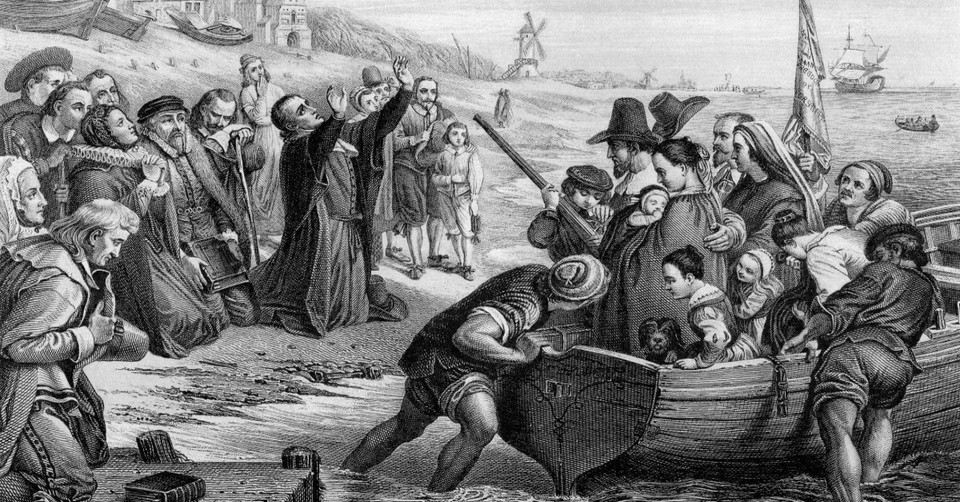
William Brewster's voice filled the cool October air as he said a benediction of thanksgiving to God Almighty. Around him, the other Pilgrims nodded their heads in heartfelt agreement; chief Massasoit and the 90 Wampanogs Indians with him sat quietly in respect for the white man's God. With the prayer completed, the feasting began. The tables were heavily laden with delicious dressed deer, wild turkey, nutritious vegetables, scrumptious pies, and various breads made from corn. Joyously the celebrations continued for three days. There were foot races, wrestling matches, contests with guns, bows and arrows, and even a military drill led by Captain Standish. The Pilgrims' first Thanksgiving was truly a momentous celebration.
Who were these brave souls who had settled in a harsh wilderness and what caused them to leave their homes in Europe? The Pilgrims belonged to a group of devoted Christians called Separatists. In England, during the reign of King James I, there were two leading factions that opposed the Church of England. The Puritans were one group thus called because they wanted to purify the Church from within. The other group were the Separatists who completely broke away from the Church of England. The party of Separatists who later became the Pilgrims lived in the Midlands town of Scrooby, but because of religious persecution they fled to Leyden, Holland. Although they enjoyed religious freedom in Holland, they found life very hard. They worked long hours and they saw that it would be easy for their children to be lured into the sinful pleasures of the world. Prayerfully they sought the will of God. God confirmed to them that they should begin a settlement in the New World. Lacking the financial means to attempt such an adventure, they borrowed money from a group of London Adventurers. The Adventurers were very corrupt and in the end the Pilgrims paid an exorbitant amount.
Finally, in 1620, their journey began. Sailing first to England aboard their ship the Speedwell, they were joined by the larger vessel, the Mayflower. At Southampton, the "saints," as the Separatists called themselves, met the other settlers who were also traveling to the New World. Many of the "strangers," as the Separatists named them, proved sympathetic to the religious beliefs of the Separatists. Others were just looking for excitement. On August 5, 1620, they set sail, only to have to turn back twice because the Speedwell proved leaky. Eventually they continued with only the Mayflower. For 66 days they endured the tempest and fury of the Atlantic Ocean. They praised God when land was sighted. Before leaving the Mayflower, the Pilgrims, "saints," and "strangers" drew up a document that was a binding agreement between them. The Mayflower Compact--which began with the words "In the name of God, Amen"--was the first document of self-government in North America. Bravely they faced the unknown with the knowledge that they and their children would be free to worship God as He was leading them.
The first winter in Plymouth Plantation was filled with many hardships, but the Pilgrims were always grateful for every blessing whether small or great. Faithfully God provided an ideal location for their town. Their charter was for land in Virginia, but heavy storms had prevented them from going south. When they arrived in New England, they found an abandoned piece of land they named Plymouth in honor of the last English town they had sailed from. The ground had been cleared and was ready for planting. Before the Pilgrims arrived, this land had belonged to the Patuxet Indians. They had ferociously killed every white man who ventured into their territory. Then, oddly, a strange plague began among them and eventually destroyed the entire tribe. Since the other tribes in the area saw how peculiarly the Patuxet had died, they avoided the region. Therefore this piece of earth was uninhabited and belonged to no one. The Pilgrims gave thanks to God.
During the first winter, the Pilgrims faced a devastating blow when nearly half their number died from sickness. The long months at sea with rotten food had weakened them. While scurvy claimed some lives, others died of pneumonia and consumption. Throughout the long winter the healthy cared for the sick. There were days when only five men were well enough to care for the others. In the end, 47 of the original 102 Pilgrims died. When spring began to appear, the Pilgrims prayed and hoped for a bright future.
The first spring began with a surprise. Walking boldly into Plymouth one day was an Indian. To their amazement he spoke English. His name was Samoset, and he helped them make a treaty with Massasoit, their nearest neighbor. He also introduced them to Squanto, who proved to be a "special instrument" sent by God to help them.
Several years before, Squanto of the Patuxet tribe had been captured by a slave trader and taken to Europe where he learned English. He eventually escaped, but when he returned to his homeland he discovered that his tribe and family had died of the plague. Strangely, Plymouth was built on the piece of land that had been his home. At once Squanto found himself drawn to the white men and deeply desired to help them. If it had not been for Squanto, the Pilgrims may not have survived. Squanto taught them how to fish, plant corn, and fertilize the ground with fish. He interpreted for them with the Indians and helped them trade with various tribes. Indeed, he assisted the Pilgrims in learning the ways of their new home. When fall emerged, the Pilgrims gathered a good harvest. Cheerfully the Pilgrims celebrated a day of Thanksgiving to God and invited the Indians to join in their merrymaking. The Pilgrims observed their first Thanksgiving!
Resourcefully, the Pilgrims prepared for the coming frost. They felt prepared for the winter until one day in November, 1621, the Fortune arrived with 35 colonists and only a few provisions. Before long everyone was put on half rations. Starvation began to set in and it appeared that this winter would be as bad as the first. Each person received only five kernels of corn a day, but by the miraculous hand of God everyone survived the second winter.
The following summer they built houses and improved their living conditions. By the third summer, Governor William Bradford and the leaders began praying about how to produce a more abundant crop. Private property was the answer. Since first landing, the Pilgrims tried living in a communal setting, but it never provided enough food. Remarking on the venture of private property Bradford said, "This was very successful." Never again were the Pilgrims in danger of starvation. In 1623, they gathered a bountiful harvest.
With so many blessings, the Pilgrims had a second Thanksgiving. Wishing to share their joy with others, the Indians were again invited. Massassoit arrived with his head wife, three other chiefs, and 120 braves. Before the feast began everyone was served a dish with only five small kernels of corn, a reminder of how God had faithfully preserved them.
The Pilgrims were a group of righteous individuals who followed whole-heartedly after God. When confronted with persecution they persevered with Christian virtue. Constantly they sought the Lord's will and tried to faithfully follow it. Above all they knew how to praise the Lord. When they experienced abundant blessings they were thankful, and when suffering came they knew God would provide. May we find encouragement from their rich Christian legacy.
Study Questions & Follow up Research:
- What religious group were the Pilgrims associated with?
- List some of the reasons for the Pilgrims settling in America.
- On a map find England and locate these towns: Southampton and Plymouth also find Leyden, Holland, and Plymouth, Massachusetts.
- At your Thanksgiving dinner place five kernels of corn by each place to remember the Pilgrims and the things they sacrificed for religious freedom.
- Read Of Plymouth Plantation by William Bradford. This is an excellent book about the Pilgrims, their depth of character and Christian virtue. A wonderful book for children about the Pilgrims is Three Young Pilgrims by Cheryl Harness. This beautifully illustrated book lets you see the Mayflower, first winter, and Thanksgiving through the eyes of three historical Pilgrim children.
- To learn more about Squanto's fascinating life, listen to The Legend of Squanto by Focus on the Family Radio Theatre.
- Make a Pilgrim meal. Eating the Plates, a Pilgrim Book of Food and Manners by Lucille Recht Penner and Food and Recipes of the Pilgrims by George Erdosh are both excellent resources with Pilgrim recipes.
Amy Puetz, a homeschool graduate, loves history, sewing, and working as a computer graphic artist for her company A to Z Designs. She is also the author of the exciting book Costumes with Character.
This article was originally published in the Nov/Dec '05 issue of Home School Enrichment Magazine.
Photo credit: Getty Images/TonyBaggett
Originally published August 27, 2024.