Home Schooling on the Internet: The Basics


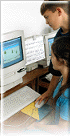
Fourteen-year-old Sam was thrilled to teach me, but bored silly with the sites on the Internet I wanted to visit –Web sites about home schooling and about the history of education. He kept asking me if he couldn’t show me some more “exciting” sites with games and cool graphics! One hour later, I had a good grasp of how the Internet worked, how to navigate, and a glimpse of the amazing resources that are out there. (Thanks, Sam!)
If you are interested in using the Internet as part of your home-schooling program, there is some basic information you need to know, and there are safety issues to consider.
1. Obtain the right equipment. You will need:
• A computer with a modem.
• A phone line (You may want to obtain a second phone line specifically for the Internet connection if you plan to use the Internet a lot in your home-schooling program. This will leave your regular phone line free for incoming calls.)
• A subscription to Internet service from a local or national Internet Service Provider (ISP). Many people use regional or national ISPs, although I personally prefer my local ISP – no matter what goes wrong with my internet connection at any given time, the local ISP technical assistants can usually walk me through a solution. Large national ISPs rarely have such personalized service.
• Virus protection software.
• Browsers. You need an Internet browser to navigate on the Internet. Most new computers come with browsers already installed. If your computer did not, or you want to upgrade to the newest version of a browser, you can go to the Web sites of the two most commonly used browsers: Netscape (https://home.netscape.com/download/index.html?cp=dju1) and Internet Explorer and download the browsers that you need.
• A filter (see below).
2. Safety first. The Internet is a wonderful resource. It also has a very dark side. Without a filter, a child left unsupervised on the Internet can end up unexpectedly encountering violence, pornography, and worse. If you have an Internet connection in a home with children present, get a filter and use it. Even then, it is wise to keep the computer in a public area of the home, such as the living room or den, under adult supervision. Your local computer store can recommend an appropriate filter.
You should also instruct your child never to give out online his or her name, address, e-mail address, social security number, or names of parents or siblings without obtaining your approval and permission first. In general, if Web sites require registration to use (some reputable Web sites do, including such well-known ones as The New York Times), then the registration should be done by the parent, and in the parent's name, not the child's.
3. Learn to type quickly. Internet research and online courses are so much easier and less frustrating if you are a fast typist! Both home-schooling parents and children can benefit from programs to increase typing speed. These can be purchased commercially, or selected from some of the free typing programs available on the Internet. Even first graders are not too young to learn touch typing using these programs. Your goal should be daily practice of about 15 minutes, until you and your child are typing at least 35 words per minute.
4. Learn to navigate the Internet and make the most of your Internet connection. Learning how to do this will come slowly, with practice and experience. You may want to try the WebTeacher Web Primer tutorial below for a jump-start.
And what if you don’t have someone like 14-year-old Sam to help you learn how to use the Internet? You might want to try some of the following free resources:
Internet Use and Navigation:
• WebTeacher Tutorial : This free tutorial was designed as a professional development course for teachers by the Tech Corps and the National Cable Television Association. It is very comprehensive, providing about 80 hours of training. The Web Primer section will get you started using web browsers, navigating the Internet, using e-mail, and locating Internet resources. The more comprehensive Web Tutorial provides advanced instruction in web browsers and navigation; HTML and web page design; Internet research; image, sound, and movie files; newsgroups, mail lists, and chat groups; and a variety of advanced topics. This tutorial is ideal for both home-schooling parents and older home schoolers, and would meet computer literacy requirements for graduation in many states.
Typing and Keyboarding Programs:
• Learn2Type is an interactive keyboarding program that automatically keeps track of your speed and accuracy. Learn2Type offers a children’s version of its program, as well.
• Easy Type! is an animated keyboarding program with wonderful graphics. Easy Type! provides three levels of instruction, for children, teens, and adults. (You will need to use the Netscape browser, and download the Macromedia Flash 4 Player in order to use the program. Directions are on the home page of the Web site).
Internet Safety:
• Web Awareness for Parents: Safe Passage is sponsored by the Canadian Media Awareness Network. This site provides parents with basic information about how children and teenagers use the Internet. It also includes tips about developing family online agreements, filtering tools, tracking where children have been on the Internet, and other safety issues, as well as links to child-friendly search engines.
Kathi Kearney has been working with home-schooling parents for 23 years. She works as an educational consultant for parents of gifted children. She has taught at the university level and is a free-lance writer.You will often find Kathi in Crosswalk.com chat rooms, helping home-school moms.
Originally published May 16, 2003.