

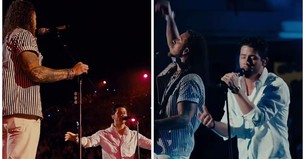



It’s this sense of the universal nature of music and its ability to communicate – to cut through borders and cross over boundaries – that Littrell embraces. When asked about the seeming disparities between mainstream versus Christian music, he responds, “I stand beside ‘the music business, is the music business’…I guess I’m an old veteran when it comes to the music business. God has used me in many different countries and many different venues, you know, giving me the platform He’s given me. But still, it’s always been the same music business. And ‘crossing over’ into the contemporary Christian music business, it’s the same.”
To make his point, he cites examples such as “the Third Day’s and the MercyMe’s and the people that are really breaking down walls” between genres and radio formats, both Christian and mainstream. After all, as the songwriters’ unions often point out, it all begins with a song – and with a message. “You know, God is moving mountains in people’s views,” he remarks. “I think of how these genres of music are coming a little closer together because it’s still about a message, whatever that message may be. And standing on the Christian side, my message is plain and clear. It’s simple to hear what my message is about and what my testimony is. But also, even on the secular side, it’s plain to see what I’m about as a person – the things that I contribute to, the things that I stand for are the same things that I’m into for the Christian side. So, a lot of people look at my situation [like it’s] backwards. You know, ‘Why go to Christian music when you sold this many records?’ To me, it’s about the message. It’s not about the sales…To me, God has truly multiplied my audiences all over the world, and I think I can maybe change a few views on how people look at the secular world [as well as how] the secular world…views Christian music. And I hope it changes; and I hope it continues to change and grow.”
With such an outlook, it’s not hard to understand why Brian Littrell is attracting attention in the Christian music marketplace. Although he is still very much a Backstreet Boy and has no plans to leave the group, with the recent high-profile release of his first solo project Welcome Home, Littrell has made a statement. He has chosen to put out a Christian record as his first solo album. Even if the music hadn’t turned out to be so exceptional, that move alone would have spoken volumes.
But the music is exceptional, as well it should be considering the lineup of pros tapped to collaborate on it. Littrell worked with producers Billy Mann (Jessica Simpson, Ricky Martin), Dan Muckala (Backstreet Boys, Mandy Moore) and the team of Mark Kibble and Dave Thomas (Take 6) to craft a great AC/pop record. (And as a side note to those readers who, along with our editor, may be concerned about the lack of artist signings and releases forecasted for AC/pop this year, Littrell’s record may be your saving grace!)