The Reality of Salvation: He Rose!


The last enemy that will be destroyed is death.
1 Corinthians 15:26
People have always been haunted by the thought of death. But now that Christ has been resurrected, there’s no need to fear death anymore. Death has lost its sting; we can escape everlasting punishment for sin and, with it, eternal separation from God.
Physical death is now but a transition into our new and glorious existence in God’s presence; it’s the shedding of our weak and frail bodies and the receiving of new resurrection bodies. That is, if we choose to accept the gift of salvation, to repent of our sin, and to make Christ the Lord of our lives.
HISTORICAL RESURRECTION
Our resurrection life hinges on the fact that Jesus really did rise from the dead to new life. And if that fact isn’t established, our faith is in vain.
So did Jesus rise? Did He truly die and then come back to life? This is a valid question that must be addressed.
The fact that Jesus lived has been clearly established. He’s not a figment of the imagination but a historical person. No educated person contests this fact; Jews, Muslims, and atheists all believe as a fact of history that Jesus lived. So there’s no need to argue this point. But many deny that the historical Jesus was the divine Son of God, and they deny He rose from the dead.
There are many approaches to answering such objections. Before we consider a quite unique and rather unexpected approach to this which we find in Scripture, let’s approach the issue from a purely historical examination.
JESUS DIED
Jesus died on the cross. This needs to be established because some argue that Jesus didn’t actually experience physical death on the cross. They suggest that He passed out, then later woke up in the tomb and walked out. They suppose that after all the torture and physical suffering He went through, He awoke from His stupor, unwrapped Himself from the burial wrappings, rolled away the stone, and left.
Not likely! But for those looking for a rational explanation, they’ll even hold on to the irrational rather than accept the miraculous. The physical suffering Jesus endured left Him in a physical condition of injury and trauma that was inescapable. His suffering began in the Garden of Gethsemane, where His sweat became like drops of blood, a detail recorded by the physician Luke in Luke 22:44. Jesus endured a medical condition known as hematidrosis, in which tiny capillaries in the sweat glands rupture, causing the skin to be extremely fragile and sensitive to the touch. This condition is rare but has been known to occur when a person is suffering under extreme amounts of stress.
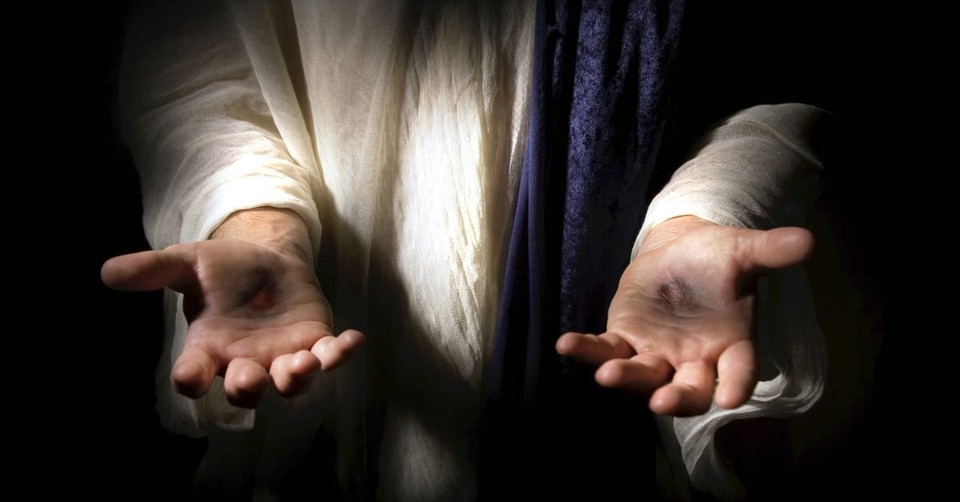
Shortly thereafter, Jesus was arrested, then questioned in a series of “trials” that lasted through the night. He was whipped with a cat-o’-nine-tails that would have torn open the skin of His back (John 19). Soldiers pressed down upon His head a crown of thorns that would have cut deeply into His scalp (verse 2). He was beaten at the hands of the Roman soldiers (verse 3). Then they placed a heavy cross upon His back as they led Him to Golgotha (verse 17). It was there that the soldiers nailed Him to that cross with thick iron spikes in His hands and feet (verse 18). And the world watched as His tortured body hung there for hours for all to see. The word excruciating—which literally means “out of the cross”—is a fitting description of the ordeal of crucifixion.
After such an ordeal, can you imagine Jesus having the strength to loosen Himself from under a hundred pounds of burial spices (verse 39), unwrap Himself from the linen strips that tightly bound Him (verse 40), and roll away the stone that sealed His tomb (John 20)? Neither can we.
Others say that Jesus never made it to the tomb, but orchestrated an elaborate plan to make it appear as though He died and rose again. Perhaps He had a twin; perhaps they substituted Judas; perhaps the sponge filled with sour wine given to Jesus on the cross was really a sedative that made Him sleep; perhaps the soldiers were paid off to lie about His death. Perhaps…
People who don’t want to believe that Jesus is the Son of God will conjecture anything to try to disprove His death and resurrection.
The enemies of Jesus, however, proved that He really died. They verified His death. A crowd of people witnessed the entire ordeal (John 19:20). A Roman soldier pierced His side on the cross, causing water and blood to come out (verse 34). The blood had started to separate, signifying that physical death had already occurred. A centurion, a man well acquainted with the signs of death, verified that Jesus was dead (Luke 23:47). There was no doubt in the executioners’ minds that Jesus was dead.
The friends of Jesus agreed. Joseph of Arimathea and Nicodemus took the body of Jesus and prepared it for burial; they knew He had died. Disciples who didn’t want to believe He was gone were absolutely convinced He had died.
Jesus was crucified…and He died on the cross.
JESUS WAS BURIED
After Jesus died, He was quickly prepared for burial and then laid in the tomb that belonged to Joseph of Arimathea (Matthew 27:57-60).
Some concede this fact, but then argue that His disciples stole the body of Jesus and propagated the myth of resurrection.
But again, His enemies ensured that this couldn’t happen. The body of Jesus was placed in a tomb that was then closed off with a huge rock and sealed by Roman soldiers. The seal was a cord placed across the tomb with wax over the cord. The Roman seal was imprinted in the wax, and Roman soldiers were placed by the tomb to guarantee that nobody stole the body. They knew it was predicted that Jesus would rise after three days, and they didn’t want His disciples to steal the body and cause an uprising (Matthew 27:63-66). The enemies of Jesus ensured that Jesus would stay in the tomb and that nobody was going to take away the body.
They did a good job; nobody stole Jesus’ body from the tomb.
THE EMPTY TOMB
Jesus died and was buried, yet three days later His tomb was empty. Not many argue this point. Everyone recognizes that something happened to the body. For on the Sunday after Passover, some women went to put spices in the tomb and found the stone rolled away and the tomb empty. Jesus wasn’t there. But they didn’t understand what had happened and surmised that somebody had taken the body (John 20:2).
These women were “Mary Magdalene, Joanna, Mary the mother of James, and the other women with them” (Luke 24:10). They went back and reported to the disciples what they had seen. The disciples were also startled and couldn’t believe the body was gone. They had to see this for themselves.
Peter and John ran to the tomb. Inside they saw the linen burial clothes—not ripped open or stolen away with the body, but lying there in an orderly manner (John 20:6-7). The body had not been stolen but had passed through the clothes… and was alive.
If the physical evidence wasn’t enough, God sent angels to explain it (Matthew 28:5-7; Mark 16:5-7; Luke 24:4-7; John 20:12). So the resurrection was confirmed not only by physical evidence but also by divine messengers.
JESUS APPEARED
It was also confirmed by many personal appearances of the risen Lord—the most convincing evidence of all. The disciples saw Jesus alive for themselves.
Still, some argue that the disciples only thought they saw Jesus; it was actually an illusion or a daydream. But this so-called illusion was far too widespread to be an imaginary vision.
Jesus was seen on the day of resurrection by Mary Magdalene (John 20:14-17), ten disciples in the upper room (John 20:19-23), and two disciples on the road to Emmaus (Luke 24:13-31). Eight days later, Jesus was seen by Thomas and the other ten disciples, again in the upper room (John 20:24-29). A short while later, Jesus was seen by the disciples on the shore of the Sea of Galilee (John 21:1-14). He was also seen by a crowd of disciples as He ascended into heaven, forty days after Passover (Acts 1:3-11).
Paul later records that the resurrected Jesus was seen by Peter and the disciples, by His brother James, and by more than five hundred people at one time (1 Corinthians 15:5-7).
Jesus was seen in many places, by many people, on many different occasions. This had to be real and no illusion; the same daydream doesn’t happen to hundreds of people at the same time!
DRAMATIC CHANGE
No one will argue that the resurrection didn’t cause some dramatic changes in the lives of Jesus’ followers. It’s undeniable.
One of those changes, which might not appear significant to many, is how the disciples changed the day of worship from Saturday to Sunday. The Sabbath day was Saturday, the day God rested after six days of creation. Honoring the Sabbath was a part of Mosaic law, the fourth of the Ten Commandments: “Remember the Sabbath day, to keep it holy. Six days you shall labor and do all your work, but the seventh day is the Sabbath of the LORD your God” (Exodus 20:8-10). And yet Sunday, rather than Saturday, became the Sabbath for the early church.
Jesus had already indicated His own authority over the Sabbath: “The Sabbath was made for man, and not man for the Sabbath. Therefore the Son of Man is also Lord of the Sabbath” (Mark 2:27-28). He centered the Sabbath on Himself, and by so doing He extended the Sabbath from just a Jewish practice to something experienced by the entire world—Gentiles included.
So when the Christians of the early church chose Sunday as their day for gathering to worship, the choice was centered on Christ’s resurrection and its universal message.
The biblical record for this change for the Sabbath is found in 1 Corinthians 16:2, where Paul gave instructions on gathering “on the first day of the week” in order to collect an offering, and in Acts 20:7, which mentions “the first day of the week, when the disciples came together to break bread.”
Whereas the Jews functioned under the Law, believers in Jesus now live in grace. Grace and truth came in the person of Jesus, and through His resurrection we now live this new life. Resurrection day, Sunday, is now the day of worship for those who have put their faith in Christ.
THE DISCIPLES’ ULTIMATE SACRIFICE
Perhaps the greatest change caused by the resurrection was in the character of the disciples. They had previously been timid, afraid, and depressed after witnessing the arrest and suffering of Jesus. But after His resurrection they became aggressive, bold, and full of joy.
Peter is a prime example. He was the one who had earlier denied the Lord to a lowly servant girl. But after the resurrection, he stood in the temple courts defying the very men who put Jesus on the cross (Acts 4:20).
When you observe the post-resurrection disciples, you see that they had life! Their circumstances didn’t matter. They had joy in the midst of suffering and peace in the midst of turmoil. Nothing could take away their passion arising from the everlasting life they’d received from Christ.
The disciples believed so much in the resurrection that they gave their lives to sharing the news. The first to die was James the brother of John, who was killed by the sword upon the order of King Herod (Acts 12:1-2). Church tradition holds that John miraculously survived being put into a cauldron of boiling water, then later was exiled to the island of Patmos; Peter was crucified in Rome upside down; Matthew was slain by a sword in a distant city in Ethiopia; James the son of Alphaeus was thrown from a pinnacle of the temple, then beaten to death with a blacksmith’s tool; Philip was hanged against a pillar at Hierapolis in Phrygia; Bartholomew was skinned alive; Andrew was bound to a cross—and preached to his persecutors until he died; Thomas was run through with a lance in the East Indies; Jude was shot to death with arrows; Matthias was first stoned and then beheaded; Mark died in Alexandria in Egypt after being cruelly dragged through the city.
Let me ask you: Would you have died for a lie? Would these disciples have endured such persecution for a dead man?
No. They saw the risen Lord—then gave their very lives in service to Him. They were no longer afraid of death because they’d found the true meaning of life. They were transformed, for they were living in resurrection life.
PETER’S EVIDENCE
So we see ample historical evidence for the resurrection.
Earlier we mentioned a unique and rather unexpected approach to the resurrection that we find in Scripture. Let’s go back and explore it.
How did Peter explain the resurrection on the Day of Pentecost? He was a close disciple of Jesus, he had been there to witness the crucifixion, and he’d talked with Jesus after He rose from the dead.
But in his Pentecost sermon, Peter didn’t give such factual evidence. He didn’t say, “I know God raised Him up again because I saw Him.” Instead he declared, “I know God raised Him up because it was impossible for Him to be held in death’s grip.” This is recorded in Peter’s words in Acts 2:24, where Jesus is referred to as the One “whom God raised up, having loosed the pains of death, because it was not possible that He should be held by it.”
Peter’s words present the first apostolic statement on the resurrection. Peter was declaring with absolute certainty, “God raised up Jesus—the man you nailed to a cross.”
Remember that Peter was speaking to a crowd in Jerusalem, the city where Jesus died. Many in that crowd had probably been eyewitnesses to Jesus’ crucifixion, which had happened there less than two months earlier. His execution had been a prominent event in the city, one that no doubt was a topic of discussion for a long time. Peter was addressing people keenly interested in what he was talking about.
In Peter’s words to them, the resurrection was just as much a fact of history as the crucifixion—a fact with immediate and powerful results. And the reason Peter gave for the resurrection is simply this: it wasn’t possible that Jesus could be held by death.
The world today says, “It’s impossible for Jesus to rise from the dead.” But Peter said, “It’s impossible for Jesus not to rise from the dead.”
How could Peter make such a statement? His argument is based not upon the kind of factual evidence we would think of, but upon two other points.
First, Peter bases it on the nature of biblical prophecy. In stating that it was impossible for death to hold Jesus, Peter noted that David spoke “concerning Him” (Acts 2:25). Christ’s resurrection had already been prophesied. And once God speaks, it is done. Jesus must rise again because God’s Word is always true; He cannot be wrong. Once the prophetic word is given, God’s nature is such that He cannot fail to fulfill it.
Peter quotes Psalms 16 and says that David was speaking of Christ when he said, “You will not leave my soul in Hades, nor will You allow Your Holy One to see corruption” (Acts 2:27).
Peter was whispering into the souls of the Jews standing before him, for Jews knew that once God spoke through a prophet, it was as good as done.
Of course, Christ’s resurrection was foretold not only by Old Testament prophets, but by the Lord Himself, as we’ve already seen: “Jesus began to show to His disciples that He must go to Jerusalem, and suffer many things from the elders and chief priests and scribes, and be killed, and be raised the third day” (Matthew 16:21). Divine prophecy is a guarantee that death couldn’t hold Jesus in the grave.
There’s also another reason Peter could present the resurrection as fact. Peter was referring to the very meaning of life itself. He bases this argument on the nature of Christ.
Because of who Christ is, it’s impossible that death could hold Him in the grave. Peter was convinced that life was the nature of Jesus. Peter would later speak of Jesus as “the Holy One and the Just” and “the Prince of life, whom God raised from the dead, of which we are witnesses” (Acts 3:14-15). Jesus is that Prince of life, and without Him, there is no life—not for anyone. It was impossible for Jesus to remain in death because He is life itself. He must burst forth from the grave or deny His very nature as the Prince of life.
Peter’s understanding of Christ’s nature is in keeping with what the other disciples had come to know. The apostle John, for example, opened his gospel by stating, “In Him was life, and the life was the light of men” (John 1:4).
Jesus Himself made this teaching very clear. He said to Mary and Martha, “I am the resurrection and the life. He who believes in Me, though he may die, he shall live” (11:25).
And He said to His disciples, “I am the way, the truth, and the life. No one comes to the Father except through Me” (14:6).
Jesus said more about His “life” nature in these words:
For as the Father has life in Himself, so He has granted the Son to have life in Himself, and has given Him authority to execute judgment also, because He is the Son of Man. Do not marvel at this; for the hour is coming in which all who are in the graves will hear His voice and come forth.” (5:26–29)
Jesus says that the Father—who “has life in Himself ”—has also given to Jesus “life in Himself. ” And this life isn’t something that anyone could ever take away from Him, for Jesus is life; He is self-existent over and above that which we call death. He lives forever because He is life and has become the source of life for all who believe in Him.
Earlier we warned of how Satan tries to keep us from seeing the truth. And God’s truth includes this: the only thing that damns us and keeps us from eternal life is unforgiven sin. Satan can tempt us, taunt us, and mock us with sin, but he cannot damn us. When Christ died for our sins and rose again, He took away the only thing that separates us from God—unforgiven sin. His resurrection proves that He is life, and it proves the genuineness of the eternal life He offers us if we come to Him for salvation.
And once we conclude that in Jesus’ eyes death is not primarily physical, then we also can conclude that life is not primarily physical. Resurrection to new life is not just a physical transaction. There’s a spiritual transaction that takes place, giving new life to the believer. And the power that raised Christ from the dead is the exact same power we experience as we walk in Christ, the giver of eternal life.
As the apostle Paul tells us, “If we have been united together in the likeness of His death, certainly we also shall be in the likeness of His resurrection” (Romans 6:5).
That is the essence of salvation—new life in Christ Jesus.
Excerpted from Henry & Melvin Blackaby's new book, Experiencing the Resurrection: The Everyday Encounter that Changes Your Life, (Multnomah Books, 2007). Used with permission. 
Henry Blackaby, Ph. D., president emeritus of Blackaby Ministries, is the author of more than a dozen books, including the best-selling classic Experiencing God. He has spent his life in ministry, serving as a music director and as a senior pastor for churches in California and Canada. Today he provides consultative leadership on prayer for revival and spiritual awakening on a global level. He and his wife make their home in Atlanta, Ga.
Mel Blackaby, Ph.D., coauthored with his father, Henry Blackaby, the Gold Medallion winner Experiencing God Together. He travels extensively as a conference speaker. He and his wife and their three children live in Cochrane, Alberta, Canada, where he serves as senior pastor of Bow Valley Baptist Church.
Originally published April 14, 2011.