Pheidippides was a Wimp: Translating the 'Headline News' of the Gospel



Jackson County, Michigan, where I live, is not for the faint of heart. Not if you’re a runner, that is.
It’s not that the hills are exceedingly steep, or excessively long. They’re just everywhere. It seems you’re always on a grade, either huffing toward a rise or coasting gingerly down the other side, planting your feet carefully because it’s a whole lot easier to mess up a knee or an ankle running downhill than it is when you’re climbing.
It was on a rare stretch of sun-dappled flatland that my friend Jess said to her husband, Phil, “You need to tell him. Tell Ron.”
Hearing my name, I glanced back.
Conversation during our early morning training runs was not uncommon. And really, they weren’t our training runs. They were Jess’s. She was in her first year of marathoning and still trying to get a handle on the whole issue of pace. Distance running is all about pace — run too fast and you’ll burn out early; run too slow and you will quite literally be an also-ran. So Phil and I, who have been running for years, were there for the same reason there is a mechanical bunny at a greyhound track. We were pacesetters.
An important key to pacesetting — one that just about every endurance athlete knows — is that the ideal pace is generally the most rapid one at which you can still comfortably carry on a conversation. So talking is good.
And that’s why I fell back into stride with my two friends and asked, “Tell me what?”
Phil shrugged. At least I think he shrugged. Either that or he’d just stepped funny on a seam in the blacktop.
“It’s that guy at work I told you about. Marty.”
“The one you brought to Westwinds a couple of weeks ago?”
“That’s the one.”
It was not unusual for our conversation to turn to church and spirituality. I had pastored a large church for nearly a decade and a half before taking on an international speaking and consulting ministry. I had even baptized Phil, for that matter.
“He seemed like a pretty nice guy,” I said. “Pretty garrulous.” I pulled in a breath, a deep one, through my nose. The roadway was starting to rise again, and garrulous was a bigger word than I wanted to use at our present speed. Did I mention that Jess had finished tenth in her last marathon? So we were going at a pretty good clip.
I caught my wind. “You work with Marty, right?”
“Uh-huh. He’s in the office next to mine. We usually grab lunch together. But lately, he’s been — well — ducking me. I’ve asked him to get together with me several times over the past few days, and he’s always had something else going on.”
I knew where this was going.
“You didn’t shove him a gospel tract or something, did you?”
Phil snorted. “Of course not. But I did... well, I did tell him about the gospel.”
Jess surged slightly ahead. Taking the hint, Phil and I picked up our pace a little. We rounded a turn and met with a slight headwind. I pulled ahead and let Jess and Phil fall in behind me. We’d be running in this direction all the way back to my place, and we would take turns pulling and drafting — either blocking the wind or running in the lee of the lead runner.
“So,” I called back over my shoulder, “what did you tell him?”
“You know,” Phil said, “that... um... that he was a sinner and Jesus died for his sins, and how... well, how he needed Jesus.”
I glanced back again. “In other words, you told him he’s totally inadequate, and you’ve got the cure.”
“Now, come on...” Phil blustered. But after a long moment of silence, he conceded, “Well — yeah. I guess I did.”
“Then no wonder.”
“But Phil’s got to do that,” Jess pointed out, her voice steady. I envied her. Even without looking, I could tell that she was fresh, not even slightly winded. The woman has lungs. “We’re commanded to do that. It’s in the Bible.”
“It is?”
“Mark 16:15.”
She said it so quickly that she must have been primed for this conversation. I wondered why it had taken her 4.7 miles to bring it up.
“Jesus said to go into all the world and preach the good news to everyone, everywhere,” she concluded.
“Okay.” I nodded out of habit, even though all they could see was the back of my head. “And what’s the good news?”
“That’s a silly question, Ron. It’s in the next verse,” Jess said. “Anyone who believes and is baptized will be saved, but anyone who refuses to believe will be condemned. Jesus died for your sins. That’s the good news. Everybody knows that.”
“Everybody does,” I agreed. “But what if everybody’s wrong?”
I sensed a change in our running formation and glanced back over my shoulder.
I was running by myself.
I stopped and turned around. Fifty feet back, Phil was bent over with his hands on both knees, huffing, and Jess was just sort of standing there, glaring at me.
“It’s cool,” I assured them. “I haven’t turned atheist. I haven’t even turned universalist. And I can explain. But first, come on, you two; we have another half mile. Let’s pick it up again before we cool down.”
There’s a secret to making a decent egg-white omelet. To start with, forget the milk. No, not even skim milk, or organic skim milk. Milk in any form has no business — ever — in an omelet pan.
The temperature is vital, too. So is aeration. You have to whip the eggs like there’s no tomorrow, but not so much that you wind up with a pastry topping.
Jess and Phil have long since learned to leave me alone in the kitchen. So, before I fired up the stove, I walked into my study, pulled down a couple of different Bible versions, and gave one to each of them, saying, “Have a run through these while I get breakfast ready. You’re looking for two verses: one saying that the gospel — the good news — is that Christ died for your sins, and another one saying you’re supposed to buttonhole people and say, ‘Okay, there are these four spiritual laws . . .’”
I heard the two of them muttering as I sautéed some onions, mushrooms, and cilantro. There was a “here” from Jess and an “uh-huh” or two from Phil as I poured the beaten egg whites into a couple of omelet pans. By the time I set their plates before them, they both had a pencils-down, test-over look on their faces.
“Okay,” Jess said, tapping a page of the New Testament. “It says here that — ”
“Hang on a sec,” I told her. “I need to get my omelet off the stove.”
I came back with my plate, set it down, sat myself down, and said, “Let’s pray.” As I offered thanks for the food, my two friends had a look of relief on their faces. I could almost read their thoughts: Well, he’s still praying, so he can’t be that far gone.
“Let’s eat this while it’s still hot,” I said. “Then we can tackle the deep theological questions, okay?”
We discussed the morning’s run while we finished our breakfast, but I hadn’t even set my fork all the way down before Jess said, “1 Corinthians 15:3.
“All right.” I nodded. “What does it say?”
“‘I passed on to you what was most important and what had also been passed on to me. Christ died for our sins.’”
“And the end of that second sentence?”
“Huh?” Jess glanced down. “Oh, ‘...just as the Scriptures said.’”
“Which may be the most important part of the verse,” I said. I turned to Phil. “What did you find?”
Phil skewed his mouth to one side, the way he does when he’s thinking things over. “Well, I was looking here in the third chapter of John. You know, the part about Nicodemus? This is verse 3, in the NIV: ‘I tell you the truth, no one can see the kingdom of God unless he is born again.’ Seems to me that Jesus is witnessing there.”
“Is he?” I asked. “Or is he just answering a question — or was there even a question asked? I think the Nicodemus passage may be a discussion for another morning run; we need to talk about that passage sometime.”
Jess and Phil looked at each other.
“In the stories of Jesus’ life, the salvation parts — all of them — are answers to direct questions,” I said. “People ask Jesus or a disciple to tell them about salvation, and they get an honest answer. But if salvation is the ‘good news’ that we read about, then why do people have to drag it out of Jesus and the disciples? Or look at Acts 16:17, nlt. In that account, a girl is tagging along behind Paul and Silas, and she is shouting, ‘These men are servants of the Most High God, and they have come to tell you how to be saved.’ But Paul, instead of saying, ‘Uh-huh — sing it, sister; we got the power,’ turns around and commands an evil spirit to leave the girl. So, apparently, Paul recognizes that emphasizing salvation is a misdirection — not to mention an irritant. Which it is.”
“It is?” Jess and Phil responded in stereo.
I gathered the plates and took them to the sink. “We need to think of these verses in the context of the time when they were written. We need to think in the mind-set of the ancients.”
“They were wimps,” Jess said.
Okay, this requires an explanation. As most schoolkids and all marathoners know, in 490 bc, the fate of ancient Greece hung on the outcome of the Battle of Marathon because Marathon was the final obstacle between the invading Persians and the city of Athens. Naturally, the Athenian rulers were on pins and needles, waiting to hear how the battle would turn out. And because this news was so crucial, a Greek warrior named Pheidippides was dispatched from the battlefield to bring the news of the Greek victory to Athens. He ran the roughly twenty-five miles from Marathon, gave his report, and then promptly died of exhaustion.
When Jess had run her first marathon, Phil and I were waiting for her as she crossed the finish line. She had been tired, but was by no means totally exhausted. After she’d caught her breath from the finishing sprint, she looked happily at Phil and me and declared, “Pheidippides was a wimp!”
When Jess made her remark about the ancients being wimps, I laughed and said, “Okay, agreed. All wimps. Every one of them. But wimps with their own cultural roots, which were very different from ours.”
Setting the dishes in the sink, I walked back into my study, retrieved a book from my shelf, and came out reading the text:
The providence which has ordered the whole of our life, showing zeal and concern, has ordained the most perfect consummation for human life by giving it to [him] . . . by filling him with virtue for doing the work of a benefactor among men, and by sending in him, as it were, a savior for us and those who come after us, to make war to cease, to create peace everywhere. . .. The birthday of the god was the beginning for the world of the gospel that has come to men through him.1
I looked up. “That’s a pretty good translation of a birth announcement that was written in koine Greek, the same form of basic, universal Greek used in the New Testament. Whose birth do you think it announces?”
Jess gave me a look like, What kind of softball question is that? “The birth of Jesus, of course,” she said.
“Wrong,” I said with a smile. “It’s the official birth announcement of Octavian — otherwise known as Caesar Augustus — written almost six decades before the birth of Christ.”
I showed them the page and they scoured it, looking for an error, a footnote, anything that might lessen the confusion. Finally, Phil looked up. “But it says savior.”
“Which, in ancient times, meant about the same thing as victor,” I said. “You probably know that when a king or a general in those days captured a city or defeated an enemy at war, it was his right to burn the city to the ground and kill everyone in it. A quick survey of the Old Testament shows that such things happened with absolutely numbing regularity. But as victor, he could also decide to spare the city and its inhabitants, which made him their savior. In other words, he kept them from a death they deserved.”
“Exactly,” said Jess. “Which was why people had to know about Jesus. They knew they needed to be saved from the consequences of their sins.”
“Did they?” I sat down at the table again. “Let’s think about this. Jesus conducted a roving ministry, walking around Palestine — a Jewish state occupied by a foreign power. The final destruction of the Temple had not yet taken place. In fact, Herod the Great — the same Herod who tried to hunt down Jesus when he was an infant, and the father of the Herod who was ruling when Jesus was crucified — had rebuilt the Temple as a means of pacifying the Jews to make them more accepting of their Roman rulers. So, if you had been in an argument with your neighbor, or you hadn’t met with your minyan, your synagogue leaders, for a few days, you could set things right by going into the Temple and making a donation or offering a sacrifice.”
I turned to Phil. “What would you say if I told you I had a great device to keep the elephants off your lawn. Would you be interested in one?”
“I’d say I don’t have a problem with elephants on my lawn.”
“That’s right. And a Jew in the first century would have given a similar reply to someone who said, ‘I’ve got the remedy for your sins.’ Jews of this period didn’t see themselves as sinful. They were doing a pretty good job of living by the rules; and when they broke one, they could offer a sacrifice at the Temple. That’s why Jesus and the disciples didn’t lead with the salvation story, as in ‘This is how you get to heaven.’ They knew they wouldn’t find any takers.”
“But Jesus died for our sins!” Phil insisted.
“He did,” I agreed. “But stay with me for a second.” I looked at Phil and Jess and asked, “Is slavery wrong?”
They nodded.
“Would you agree that it’s a sin?”
They nodded again.
“So the plantation owners of the antebellum American South — were they sinners?”
“Sure,” Phil said.
“Then, in that case, every Union soldier who perished during the Civil War died for slave owners’ sins. Does that make all those soldiers the same as Jesus?”
“Of course not!” Jess realized she had almost shouted her reply, and added, “Sorry.”
“Jesus was not the only Jew to die on a tree in those days,” I said. “Thousands did. It was the most common means of executing people who were seen as enemies of the Roman state — non-Romans, at least. So, although his death gained some notoriety, it didn’t make him unique. And even though John 3:16 makes it clear that Jesus died to create a pathway to God, that isn’t the good news we’re talking about when we read the New Testament. In fact, I’m not even sure ‘good news’ works as a translation in this day and age. It’s more of a ‘breaking story’ or ‘headline news.’”
Jess and Phil looked at each other, and then at me.
“So,” Jess asked after a moment of silence, “what is the headline news?”
Not many people ask Jess’s question: “What is the headline news?” or even “What is the gospel?” In fact, I had never asked either question myself. I assumed I knew the answer.
I was part of the church. I was studying Scripture. I thought I knew it all. But when I talked to people outside the Christian bubble, people who didn’t believe or who were searching for a deeper spirituality, I hit a brick wall every time. It was as if I had a weak cell-phone signal and static was chopping up my words. Does that sound familiar to you? That’s what Jess and Phil were experiencing with Marty.
When you hit so many brick walls, eventually you’ve got to question whether you truly understand the message yourself — or whether you really know how to communicate it. When I found myself hitting brick walls, I started a search to understand what was going on. I read. I talked to people. I listened. This book contains the results of my search.
Maybe you’re on the same journey I’ve been on. You know something isn’t working, but you’re not quite sure what. I invite you to see what I’ve learned. On the other hand, maybe you’re on a much different journey than I am. Maybe you’re burned out by church. Or maybe you’ve experienced a lot of static when you’ve talked about God or spirituality with other people. Maybe you’re searching for something, but you’re not sure what. I hope that some of the lessons I’ve learned on my journey will help you see more clearly what you’re ultimately searching for in life.
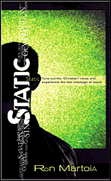
Ron Martoia is an author, speaker, and former pastor. His passion is helping people, and the organisms they serve, design, build and experience revolutionary change. Over the last two years Ron has spoken to more than 25,000 leaders in conference settings. His area of expertise is on the new and shifting landscape of church/cultural intersection, where he helps churches consider how they can shift their theological outlook which in turn will shift and adjust their ministry trajectory and cultural interface. Through his speaking, consulting, writing, and acting as "a distant staff member" to a number of churches, Ron is using his cultural intonation to help churches shift paradigms from the old Newtonian world to the Quantum world of the 21st century context.
Originally published April 25, 2007.