Do Prophets Still Exist Today?


I sat in a local church in my hometown shortly after 9/11, where a self-proclaimed "prophet" had come in to conduct a three-day revival. It was not my church home, but I was curious as to what a prophet would have to say in light of the recent events. Besides, I was still unsure about the whole prophet thing—did they still exist or did they become extinct with the Bible days?
From the time he stood up front… until I walked out about fifteen minutes later… nothing about this guy felt right to me. He was silly, flamboyant, and nothing like I expected a sober-minded prophet to be. He stood in front of the congregation, promising blessings, prosperity, healing… everything your average American wants more of and none of what they don't. There was no mention of sin, repentance, confession, or obedience. Just one blessing after another. One of the things he said (right before I walked out) was that he had a "revelation from God while he was relieving himself in the bathroom." Before the three-day revival was over, "God was going to make it rain in the natural world to confirm the blessings He was getting ready to rain down in the spiritual realm for every and all attendee."
What is a prophet?
Luckily, before I dismissed the whole idea of modern-day prophets, I decided to study the concept for myself. Webster's definition is: "one who utters divinely inspired revelations; one regarded by a group of followers as the final authoritative revealer of God's will; one gifted with more than ordinary spiritual and moral insight; one who foretells future events." In Deuteronomy 18:18 (NIV) we find the first reference to a prophet. "I will raise up for them a prophet…I will put my words in his mouth, and he will tell them everything I command him."
ChristianAnswers.net describes prophets as "the immediate organs of God for the communication of his mind and will to men. The foretelling of future events was not a necessary but only an incidental part of the prophetic office. The great task assigned to the prophets whom God raised up among the people was ‘to correct moral and religious abuses, to proclaim the great moral and religious truths which are connected with the character of God, and which lie at the foundation of his government.'"[1] I think in over-simplistic terms, you could say a prophet is a truth teller.
Do they still exist?
In Acts 2:17-18 we read, "In the last days, God said, ‘I will pour out my Spirit on all people. Your sons and daughters will prophesy, your young men will see visions, and your old men will dream dreams. Even on my servants, both men and women, I will pour out my Spirit in those days, and they will prophesy.'" Clearly, since the time of Christ we have been living in "the last days" and this gift is anything but gone.
However, perhaps more than with any other label, we must use extreme caution when either demonstrating this gift or receiving it from others, because we are forewarned: "Dear friends, do not believe everyone who claims to speak by the Spirit. You must test them to see if the spirit they have comes from God. For there are many false prophets in the world." 1 John 4:1
How do you tell a true prophet?
Some of the signs of a true and authentic prophet (not inclusive) are:
They have received this gift from the Holy Spirit (see 1 Corinthians 12:28-29 & Ephesians 4:11). However, sometimes God temporarily gifts people to prophesy for a specific purpose when they are not prophets, such as when Saul began prophesying as a sign from God that he would be the next king (see 1 Samuel 10:9-11).
They will always agree with scripture or what the Lord has previously spoken. Such was the case in 1 Kings 13 when God told a certain man to deliver a message to King Jeroboam and to leave without eating or drinking in that town. A lying prophet approached him and told him that God said it was okay for him to eat at his house after all. The man believed the prophet and ate with him, which resulted in devastating consequences. The man should have realized the lie and stuck with what God had already told him.
If what they speak is truly from the Lord, it will come true 100% to the letter. "So a prophet who predicts peace must carry the burden of proof. Only when his predictions come true can it be known that he is really from the LORD." Jeremiah 28:9
Their prophetic words should be confirmed. One time someone told me about a sin that God wanted to deal with in me that I hadn't even seen in myself yet. Over time, it became an apparent theme that God was indeed showing me this sin and dealing with it. On another occasion, I had asked God to show me the answer to a question, and someone came up to me out of the blue and said, "I have the answer to your question…" and they proceeded to confirm an answer that God had already been showing me through prayer and His word.
Their lives will be aimed at godliness. Jeremiah 23:14 says, "And among the prophets of Jerusalem I have seen something horrible: They commit adultery and live a lie. They strengthen the hands of evildoers, so that no one turns from his wickedness. They are all like Sodom to me..." God cares about hypocrisy among those speaking in His name, and so should you.
They will speak truth in a spirit of humility. Many of the prophets in the Bible spoke with authority and boldness, but all of them spoke in humility. Jesus was the ultimate example.
They announce sins before promising blessings: A blessed life is no good if you're still lost in your sins. God has always had the condition of obedience before blessing. In Lamentations 2:13b-14 we read, "Your wound is as deep as the sea. Who can heal you? The visions of your prophets were false and worthless; they did not expose your sin to ward off your captivity. The oracles they gave you were false and misleading." (Also see Jeremiah 23:16-17, 22)
They offend many. People do not want the truth; hence, prophets are not usually popular. Isaiah 30:9-11 says, "These are rebellious people, deceitful children, children unwilling to listen to the LORD's instruction. They say to the seers, ‘See no more visions!' and to the prophets, ‘Give us no more visions of what is right! Tell us pleasant things, prophesy illusions. Leave this way, get off this path, and stop confronting us with the Holy One of Israel!'" (see also Luke 4:24, Acts 7:51-52, 2 Timothy 4:3)
They won't predict "new truths" about end times and their words will not conflict with or go outside the bounds of scripture. Revelation 22:18 says, "If anyone adds anything to what is written here, God will add to that person the plagues described in this book."
Their gift isn't "one size fits all." Consider King David. Acts 2:30 tells us that David was a prophet, yet during his life you don't find him foretelling events to individuals like say, Isaiah or Ezekiel, or displaying special powers like Moses or Elijah. But throughout the Psalms, David prophesied about the future Messiah and His kingdom. So there are different kinds of prophets, and different kinds of messages.
Remember, the gift of prophecy can work out in many different ways. A few examples might be in dreams, special insight either in the Bible or in life situations, direction for future events, declaration of sin, and even just "truth-telling." And it can come from many different vessels, according to Acts 2—men, women, elderly folks, and even children.
When in doubt, wait it out.
We must keep our ears attuned to listen for prophetic words and signs. But again, one must use extreme caution and "wait it out" to see whether the word is from God, lest we be tricked by a false gift or a false impression.
One warning: Be very careful about speaking for the Lord or interpreting His message! 2 Peter 1:20-21 tells us, "Above all, you must understand that no prophecy of Scripture came about by the prophet's own interpretation. For prophecy never had its origin in the will of man, but men spoke from God as they were carried along by the Holy Spirit.
It's so easy to get a word from God and interpret it totally different than what He means by it. It's better to wait to see how He unfolds it, or even if it's from Him. Even after the prophets of the Old Testament, no one had a clue about what the Messianic prophecies meant until after Jesus' death—and even then many still never got it (also see Jeremiah 23:31-32).
As you can see, determining authentic prophecy and recognizing true prophets is very serious business to God. One can never be too careful. It was no surprise at our hometown revival that it never did rain those three days. But now I'm not deterred. I know prophets do exist and I've become much better at spotting the real thing.
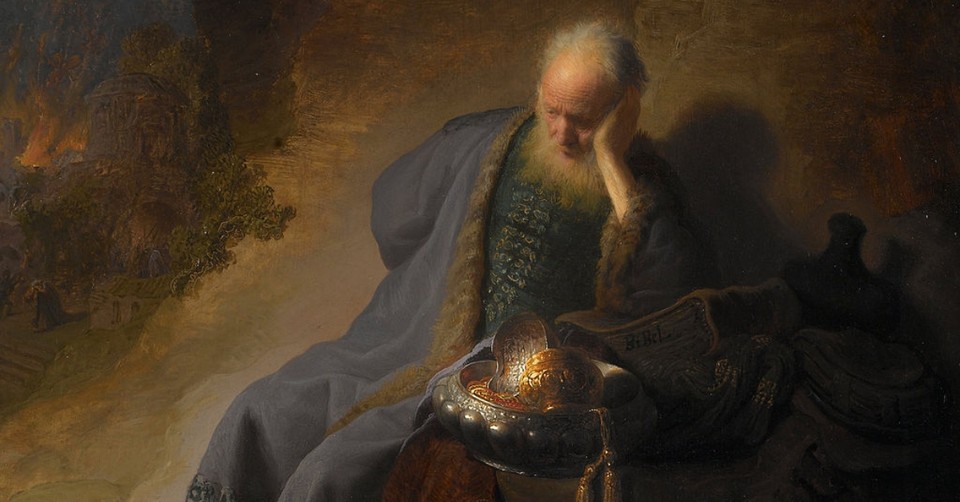
Photo credit: Wikimedia Commons/Public Domain Images/Rembrandt
How do you personally test whether a “prophetic word” is truly from God? Have you ever seen a prophetic claim do more harm than good? What happened? Share your story and connect with other believers on Crosswalk FORUMS!
[1] https://christiananswers.net/dictionary/prophet.html, accessed June 15, 2008.
Julie Ferwerda is the author of The Perfect Fit: Piecing Together True Love, and has written for publications such as Marriage Partnership, Focus on the Family, and Discipleship Journal. Find out more: www.JulieFerwerda.com
Originally published January 26, 2026.