Why the Daughters of Jerusalem Cried


Echoing through the twisting limestone passageways of Jerusalem's Old City was the tapping cadence of the Greek Orthodox bishop’s scepter. Dressed in liturgical costume, the bishop also swung a smoking brazier of incense in rhythmic arcs as he led a cluster of solemn, black-garbed priests. What was this ceremony was all about?
My bewilderment must have shown. “They follow the Via Dolorosa every Thursday,” a shopkeeper whispered to me. “Would you like to see my shop now?” I declined, joining a clutch of sad-faced women trailing the procession ending inside the Church of the Holy Sepulcher.
As I followed, a bell rang in my head: I remembered the weeping women who followed Jesus to the cross, as noted by Luke (23:27-31).
A large number of people followed Him, including women who mourned and wailed for Him. Jesus turned and said to them: “Daughters of Jerusalem, do not weep for Me…” vss 27, 28a
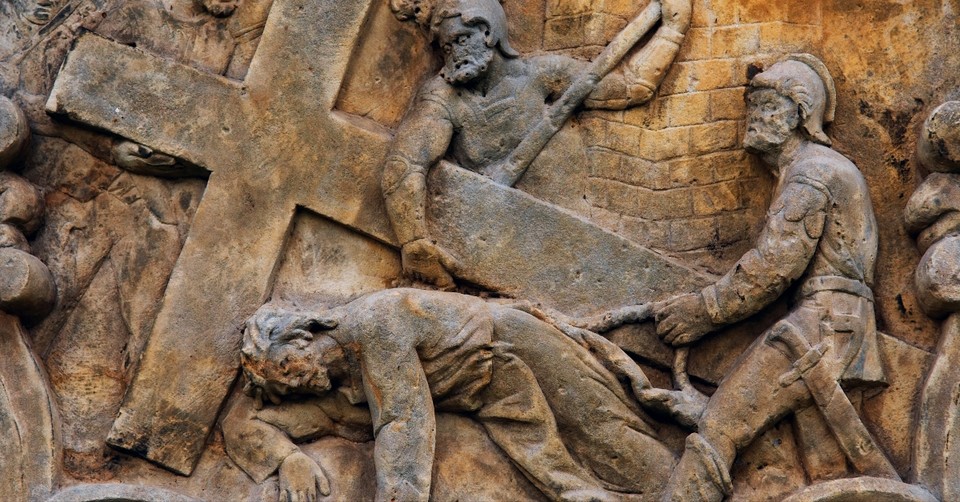
There are, of course, no archeological remains to commemorate the tears of Jerusalem’s daughters. Memorialized as the eighth station of the cross, the event is marked by a beautiful but wildly inaccurate bas-relief of a robust Jesus politely addressing two women and a baby. The Gospel chronology, however, recounts that by the time Jesus spoke to the women, Simon was already conscripted as His cross-bearer and crucifixion was a few heartbeats away.
The event puzzled me. Why did these women weep when everyone else was howling for His blood? These were His last recorded words before being hammered to the cross: What was so important that He would muster strength to prophesy? And what meaning does His prophecy have to those following the cross today?
The road to Calvary is not the first time that the “daughters of Jerusalem” appear in the Biblical narrative. They figure prominently as the muse of the Beloved in the Song of Solomon sonnet. They helped her choose rightly between the flashy wealth of the king and the ardent true love of the Shepherd.
The women in Luke attempt to do the same. They call to the Beloved — Israel — to choose between a powerful, consolidated leadership and Jesus the Good Shepherd. The daughters of Jerusalem are the conscience of the nation.
“Weep for yourselves and for your children. For the time will come when you will say, ‘Blessed are the barren women… vss 28b-29a
Jesus’ prophecy addresses another facet of their tears: Despite the popularity of The DaVinci Code alleging that Jesus and Mary Magdalene were married with children, the women weep because they know Jesus is about to die and leave no offspring.
Said Dr. Paul Wright of : “The two greatest values of life in ancient times were the maintenance of your ancestral land and your family; your ancestors behind you, your unborn descendants before you. Woe be it if your generation cuts that because you don’t have kids and all of your ancestors behind you are anticipating an unlimited eternity of descendants but that stops because you were infertile”
Direct fulfillment of Jesus’ words came less than 30 years later, but like many prophecies, His words find secondary fulfillment: many women no longer feel that children are a blessing but a nuisance and drain on their quality of life.
“Then they will say to the mountains, ‘Fall on us!’ And to the hills, ‘Cover us!’ If men do these things when the tree is green, what will happen when it is dry?” vss 30, 31
Jesus was quoting an old proverb whose underlying idea is that if people foolishly try to start a fire with a green tree that won’t ignite, what trouble will they kindle with a dry tree that will burn? The world was about to find out.
In less than a generation, Jerusalem was deforested and set to the torch, the temple buildings leveled so “not one stone is left standing upon another,” and the populace enslaved or slaughtered. The siege of Jerusalem and the aftermath was a terrible time for mothers and their babies. Women with no dead child to mourn were indeed blest, just as Jesus said.
On the day when Jesus spoke to the daughters of Jerusalem, they took the green tree and nailed the Savior of the world to it. The women wept because they thought Jesus had no one to carry on His name and His line would perish.
But don’t cry for Him: For better or worse, we are His progeny.
In His great mercy He has given us new birth into a living hope through the resurrection of Jesus… an inheritance that can never perish… kept in heaven for you. 1 Peter 1: 3, 4
© Rebekah Montgomery 2008, For reprint requests, contact Rebekah at her website, www.Rebekah Montgomery.com
Photo credit: iStock/Getty Images Plus/siloto
Rebekah Montgomery, author/speaker/teacher, is a gifted, dynamic communicator. She is the author of more than five books and has penned 1,100 articles. She shares tough real-life topics and biblical application in a simple easy to grasp manner. To book Rebekah for your next event visit www.rebekahmontgomery.com . Rebekah is also the editor of Right to the Heart of Women and a publisher at Jubilant Press.
Originally published May 11, 2021.