Why Do Catholics Have a Pope?


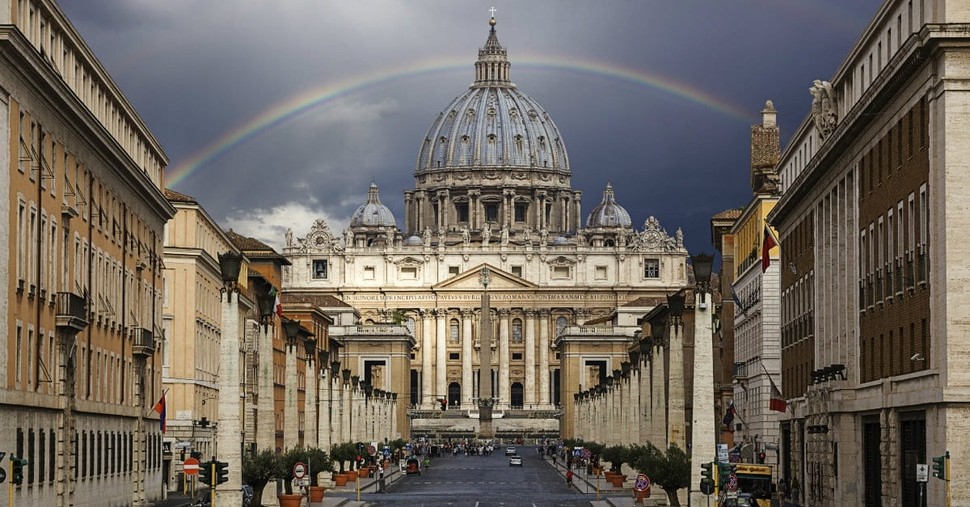
Editor's note: This piece first ran in 2008 when Pope Benedict XVI visited the U.S. We're re-running it in light of Pope Francis's 2015 visit.
Pope: From the Greek word papas, a term of endearment meaning "papa" or "daddy."
With the recent, historic visit of Pope Benedict XVI to the U.S., many Christians may be wondering what exactly Catholics believe about the robed figure with the German accent and his line of predecessors. Why do Catholics have a Pope? Do Catholics worship him? Is his authority political, spiritual, or is he just a figurehead?
While I had a basic understanding of the Catholic papacy before his visit, I didn't fully grasp it. So, in an effort to better understand this central figure in Christendom and to help Christians more effectively dialogue, I dove into some heady reading materials from both Catholic and non-Catholic sources. Hopefully, my explanation here will offer some clarity on what Catholics really believe.
First, a summary: For Catholics, the Pope is more than a ceremonial leader. The Pope is considered the spiritual successor to the Apostle Peter. As successor to the "Chair of Peter," he is the Supreme Pastor of the Catholic Church, God's steward ordained to authoritatively teach, unify, and protect God's people, keeping them free from error and deception (CCC 882, 890).
Of his many official titles, the Pope is the Bishop of Rome and the head of the Magisterium (the teaching authority of the Church made up of the college of Bishops). He holds the final word on matters of faith and morals (known as "papal infallibility"). In the words of the Catechism of the Catholic Church (937): The Pope enjoys, by divine institution, 'supreme, full, immediate, and universal power in the care of souls' (CD 2)."
There's a lot of strong wording here, but before we dive into some of the details, it's important to clarify that Catholics, in fact, do not worship the Pope or see him as a replacement of Christ or the Heavenly Father. From the Catholic perspective, the office of the papacy affirms Christ's Kingship and the Church's confidence in the Holy Spirit to guide believers. So, to fully understand the relationship Catholics have with the man they call both "Papa" and "Supreme Pontiff," let's look at a source all Christians have in common: Scripture.
Matthew 16: 13-19
While Catholic doctrine pulls from many Scriptures when defining Church authority, Matthew 16:13-19 is one of the most important. Indeed, Catholic teachings point to Matthew 16: 18 as the moment when Christ officially instituted Peter as the first Pope, so it's worth spending the bulk of our time here.
The scene opens with Jesus and the Twelve in the region of Caesarea Philippi – an area where ancient pagan worship of the Greek god Pan, the god of Spring and shepherds, once flourished (Ray 1999, 32-33). It was a dramatic place located on the side of a mountain with a sheer rock wall overshadowing the town with Pan's namesake, Paneas. Adding to the already stunning landscape, a temple to the Roman Caesar Augustus stood at the wall's highest point. The scene is ripe with symbolism for Catholics. Catholic apologist Stephen Ray points out, "By choosing this location for the appointment, Jesus clearly shows that he is setting up his divine kingdom in opposition to the worldly kingdom of the Roman Caesars, who claimed divinity for themselves" (1999, 32).
When Jesus came to the region of Ceasarea Philippi, he asked his disciples "Who do people say the Son of Man is?"
They replied, "Some say John the Baptist; others say Elijah; and still others, Jeremiah or one of the prophets."
"But what about you?' he asked. "Who do you say I am?'
Simon Peter answered, "You are the Christ, the Son of the living God."
Jesus replied, "Blessed are you, Simon son of Jonah, for this was not revealed to you by man, but by my Father in heaven. And I tell you that you are Peter, and on this rock I will build my church, and the gates of Hades will not overcome it. I will give you the keys of the kingdom of heaven; whatever you bind on earth will be bound in heaven, and whatever you loose on earth will be loosed in heaven."
The Catholic Church sees three important points here:
- The Primacy of Simon Bar-Jonah above the other apostles demonstrated through his divinely-inspired response to Jesus.
- The establishment of Simon Bar-Jonah, renamed "Peter," as the Rock from which Christ expressed intention to build His Church.
- The handing over of the keys to the kingdom with the authority to "loose" and "bind."
Simon's divinely-inspired response. While our ears may have become numb to these passages over the centuries, this moment was, no doubt, as dramatic as the surrounding landscape – one on which Protestants and Catholics alike hinge their faith. Jesus' earthly ministry had made waves among the Jews and Gentiles. The apostles here recount how, in awe of Jesus' teaching and miracles, many surmised he must be an Old Testament prophet come back from the dead. But the truth about Jesus' identity was even more astonishing than the rumors, so amazing that even His closest followers had yet to make the connection. When Jesus turns to His chosen twelve to identify Him, Simon Bar-Jonah ("son of Jonah") speaks first among all – a pattern of leadership the Catholic Church teaches can be found throughout the New Testament (CCC 880). In this defining moment, Simon asserts Jesus is not merely a prophet but the Messiah, God Incarnate. The Apostle's astounding profession of faith – directly inspired by the Heavenly Father – leads into Christ's words that for Catholics have had tangible implications to this very day.
The renaming of Simon. And I tell you that you are Peter, and on this rock I will build my church, and the gates of Hades will not overcome it.
When a person in the Bible is renamed, it is a sign of God's intention to work in a special way through that individual. Abram became the father of nations after being renamed "Abraham," and Sarai the mother after being renamed "Sarah." Other pivotal renamings in Biblical history include Jacob becoming "Israel" and Saul becoming "Paul."
In regards to Catholic doctrine, the implication of Simon's new name is easiest to understand when going back to Jesus' native language, Aramaic -- the language scholars believe the original words were spoken (Ray 1999, 34). Unlike modern English and New Testament Greek, the Aramaic word for "Peter" and the word "rock" are identical: Kepha. So this verse, when spoken, would have sounded something like this:
And I tell you that you are Rock (Kepha), and on this rock (kepha) I will build my church…
Catholic doctrine asserts that linguistically, Christ links the person and position of Peter – not Himself or a general profession of faith – to the founding of His Church here (CCC 881). While both Christ and the Apostles are referred to as "rocks" (kepha) and "small stones" (Greek, petros) in other areas of Scripture, Catholic teaching points to Peter as the only person in the Bible given the proper name "Kepha," later spelled "Cephas"(Ray 1999, 35).
While some Christians might see the assertion that Peter was the rock upon which Christ would build His Church as an affront to Christ's Headship and status as the true Rock, Catholics take a different view. To better understand why, let's move to the next Scripture, involving the keys to the kingdom.
The keys to the kingdom
I will give you the keys of the kingdom of heaven; whatever you bind on earth will be bound in heaven, and whatever you loose on earth will be loosed in heaven.
If you've ever seen the official Papal seal, you'll notice a set of golden keys included in it. Catholic teaching puts this verse in context with Isaiah 22:22, where God tells Isaiah to go to King Hezekiah's steward, Shebna, and inform him of God's intention to replace him with Eliakim. In regards to the new steward, Eliakim, God says: I will place on his shoulder the key to the house of David; what he opens no one can shut, and what he shuts no one can open.
In Old Testament times, the steward of the palace was the king's right-hand man, the second-in-command. When the king was away, the royal steward was keeper of the keys to the kingdom, ruling in the king's stead. While he looked after the affairs of the kingdom as the king instructed, he never replaced the king but awaited his return. When the present steward died (or in this case, when the Almighty intervened), the office was filled by another.
The office of the Papacy works in the same manner. Catholics believe Christ, to ensure the unity and health of His flock, gave Peter governing authority over His Church by handing over the keys to His Kingdom. Like the ancient "key keepers," Catholics do not believe the Pope is the new king but instead a steward awaiting the King's return. Even the Pope's title "Father" imitates the role and title of the steward of Judah, also called "father." Until Christ's second coming, the keys will be passed on to each successor to the Papal office (Ray 1999, 29-40; CCC 857-860).
Now, what do the terms "binding" and "loosing" refer to? These words sounded strange to my modern ears, so I looked for some historical context. Apparently, the terms were common in Rabbinic canon-law, representing the legislative and judicial powers held by a Rabbi (Ray 1999, 40). In this context, Catholics view Peter's key-keeping status as one that makes him "Supreme Pastor," with final authority over what is permitted and what is denied in matters of doctrine and spiritual discipline.
How does Papal Infallibility work?
The issue of religious authority brings up an often misunderstood doctrine of Catholic teaching: Papal infallibility. We see that Catholics believe the Pope has great authority in matters of the faith, but this doesn't mean that Catholics believe every word the Pope says comes straight from the Heavenly Father like Peter's first pronouncement.
Papal infallibility refers to the belief that while all Christians have personal access to the Holy Spirit in prayer, Christ promised a unique protection over the Apostles’ teachings, ensuring they would preach without error (John 16:12-15). In order for a papal teaching to be considered free of error or "infallible," the Pope must a) be speaking on a matter of faith and morals (not on his recent vacation plans) and b) make it clear he is speaking from the "Chair of Peter" and that what he is about to say is binding. Back to the concept of guardianship, the Catholic Church teaches that infallible statements are for affirming what has always been true and is not a method of creating new beliefs (CCC 86, 888-891). Official statements of infallibility are rare today – the last one was made in 1950, long before Pope Benedict XVI.
Another important clarification: Papal Infallibility refers to doctrine being protected from error, not the man holding the Papal office being free of imperfection or sin. Catholics point to Peter's sinfulness as an example of failings in a Pope, and John Paul II was known to confess his sins weekly.
Servant of the Servants of God
One last "key" element of Catholic teaching on the Papacy is worth mentioning. As is typical with the Christian faith, a great paradox exists that endears Catholics further to their "Papa." Three times after Christ's resurrection, Jesus asked Peter if he loved Him, and in response to each of Peter's professions of love, Jesus instructed him to feed and care for His sheep (John 21: 15-17). Catholics believe that in imitation of Christ, Peter's successor is a shepherd called to embrace the biblical model of servant-leadership, earning him the official title "Servant of the Servants of God." The sacrifices made of Pontiffs are often so great, that it is not uncommon for Popes, including the current Pope, to accept their appointment out of a sense of obedience instead of personal desire. So the office, while powerful, is meant to be authoritative in nature, not authoritarian like a dictatorship.
Sources:
1. The Catechism of the Catholic Church, 2nd Edition. 1997. Rome: Libreria Editrice Vaticana. https://www.scborromeo.org/ccc.htm
2. Ray, Stephen. 1999. Footnotes in Upon This Rock, 32-40. San Fransisc Ignatius Press.
3. Joyce, G.H. 1910. “Pope,” in The Catholic Encyclopedia, Volume VII. New York: Robert Appleton Company. https://www.newadvent.org/cathen/12260a.htm
4. Toner, P.J. 1910. “Infallibility” in The Catholic Encyclopedia, Volume VII. New York: Robert Appleton Company. https://www.newadvent.org/cathen/07790a.htm
5. Wikipedia.org, 2008. https://en.wikipedia.org/wiki/Pope.
6. Archdiocese of Lincoln’s wesbite, 2008. “Ask the Register,” https://www.dioceseoflincoln.org/purple/pope/index.htm
7. St. Charles Borromeo Catholic Church website, Picayune, Mississippi, 2008. “I’m Glad You Asked!” https://www.scborromeo.org/glad/c5.htm
8. Rodriquez, Pedro, “The Papacy and Primacy of Peter,” reprinted on www.ewtn.org from “The Primacy of the Pope in the Church,” from Catholic Position Papers, September, 1981 -- Japan Edition (https://www.ewtn.org/faith/teachings/papab1.htm).
9. Mirus, Jeffrey, Ph.D. “Papal Infallibility” posted on www.ewtn.org, (https://www.ewtn.org/faith/teachings/papac2.htm)
10. Kellmeyer, Steve. 2000. Bible Basics, 107-111. Steubenville, OH: Basilica Press.
Originally published September 21, 2015.