
First of all, we really do not when Golan did obtain the box from the antique dealer in the Old City. There is a law in Israel which states that any archaeological artifact discovered after 1978 is the property of the State of Israel. In 1978 Golan was sixteen years old. Some doubt that a sixteen year old would have made such a purchase as this. If not, and the purchase was made after 1978, then Golan and the antiquity dealer broke the law.
A second problem is that we do not know where the ossuary was found. If it was found in Silwan, as Golan has stated, this raises some interesting possibilities. We will discuss this later. But since we cannot know for sue where the ossuary was found we cannot scientifically verify the authenticity of the artifact.
Furthermore, the cave or tomb where the ossuary was kept has most likely been destroyed. This means we can never properly investigate the history of the ossuary.
The Death of James
The second century Christian writer Hegesippus offers a detailed account of the martyrdom of James. He writes,
"The aforesaid scribes and Pharisees accordingly set James on the summit of the temple, and cried aloud to him, and said: ‘O just one, whom we are all bound to obey, forasmuch as the people is in error, and follows Jesus the crucified, do thou tell us what is the door of Jesus, the crucified’. And he answered with a loud voice: ‘Why ask ye me concerning Jesus the Son of man? He Himself sitteth in heaven, at the right hand of the Great Power, and shall come on the clouds of heaven.’
‘And, when many were fully convinced by these words, and offered praise for the testimony of James, and said, ‘Hosanna to the son of David,’ then again the said Pharisees and scribes said to one another, ‘We have not done well in procuring this testimony to Jesus. But let us go up and throw him down, that they may be afraid, and not believe him.’ And they cried aloud, and said: ‘Oh! oh! The just man himself is in error.’ Thus they fulfilled the Scripture written in Isaiah: ‘Let us away with the just man, because he is troublesome to us: therefore shall they eat the fruit of their doings.’ So they went up and threw down the just man, and said to one another: ‘Let us stone James the Just.’ And they began to stone him: for he was not killed by the fall; but he turned, and kneeled down, and said: ‘I beseech Thee, Lord God our Father, forgive them; for they know not what they do.’
‘And, while they were thus stoning him to death, one of the priests, the sons of Rechab, the son of Rechabim, to whom testimony is borne by Jeremiah the prophet, began to cry aloud, saying: ‘Cease, what do ye? The just man is praying for us.’ But one among them, one of the fullers, took the staff with which he was accustomed to wring out the garments he dyed, and hurled it at the head of the just man.
‘And so he suffered martyrdom; and they buried him on the spot, and the pillar erected to his memory still remains, close by the temple. This man was a true witness to both Jews and Greeks that Jesus is the Christ.’ "
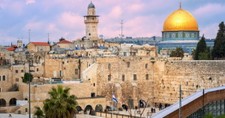
According to Hegesippus, James was thrown off the Temple on the southeastern corner. He did not die from the fall and was stoned in the Kidron Valley. Later traditions state that James was buried in the area of his death. Today this area is known as Silwan, the place where the ossuary of James was supposedly discovered prior to 1978.
In our next offering we will look at arguments that dispute the authenticity of the ossuary of James.
Charles Page is the Vice-president for Academic Affairs at the Jerusalem Center for Biblical Studies and the Director of the Kursi and Capernaum Excavation Projects in Galilee. His field work in Israel spans four decades.
For more information about the Jerusalem Center for Biblical Studies, our excavations in Galilee, or other study opportunities in the lands of the Bible please see www.jerusalem-center.org or write to Dr. Page at charles@jcbs.org.
Sponsored by Trinity College of the Bible & Trinity Theological Seminary