
A Worshipping Community.
"People want churches to give priority to the ministry of worship, satisfying all the various aspects worship involves," the survey report found.
As one might expect, there were thousands of responses dealing with the form, or style of worship in the service. While some called for more traditional liturgy, and others for a more modern approach, both sides conceded that a balance of styles would be fine. Almost all were in agreement, however, that services that "bordered on entertainment rather than worship" were the most disappointing.
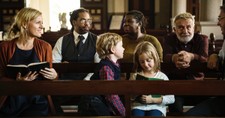
Moreover, many of the respondents realized that their spiritual journey was not one to be taken alone, and so it is not surprising that "the sense of fellowship experienced" was also something that made a difference for churchgoers.
"They said that they derived pleasure from worshipping with others, it gave them a sense of belonging," the report said, " a sense of comradeship and a sense of being part of a 'spiritual family.'"
This sense of belonging to a spiritual family was made more critical because of the brokenness of relationships, marriages and families in the U.K.
A Prophetic Church.
There was a real desire expressed in the survey responses for more teaching emphasis "on the nature of God's holiness and the implications this has for individuals and our two nations."
Many said this message had been missing from the church for decades, having been gradually replaced by a one-sided proclamation that God was "loving and nothing more."
Approximately 75 percent of respondents -- more than 10,000 in number -- saw the lack of a clarion call for holiness as a very real explanation for the decline of Christianity's influence in the U.K.
"Many who used to attend church are now filled with apathy," the report summarized. "They no longer see any point in attending, because the message they have been given is that 'God loves me anyway,' regardless of whether or not they attend church or change their lives, so why bother?"
This was one of the central laments of the Christians that answered the ERC questionnaire. People "are calling on churches to robustly defend moral values with conviction and courage and cease being 'silent' and 'lukewarm' in the face of moral collapse" in the U.K., the report said.
To accomplish this, the church must arise to its "divine calling" as a prophetic voice in the nation, because the church was given the task of "being the moral conscience of the [U.K.] and a proclaimer of the true character of God."
Defense of the Faith.
In the face of an entrenched secularism in the U.K., many respondents said they wanted churches to "emphasize the many reasons why believing in God and Christianity makes sense and to challenge a doubting society."
This was a factor that was mentioned in 73 percent of the letters received. Said one churchgoer: "It is a myth to say that the people of this country have rejected Christianity; they simply haven't been told enough about it to either accept or reject it."
The lack of both a bold declaration of the Christian faith and a vigorous defense of Christian truths -- apologetics -- seems to have occasioned much discouragement among those Christians in the U.K. who remain true to the faith.
"If churches started defending these beleaguered [Christian] values, the effect would be profound, galvanizing and encouraging millions of ordinary decent people," Betchworth said.
Will the churches -- and especially the clergy -- listen to the thousands of Christians who responded to the ERC survey? Only time will tell, but the future of the United Kingdom may rest on that decision.
Ed Vitagliano, a regular contributor to AgapePress, is news editor for AFA Journal, a monthly publication of the American Family Association. This article appeared in the July 2005 issue.