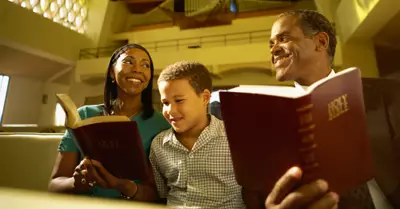

While many parents probably doubt that they have much influence on their teenagers -especially as compared to that of friends or the media -- the opposite is actually true, Smith and Denton said.
"Most teenagers and their parents may not realize it, but a lot of research in the sociology of religion suggests that the most important social influence in shaping young people's religious lives is the religious life modeled and taught by their parents," the researchers said.
Even in the research for Soul Searching, Smith and Denton found "that the importance of faith for teenagers fairly closely tracks the importance of faith for their parents. Parents for whom religious faith is quite important are thus likely to be raising teenagers for whom faith is quite important, while parents whose faith is not important are likely to be raising teenagers for whom faith is also not important."
Understanding this truth might be empowering to parents, or even alarming, they said. But it should not be ignored. The state of teenage religious beliefs in this country should be "understood as largely reflecting the world of adult religion, especially parental religion, and are in strong continuity with it. Few teenagers today are rejecting or reacting against the adult religion into which they are being socialized."
So if the religion of churchgoing teens is increasingly non-Christian, and if their religious beliefs are to a large extent shaped by parents and other Christian adults, what does this say about the religious beliefs of the adults themselves?
In his book, Real Teens: A Contemporary Snapshot of Youth Culture, pollster and researcher George Barna reaches the obvious conclusion: "Without a doubt, teen America's confusion regarding truth is a reflection of the distorted and contradictory teaching ..." they get from the adults in their lives.
Moreover, beyond simply what adults say about religion is the manner in which adults live their lives in front of teenagers. "We may conclude that teenagers don't think about moral truth often or deeply because they are neither challenged to do so nor is such behavior modeled for them," Barna said. "Their attitudes suggest that they have a sneaking suspicion that this is a vital issue, but without the people they can trust and imitate devoting themselves to the matter, they have no trouble ignoring the issue."