
Declare Your Faith - Sign the "I Am a Christian" Pledge
E-MAIL NEWSLETTERS


There was an error processing this request. We cannot subscribe you to newsletters at this time. Please contact technical support with details.
Featured Sponsors
HOME

AVERAGE USER RATING

RATE THIS ARTICLE

  • Email
  • Print
  • Discuss
Search The Bible   
Advanced Search
Church: What Will it Look Like?

Church: What Will it Look Like?...Continued from page 1

Ed Vitagliano

AgapePress

The only two areas out of the seven that did not see an increase were prayer and evangelism. In the survey, 84% said they had prayed during the preceding week -- a high percentage that has not changed since 1993, when Barna said it first began tracking the practice of prayer.

As for personal evangelism, 60% of born again Christians said they had shared their faith with someone they knew was not a Christian. As with prayer, this was a percentage that had not changed during the last decade, Barna said.

"It is typical for us to see one or maybe two measures surge forward in a given year, only to stabilize or perhaps retreat to prior levels in subsequent years," Barna said. "The intriguing possibility is that with most of our key behavioral measures showing increases at the same time, there is the possibility that this may herald a holistic, lasting commitment to engagement with God and the Christian faith."

Barna added that if these increases in religious activity stabilize or even grow in minimal fashion, "then we can confidently suggest that the U.S. is genuinely experiencing meaningful change in people's religious habits."

A religious shift occurring
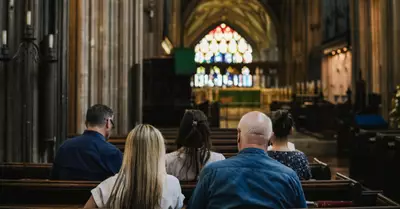
Despite these hopeful signs, however, research reveals the rumblings of a possible radical shift in the way many Americans think about religion and the Christian life. More and more adults -- even Christians -- believe that church involvement is unnecessary for an individual's spiritual development.

"Only 17% of adults said that 'a person's faith is meant to be developed mainly by involvement in a local church,'" said a Barna report. "Even the most devoted church-going groups -- such as evangelicals and born again Christians -- generally dismiss that notion: only one-third of all evangelicals and one out of five non-evangelical born again adults endorsed the concept."

In a 2005 Newsweek cover story, writer Jerry Adler found "a flowering of spirituality" in America that seemed to be occurring outside church walls. "Whatever is going on here, it's not an explosion of people going to church," Adler said.

"Spirituality," or "the impulse to seek communion with the Divine," he observed, "is thriving." Adler cited a Newsweek/Beliefnet Poll which found that "more Americans, especially younger than 60, described themselves as 'spiritual' (79%) than 'religious' (64%)."

In the wake of America's rich heritage of political, economic and, over the last 40 years, sexual freedom, a spirit of religious individualism seems to be flourishing.

Harvey Cox, professor at Harvard Divinity School, wrote in Foreign Policy: "More and more people view the world's religious traditions as a buffet from which they can pick and choose."

The trend has tremendous ramifications for religious hierarchy, which Cox said is "crumbling fast." He said, "The notions of consumer choice and local control have stormed the religious realm, and decentralization of faith is now the order of the day. Religious leaders who once could command, instruct, and expel now must cajole, persuade, and compete."

Previous | 1 | 2 | 3 | 4 | Next | All
Most Recent User Comments
Be the first to comment on this article!
Sign up to post your comments

It's quick and easy to register with Crosswalk.com! Just fill out the short form below. You'll have the opportunity to post comments, and be more involved in our community and forums. Plus, with this one account, you can sign in anywhere in our network of sites displaying the Salem All-Pass logo, including Oneplace.com, Christianity.com, Lightsource.com, Crosscards.com, and more!