Declare Your Faith - Sign the "I Am a Christian" Pledge
E-MAIL NEWSLETTERS


There was an error processing this request. We cannot subscribe you to newsletters at this time. Please contact technical support with details.
Featured Sponsors
Sponsorship

About Albert Mohler

Dr. R. Albert Mohler, Jr., serves as president of The Southern Baptist Theological Seminary—the flagship school of the Southern Baptist Convention and one of the largest seminaries in the world. He is a theologian and ordained minister, as well as an author, speaker and host of The Albert Mohler Program.

Search The Bible   
Advanced Search
<< >>

Albert Mohler

Author, Speaker, President of the Southern Baptist Theological Seminary

Tuesday, October 06, 2009

The Cross of Christ is Not a Secular Symbol

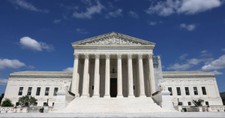
A looming constitutional crisis now hangs over the Mojave National Preserve in California, and the stage is set for a constitutional battle at the U.S. Supreme Court. The story is a bit convoluted, but the issue at stake is a cross erected by the Veterans of Foreign Wars at Sunrise Rock in the Mojave Desert.  The VFW erected the cross in 1934 as a memorial to the dead of World War I.  Sixty years later, that piece of property became part of the Mojave National Preserve, which is under the supervision of the National Park Service.  That sets up a legal battle that arrives at the U.S. Supreme Court on Wednesday.

The cross, just six and a half feet tall, is now covered with plywood.  The Ninth Circuit of the U.S. Court of Appeals ruled that the display of the cross is an unconstitutional establishment of religion. An appeal of that decision now goes before the nation's highest court -- and the eventual ruling could have sweeping effects.

The Supreme Court's rulings in similar cases have bred nothing but confusion. In recent years, for example, the Court has held that a display of the 10 Commandments in Texas meets constitutional muster while a display of the same 10 Commandments in Kentucky is unconstitutional. The very fact that the Court accepted this case may indicate that it intends to clarify the confusion it has itself spawned.

The Mojave cross became the focus of legal action in March 2001, when Frank Buono, a former assistant superintendent of the preserve, filed suit to demand that the cross be removed from government land. Buono, a Roman Catholic, claims that he is not offended by the cross as a religious symbol but by the fact that it stands as part of a national preserve. He claims to be offended because the National Park Service will not remove the cross and that other religious groups are not allowed similar displays.

In an attempt to resolve the issue, the National Park Service transferred the property on which the cross stands to private ownership. Nevertheless, lower courts have found that this does not represent a satisfactory solution in light of constitutional questions.

The case before the Supreme Court, Salazar v. Buono, raises very few new issues. For this reason, many observers expect that the Court's majority must intend to send a message as they rule on this case. If so, the Court could finally declare its unwillingness for the legal system to be used as a means of constantly challenging any religious symbolism on government property or under government supervision. If it does not rule in this direction, the stage could be set for an avalanche of legal claims against everything from the language on our coinage to the text of the Pledge of Allegiance.

In a brief submitted to the Court, lawyers for the American Center for Law & Justice made the following observation:

This case is only the most extreme example of a phenomenon that has plagued the federal courts for the past three decades. Ideologically motivated citizens and public interest groups search out alleged Establishment Clause violations, almost always in the form of a passive religious symbol or display of some sort, and make a federal case out of offense at the display. The basis for standing is typically that the religious display offends the sensibilities of the plaintiffs. The offense may be characterized as an affront to religious values, or as one in which plaintiffs feel stigmatized as political or community outsiders. But the sum and substance of the injury is that the display bothers the plaintiffs
.

This raises one of the central constitutional questions faced by the Court: Is being offended or bothered by a display sufficient cause to be granted standing for a federal lawsuit? As numerous observers have recognized, the only claims accepted by the courts in this regard are those related to religious expression or symbolism. "Offended observer" status is a legal disaster. There is no end to the reasons why any citizen may be offended at any time by any display, language, or symbolism. If the Court does not put an end to this argument, the floodgates will be opened for a virtual flood of similar claims.

After all, the Mojave display is hardly unique in this respect. Far more visible is the Argonne Cross in Arlington National Cemetery, for example, or the Memorial Peace Cross in Bladensburg, Maryland.

Arguing for the retention of the display, lawyers for the government are expected to argue that the Mojave cross is constitutional because it represents a secular symbol intended to honor those who died in the nation's service in World War I.

At this point, Christians should pay particular attention. While the government's lawyers try to press their case, Christians should reject any argument that presents the cross as a secular symbol. There is nothing remotely secular about the cross of our Lord Jesus Christ. Arguments for the constitutionality of religious language and symbolism based in the supposedly secular character of the speech or imagery may win in the courtroom, but the arguments are devastating to authentic belief.

Of all people, followers of the Lord Jesus Christ must be the first to insist that the cross is a symbol of Christian faith, pointing directly to the cross on which Christ died as our substitute. The cross must not be reduced to a generic symbol of death and the memory of loved ones.

Salazar v. Buono
is a case worth watching. The eventual outcome of the case may set a direction for Establishment Clause challenges in decades ahead. Yet, the arguments presented in this case may be just as important as the eventual decision handed down by the Court. Even as the government's lawyers present the arguments they believe will best serve their cause, Christians must serve the cause of Christ.

In this case, this means that we must defend the integrity of the cross as the preeminent symbol of Christian belief. As the Apostle Paul would remind us, we must frame our arguments carefully and never compromise the meaning of the cross.  The cross is about Christ's atonement for sin. We must never be even the slightest bit unclear about the meaning of the cross, lest it be robbed of its power.


I am always glad to hear from readers. Write me at http://mail@albertmohler.com. Follow regular updates on Twitter at www.twitter.com/AlbertMohler.


  • Email
  • Print
  • Discuss
Most Recent User Comments
jwweath
10/7/2009 5:21 PM
We should not be watching this and then worrying about the results. We, as Christians should be active, we should be actively exercising our God given right to pray for the court to have the wisdom to make the correct decision and for our Judges to come to know the Lord so these types of decisions won't be an issue in the future. After I exercise the first right I am going to exercise my constitutionally given right to communicate with those same Judges and let them know how I feal about the subject. I know the first communication will be heard. The second may be ignored but I KNOW the first will be listened to.
PJRodgers
10/7/2009 1:40 PM
extend the same love, compassion, and patience that has been afforded us from our Heavenly Father, while we were yet sinners. That, with prayer....that is our fight.
We should focus less in the secular boxing ring and more on the Highest Court of love and intercessory prayer.
PJRodgers
10/7/2009 1:08 PM
Why are Christian's rights being challenged? Why do Christians claim they even have rights? We are sojourners in a foreign land. We are called to witness to the lost and unchurched, not go to battle against them. If we fight to keep the cross, the ten commandments, in God we trust, etc., and win, then this will not make us exclusive. By law, it will open the door for other symbols and gods to be placed among them. The 2nd commandment is clear about making things that resemble anything in heaven or on Earth. The fight is not flesh and blood, but in the heavenly realms. Christians are engaging in a battle of things, rather than focusing on changing the hearts of the lost by the love of God. Honestly, what will Christians gain by keeping the cross or the ten commandments? Isn't it the hearts of the unsaved that need change, not the laws that enable us to keep our religious icons? All of these things we are to treasure in our heart, not on the playing field.
Who did Jesus rebuke? The religious leaders misleading the lost. Who did Jesus adjure and work patiently with? The lost.
Why is the church butting heads with unbelievers and special interest groups? We have been told that we live among the tares, i.e., evil. Why then, do we behave like them? Our witness is our strength...not our retribution against the beliefs of the various groups trying to force their ways upon us.
Were you ever enticed or lured by someone hammering their rights and morals on you? No, not at all. We all cringe at forced belief. Why then, do we think forced 'Jesus' would be any different than what special interest groups are doing?
Our testimony to the world is our emptiness...i/e, the strength and love of God. Not our abilities in stacking up against wickedness because we now have enough money and clout to face them all in a court of law. Prayer and a loving intercession towards the lost....that is what we are called to.
With fellow Christians, we rebuke. With our lost neighbors, we ext