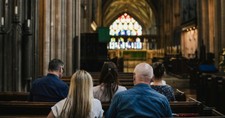

Where shall we turn for instruction on how we ought to worship? There is only one place we can turn, and that is to the Word of God. The norm of our worship must be the Word of God--this Word that He has spoken. As we turn to this Word, we do see a pattern of worship, a pattern that is replicated throughout the fabric of Scripture from beginning to the end.
Scripture is, as the Reformers confessed, norma normans non normata, "The norm of norms which cannot be normed." Sola Scriptura. This is the norm of our worship. There is nothing external to Scripture that can norm or correct it. Scripture sets the terms, and in Isaiah 6:1-8 we see a picture of authentic worship.
In this well-known "call" passage of Isaiah, the prophet experienced a theophany: a vision of the true and living God. Out of this encounter, Isaiah received his call as a prophet.
Isaiah recounts that it was in the year of King Uzziah's death that he saw the Lord sitting on a throne lofty and exalted, with the train of His robe filling the temple.
What does it mean that God sat on a throne? Well, clearly it is a symbol of kingship and sovereignty. The throne indicates that the one who sits upon it is both king and judge. It represents both power and righteousness.
But there is more to this high and exalted Lord who revealed himself to Isaiah. The one whose train filled the temple with His glory is not alone. Isaiah is not alone. There are beings here with him. Verse two tells us that "seraphim stood above him, each having six wings: with two he covered his face, and with two he covered his feet, and with two he flew."
These seraphim (literally, "burning ones") had six wings, and these six wings convey a great deal of symbolism. "With two he covered his face." That must certainly indicate humility. They dared not look at the holiness of God. "And with two he covered his feet." Surely this represents purity. "And with two he flew." But these winged creatures are not merely flying. "And one called out to another and said, Holy, Holy, Holy, is the Lord of hosts. The whole earth is full of His glory."
We know the words, "Holy, Holy, Holy" as the "trisagion." In the Hebrew language there is no adequate comparative or superlative form, so the pattern of repetition is used in order to make a point. We see this thrice-repeated pattern again in Revelation 4:8-11: "And the four living creatures, each one of them having six wings, are full of eyes around and within; and day and night they do not cease to say, Holy, Holy, Holy is the Lord God, the almighty, who was and who is and who is to come."
The early church saw in this pattern a Trinitarian understanding. As we look back with New Testament eyes, we can certainly see that affirmation, but the central point of this construction seems to be the same as in Genesis 14:10. There we find reference to the construction "pit, pit," which may be translated "deep and great pit." It is one thing to fall into a pit. It is another thing to fall into a "pit, pit." But here we see God's essence, identity, and being characterized by the attribute of holiness.
What does the holiness of God mean? It means certainly His separateness from his creation. He is what we are not. We are finite; He is infinite. God is transcendent. God's separateness certainly reveals the difference, the infinite contrast between His moral nature and ours. Holiness also certainly refers to His majesty and power.
J. Alec Motyer defines holiness as "God's total and unique moral majesty." It is a wonderful expression--God's total and unique moral majesty. E. J. Young suggests that holiness is the entirety of the divine perfection that separates God from His creation. That which is almost beyond our definition is what makes God, God. Holiness includes all God's attributes. His holiness is that which defines him.
I wonder if the vision of the God held by so many who come to worship is anything like what the seraphim are telling us here. Do we worship with the understanding that God is holy and that "the whole earth is full of His glory?" I fear not. I wonder if in our worship we encounter anything like this vision of God. Do those who come to our services of worship come face to face with the reality of God? Or do they go away with a vision of some lesser God, some dehydrated deity? Worship is the people of God gathering together to confess his worthiness, his "worth-ship." How can we do that if we do not make clear who God is? Our very pattern of worship must testify to the character of God.