
Follow us on Facebook

Recommend this article to your friends.

Comments

September 17, 2008 

In the wake of back-to-back weather calamities, Christian relief organization workers may be tired, but they’re not whining about it. Rather they are enthusiastic about the unprecedented opening the Church has to clean up — literally.

Mary Marr of Christian Emergency Network (CEN) says recent hurricanes present a window of opportunity for Christians to shine through grassroots self-organizing responses through local churches.

 “We’ve seen an overwhelming response (to this concept) both from churches and victims. The litany of ‘the government will save us’ has been proved false. Moreover, it has robbed Christians of our ability to be the church and stand in the gap during a disaster. Local churches and people not working together becomes a disaster within a disaster.

“In a disaster, victims and volunteers alike ask ‘Who do we trust?’ The answer needs to be ‘The local church.’”

Rick Draeger of Salvation Army’s (SA) Heartland Division understands the need for cooperation and coordination between national Christian agencies, local, national, and regional authorities (police, fire, FEMA, Homeland Security, etc.), and the local church. Under the SA command structure, advance agreements have been forged with Christian agencies and local churches to contribute much-needed response elements.

Said Draeger: “Our staff and volunteers provide not only food, water, and clothing, but a spiritual component. This adds more to our plates.”

For this reason, Draeger requests prayer for volunteers and staff as well as disaster victims.

“Because we have partnerships with churches and local SA chapters who remain attached to affected areas after the emergency is passed, we are engaged with the full spectrum of care.”

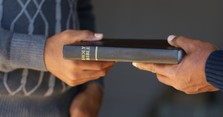
Sues Hyde, IBS-STL (International Bible Society-Send The Light) Outreach Director, said hurricane weary coastal residents are turning to God’s Word in record numbers and in short order. She underlined the need for churches and pastors to step in to provide long term spiritual, emotional, and community support.

“Typically,” said Hyde, “it has taken a while — maybe a month — for people to turn to the Bible for help. But after Gustav, chaplains said in two days people were asking for resources.”

IBS-STL Global, one of the largest Christian literature ministries worldwide, has developed “scripture tools” for disaster victims, depending upon the loss (property, loved ones, etc.) and age.

“We have a range of scripture tools ranging from 30-day daily readings for individuals to studies entire churches can go through as they rebuild their lives. We have scripture tools for children, too.

“Our distribution of scripture tools isn’t limited to the United States, but also in areas around the world where Christianity isn’t the primary faith. As we train new pastors in war-torn areas, we provide disaster recovery counselor training as well.”

IBS-STL Global has formed a partnership with PRC Compassion to distribute 21,400 scripture pieces to church-based shelters.

Marr believes local churches need to train for disaster mobilization prior to calamities because it is only a matter of time until every community will have a disaster of some sort.

“Is your local church preparing for the next disaster? If not, they may miss an opportunity to be the church,” said Marr.