
From the comfort of my home, caught up in the busyness of living, it's easy to put the tragedy of others out of my mind. I can't fathom the devastation and don't want to feel the pain of losing one of my own children. But John Tesh and his family chose to personally face the aftermath of the Tsunami and to use their influence to encourage others to do the same.
After interviewing Bill Horan, president of Operation Blessing, on his radio program, Tesh asked if there was anything he could do to help. Horan invited him to join Operation Blessing on site to distribute food, medicine and clothing.
At the time Tesh wasn't sure why, but it was important to him to bring the rest of his family, including wife Connie Selleca, son Gib, 23, and 10-year old daughter Prima.
"It just felt right for all of us," he explained to Crosswalk.com in a phone interview earlier this week.
Tesh and his family's journey began with a flight to London, then a five-hour layover before flying another 10 hours to Colombo, Sri Lanka. During the layover in London, Selleca writes the following concerns in her journal, "I wonder if I am prepared to handle her (Prima's) reaction to the devastation she is about to witness. I wonder if the math homework I am working on with her will be anywhere as important as the life lesson she is about to learn."
From Colombo, the family met up with a caravan of vehicles traveling to Ampara, one of the areas most affected by the Tsunami. In Ampara, they joined Operation Blessing team members who were distributing food, providing shelter and administering antibiotics to survivors.
Upon arrival, Tesh soon discovers that as a family, he, Connie, Gib and Prima have a far greater impact together than he could have ever had alone. On their first day, in a refugee camp near the Indian Ocean, three hundred children immediately run to greet them.
"...suddenly, my son Gib was doing magic tricks, my 10-year-old daughter was teaching the girls new dances, and my wife Connie found herself consoling mothers who had lost entire families."
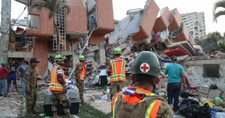
Everywhere they went, they witnessed the decimation of lives ... rubble on the beaches, debris in the roadway and pieces of homes strewn across the landscape. "It is impossible to imagine the wall of water rising up and taking everything away," Selleca says.
She describes watching two women walking down the beach together. It had taken the former neighbors 15 days to find the courage to come back and see what might be left of what were once their homes. "...veils of sadness thickly laying on their faces... One 'lucky'; lucky to have found the body of her 4-year-old daughter...the other...not so lucky...still searching without hope to find her 1-1/2-year-old baby." Selleca watched as the latter found and then desperately clung to a piece of clothing belonging to her child.