
August 22, 2008
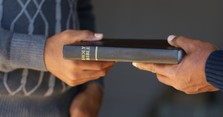
China’s communication about the Christians in its midst has left believers in other countries scratching their heads. Official statements and promises of Bibles during the Olympics contradict reports of crackdowns on house churches. Can both scenarios be true? Is the house church the only place where the Gospel is spreading?
Dr. Mark Bailey, president of Dallas Theological Seminary, shared his thoughts with Crosswalk after he returned from a visit to Kuanjie Protestant Church in Beijing with President Bush.
Dallas Seminary recently began translating its online courses into Mandarin, becoming the only U.S. seminary that enables students in China to attend lectures virtually in their own language. These courses have put Dr. Bailey in touch with Chinese students abroad and in Beijing, and exposed him to aspect of Chinese culture that most Americans hear little about: China’s institutional church. The following is an excerpt from Crosswalk’s interview.
CW: Tell us about the church service at Kuanjie Protestant Church with the president in Beijing. What did you see there?
Bailey: This is my second time to Beijing, and I saw a service very similar to what I’d seen before. Obviously, things are different with security having swept the place and prepared for having the president there for two weeks, just like it would be in this country. But it was a very typical worship service as I had experienced in China before.
[There was] great singing, songs like “Onward Christian Soldier,” “I’ll Go Where You Want Me to Go, Dear Lord,” great evangelical prayers by Pastor Li (SP) at the Kuanjie church where we attended… The children’s choir that was the result of the work that a couple of churches in the States had done in doing an English in character form of VBS over there last summer, and they sang “Amazing Grace.” The Gospel was plainly presented in prayer, in song as well as in the preaching.
CW: That’s not exactly what Americans expect from a state-sponsored church. Do you find the church in any way tainted by its association with the state?
Bailey: China is a very complicated culture… in my experience, in all the times that I have either preached or spoken there in two different trips, nobody has ever asked me to control or censor my message or asked for a previous script of what I would say. I had absolute freedom to present the gospel straightforwardly, plainly, in churches. There are pockets of freedom that are developing. That’s what we’ve been praying for and what we’ve been dialoguing with the government and church leaders to accomplish there.
[In the past], we’ve used their translators, and we’ve used our own translators… and never has there been censorship or couching of the message that we have preached. That’s been our experience and we know that’s a measure of freedom that we hope would continue to spread.
In one sense, it’s interesting that in our country you have to get approval to be a church and to have a 501c organization through the IRS here. You can only build where they’ll let you in a zoning [area], you have to build according to code, and you have to have parking restrictions. We have more government involvement here than most people might recognize or might be conscious of, but that hasn’t limited us so far. The United States hasn’t limited our expression of worship. That’s what we would pray for over there, whether that’s for the registered or unregistered church.
CW: So you feel like in the registered church there isn’t any restriction on expressing your religion?
Bailey: Well, I think that there probably are in some different situations. [The government’s] biggest concern obviously is the cults, and making sure that money isn’t taken out of the culture and controlling rebellions and rebellious movements. There’s fear on both sides that goes back hundreds of years. There was the communist regime where Christianity obviously was outlawed, discouraged and prohibited, but that’s changing.