Should Christians Listen to Secular Music?



I was a teenager in the 1980s, and like most teens, I loved listening to music. My favorite bands were Journey, Def Leppard, The Police, Michael Jackson, and many others. I had no issues with the lyrics I heard or the music's style. I just loved it all. But then I wasn’t a believer at the time either, and my musical tastes and preferences had no spiritual compass.
When I committed my life to Christ in 1987, though, I was faced with a conundrum. Could I still listen to my secular 80s music and the artists I loved, or did God require that I “put them aside” as a new creature in Christ and listen only to Christian music and Christian artists? This was an honest-to-goodness dilemma for me, as it has been (and continues to be) for many Christians, past and present. But over the past 30 years, since becoming a believer, I’ve come to realize that there isn’t a carte blanche, a black-and-white answer to this question, although some might say differently. Some take a hard-core stance that believers should not listen to any secular music, that it is ungodly, even satanic.
Key Points
- Christians have freedom to enjoy music, but that freedom should be guided by wisdom, discernment, and a desire to honor God.
- Music is a gift from God and can serve many purposes, including worship, comfort, warning, encouragement, and creative expression.
- Scripture does not elevate one musical style or instrument over another as more biblical, so personal preference and conscience matter.
- The lyrics of a song are the most important consideration because words can shape thoughts, desires, attitudes, and actions.
- Philippians 4:8 and Colossians 3:2 can help believers discern whether a song points their minds toward what is true, pure, lovely, and honoring to God.
Rejecting all secular music as inherently sinful can create an extra-biblical rule that encourages legalism, judgment, and self-righteousness. On the other hand, we don’t want to be so liberal in the listening preferences that we desensitize our consciences and completely disregard God’s glory in this area. To that end, the following points may help you find the answer (and balance) when it comes to determining whether you, as a believer, should listen to secular music.
1. What Is the Purpose of Music?
Scripture presents music as a gift for worship, encouragement, celebration, communication, and other purposes. Just as God created all things—the heavens and the earth, the sky and the sea, the vegetation and the animals, and all human beings—He is also the author of the arts, which includes music. God graciously gave men and women musical abilities, whether with instruments, their voices, or with composing music. Think of Miriam, Moses’ sister, and David. Both played instruments: the tambourine and the harp, respectively. David was also a composer. Many of the Psalms he wrote were set to music and sung in worship to God. God also formed the first choirs and gave them songbooks, called psalters (1 Kings 10:12, 1 Chronicles 9:33, 15:19).
But from these two Biblical examples, does that necessarily mean music is solely for worship? No. There were numerous instances in Scripture when music was used for reasons other than worship. David played his harp at times to soothe the troubled spirit of King Saul (1 Samuel 16:14-23). The Israelites used musical instruments to warn of danger and to surprise their enemies (Nehemiah 4:20, Judges 7:16-22). Paul instructed Christians to “speak to one another with psalms, hymns, and spiritual songs” (Ephesians 5:19).
It would seem, then, that God gave us music and instruments for uses other than in worship. But are those uses limited to Christian contexts for believers only? Can we use them and listen to them outside the Christian realm? After all, many secular artists have been blessed with immense talent, which is the result of God’s common grace to all of mankind. Do Christians have the freedom to listen to them? Yes and no.
2. Does the Bible Condemn Any Style of Music?
The Bible does not identify one musical genre or instrument as inherently holy or sinful. Scripture does not approve (or disapprove) of any one particular style of music over another. That also goes for instruments, which, again, some would argue differently. But a quick study of Scripture reveals that various kinds of stringed and wind instruments were used in worship, even percussion instruments (Psalm 68:25, Ezra 3:10)
[NOTE: Instruments in and of themselves are neutral; no sin-value is attached to them. Rather, it is the heart of the person playing the instrument that determines sinfulness, not the instrument.]
Style and instrumentality, then, are completely subjective, based on culture, geography, and generation. While some believers prefer traditional hymns accompanied by an organ or piano, others—usually the younger generation—want more upbeat, contemporary music. Some even prefer hard rock. Neither traditional nor contemporary is the only “biblical” or “most godly” style. Nor are either considered satanic, ungodly, or unwholesome. God, in his sovereignty and graciousness, allows for all styles of music, giving his children the freedom to choose, based on personal preference and musical taste.
3. How Should Christians Evaluate Secular Song Lyrics?
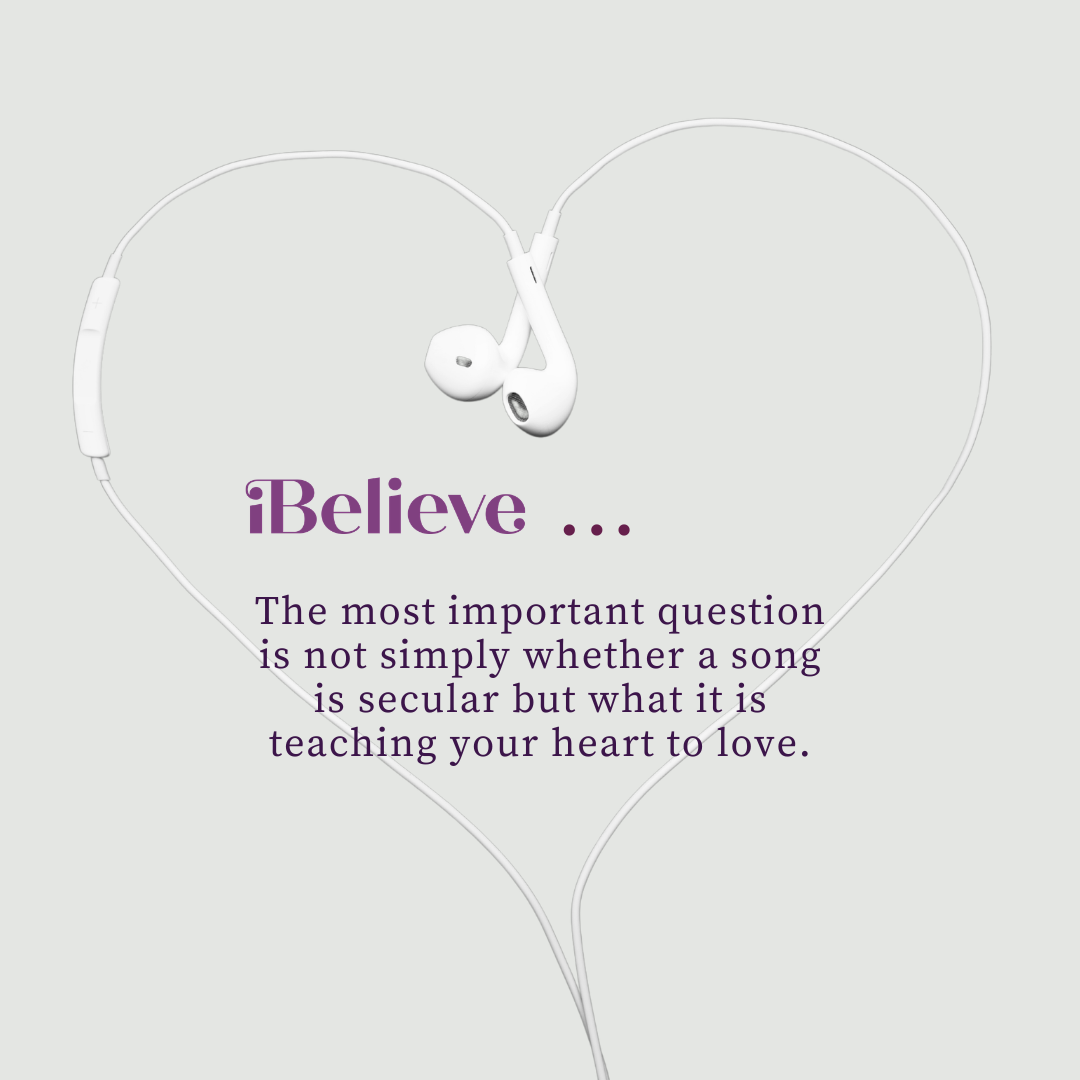
A song’s lyrics are one of the most important factors Christians should evaluate because repeated messages can shape what we think about and celebrate. Here is where we run into the more challenging of the three considerations. While neither the purpose of music nor the style of music determines whether a Christian should listen to secular music, the content of the lyrics should. “Music is powerful,” writes Russell Moore. “It can embed concepts in the heart in ways that prose simply can’t.” This “embedment” often happens subconsciously, which is why believers must be discerning and guarded when it comes to the lyrics of secular songs.
What we feed our minds—whether it is lyrics, literature, or visual art—can influence our thoughts, speech, and actions. To that end, a good Biblical litmus test for secular lyrics is Philippians 4:8, “Finally, brothers, whatever is true, whatever is noble, whatever is right, whatever is pure, whatever is lovely, whatever is admirable—if anything is excellent or praiseworthy—think about such things.” Another Scripture is Colossians 3:2: “Set your minds on things above, not on earthly things.”
When it comes to a secular song’s lyrics, we should screen them against these Scriptures. We also need to discern whether the lyrics are in opposition to God’s principles of ethical and moral righteousness (love, peace, justice, faithfulness, and purity). If they hold up to Philippians 4:8 and Colossians 3:2, we’re free to listen and enjoy. If not—if the lyrics are sexually explicit, humanly degrading, and/or debasing—we must exercise self-control and deny ourselves that listening opportunity, no matter how much we like the song’s tempo or the artist. In short, if the song glorifies sin, don’t listen to it.
4. How Does This Music Affect My Conscience and Faith?
Christians should consider not only what a song says but also how listening affects their conscience, desires, attitudes, relationships, and walk with God. Before listening, consider:
- Does this song celebrate something Scripture identifies as sinful?
- How does it affect my thoughts, desires, words, or emotional state?
- Can I listen with a clear conscience before God?
- Is this music becoming controlling or spiritually distracting?
- Could my choice place an unnecessary stumbling block before someone else?
How Can Christians Make Wise Music Choices?
Wise music choices are guided by Scripture, prayer, conscience, self-control, and a desire to glorify God. We should be people of the Word, not rules. This applies to all areas of our lives, including music. As created beings who crave and seek creative expression and experiences in all forms—prose and poetry, music, theater, and movies, the media and museums—we have been given much freedom. Yet, we are not to use that freedom as a license to sin or to cause another to sin. In short, we are called to exercise wisdom and self-control in the area of the arts.
Frequently Asked Questions About Christians and Secular Music
- Does the Bible say Christians cannot listen to secular music?
No Bible passage prohibits every form of secular music. Scripture instead gives Christians principles for evaluating content, conscience, influence, self-control, and whether a choice honors God. - Is listening to secular music a sin?
Listening to secular music is not automatically sinful, but a particular song or listening habit may be spiritually harmful. Christians should consider what the music celebrates and how it affects their thoughts, desires, conscience, and behavior. - How can Christians decide whether a song is appropriate?
Christians can evaluate the lyrics, message, emotional influence, associations, and spiritual fruit. Philippians 4:8, Romans 14, and 1 Corinthians 10 offer helpful principles for making a conscientious decision. - Should Christians listen only to worship music?
Scripture does not command Christians to listen exclusively to worship music. Believers have freedom to enjoy artistic expression, but that freedom should be exercised with wisdom, self-control, and concern for God’s glory.
For Further Reading
- Be Careful Little Eyes What You See
- Where Exactly Is the Line for Christians in Today's Entertainment?
- What Is Discernment? 6 Ways to Grow More Discerning
- How to Genuinely Worship in Church When the Songs Aren't Your Style
- What Hallelujah Means in Worship
Photo Credit: ©Getty Images/Tatyana Maximova

Originally published March 13, 2023.