Does Handwriting Still Matter?


Listen or Read Below:

Audio By Carbonatix
A high school student who took the preliminary SAT for college admittance confessed to the Wall Street Journal that “audible gasps broke out in the room” when students learned they would have to write a one-sentence statement certifying that all the work is the student’s own in cursive, or joined-up handwriting. “Cursive? Most students my age have only encountered this foreign language in letters from Grandma.”
Or as an article in The Guardian noted:
Schoolchildren are not the only ones who can no longer write or read cursive. Fewer and fewer of us put pen to paper to record our thoughts, correspond with friends, or even to jot down a grocery list. Instead of begging a celebrity for an autograph, we request a selfie. Many people no longer have the skill to do more than scrawl their name in an illegible script, and those who do will see that skill atrophy as they rely more on computers and smartphones. A newspaper in Toronto recorded the lament of a pastry instructor who realised that many of his culinary students couldn’t properly pipe an inscription in icing on a cake—their cursive writing was too shaky and indistinct to begin with.
So why be concerned? Chalk it up (if you can still do that with your hands and a piece of chalk) to one more aspect of human toil replaced with enabling technology.
Or is it?
As The Guardian continued:
But we lose something when handwriting disappears. We lose measurable cognitive skills, and we also lose the pleasure of using our hands and a writing implement in a process that, for thousands of years, has allowed humans to make our thoughts visible to one another. We lose the sensory experience of ink and paper and the visual pleasure of the handwritten word. We lose the ability to read the words of the dead.
But that’s not all.
Research has found that good handwriting isn’t merely an aid to communication. There is something about writing by hand, unlike tracing a letter or typing it, that primes the brain for its ability to learn how to read.
Psychologists Pam Mueller and Daniel Oppenheimer compared students taking notes by hand to students who took notes on a laptop computer or phone to test whether the medium mattered for overall student performance.
It did.
They found that there was “shallower processing.” In three different and distinct experiments, they found that students who used laptop computers performed worse on “conceptual questions” when compared to students who took notes by hand. In essence, when we type, we transcribe; when we write by hand, a slower enterprise, we tend to summarize.
Or as an article in the National Library of Medicine put it, handwriting “activates a broader network of brain regions involved in motor, sensory, and cognitive processing. Typing engages fewer neural circuits, resulting in more passive cognitive engagement.” So, despite the advantages of typing in terms of speed and convenience, “handwriting remains an important tool for learning and memory retention, particularly in educational contexts.”
As Christine Rosen, the author of the Guardian piece, concludes, the “researchers studying how technology transforms the way we write and learn are akin to ecologists who warn of species decline or environmental pollution.” Which means that facing a future without handwriting could lead “to any number of unforeseen negative consequences.”
There is, of course, another dynamic to the loss of handwriting, and it is the loss of personhood and personality. In the world of AI, it may be among the last things that marks something as truly human in origin. Someone’s handwriting is uniquely personal.
I think of how the apostle Paul signed off on his letter to the Galatians, “See what large letters I use as I write to you with my own hand!” (Gal. 6:11, NIV). It is widely felt that Paul had developed poor eyesight (cf. Gal. 4:13-15), and that he had dictated Galatians to a scribe. But then, at the end, Paul took up the pen in his own hand and finished writing the letter.
Without a doubt, it made the letter to the Galatians feel even more personal. All of the words to that point were his. But the “large letters” at the end made it clear that it wasn’t just the words and ideas of Paul, but rather from Paul himself.
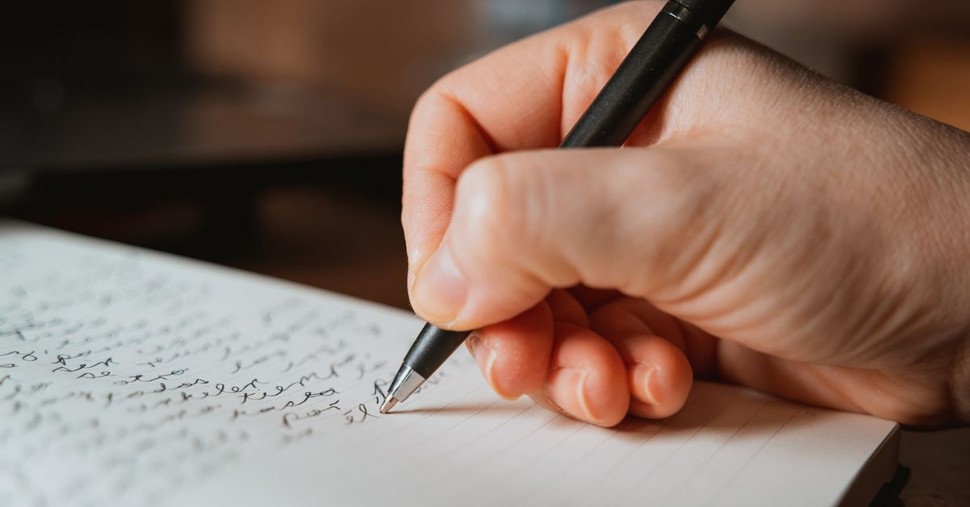
So take up a pen and put it to paper and keep writing. Even in a day of typing and texting, dictating and tapping,
... it still matters.
James Emery White
Sources
Christine Rosen, “Signature Moves: Are We Losing the Ability to Write by Hand?” The Guardian, January 21, 2025, read online.
“The Neuroscience Behind Writing: Handwriting vs. Typing—Who Wins the Battle?” National Library of Medicine, February 22, 2025, read online.
Related Article
3 Ways Journaling Can Grow Your Faith
Photo Credit: ©Getty Images/Jacques Julien
The views expressed in this commentary do not necessarily reflect those of CrosswalkHeadlines.
James Emery White is the founding and senior pastor of Mecklenburg Community Church in Charlotte, NC, and a former professor of theology and culture at Gordon-Conwell Theological Seminary, where he also served as their fourth president. His latest book, Hybrid Church: Rethinking the Church for a Post-Christian Digital Age, is now available on Amazon or from your favorite bookseller. To enjoy a free subscription to the Church & Culture blog, visit churchandculture.org where you can view past blogs in our archive, read the latest church and culture news from around the world, and listen to the Church & Culture Podcast. Follow Dr. White on X, Facebook and Instagram at @JamesEmeryWhite.
Originally published February 05, 2026.