Preparing the Next Generation of Christian Filmmakers for Hollywood’s Uncertain Future
Listen or Read Below:

Audio By Carbonatix
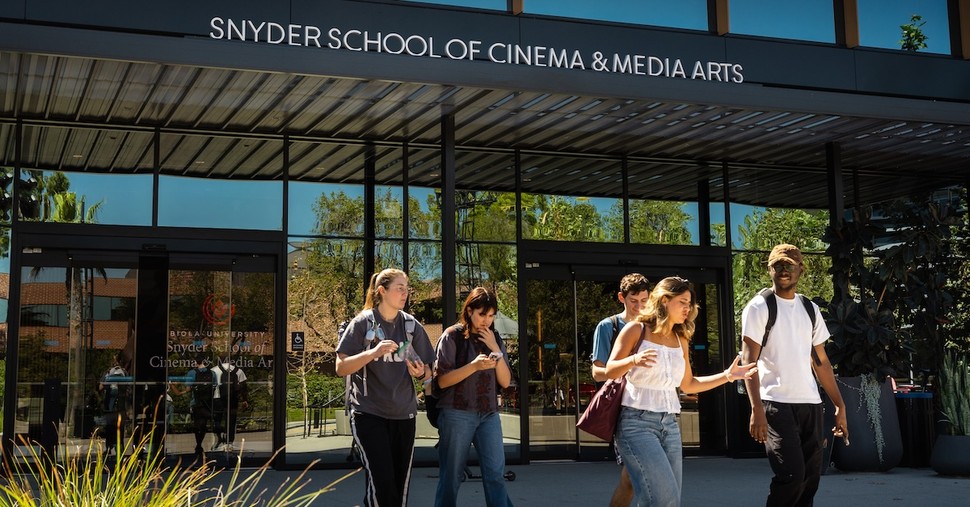
Dean Tom Halleen of Biola University’s Snyder School of Cinema and Media Arts is excited about the future of Christian filmmaking, the incoming students, and all that the school has to offer them in preparing them for the future of Christian filmmaking. The school is ranked within the top 25 Universities for Media Arts, and it’s the only Christian university on that list. The 75 million dollar training facility is the most technologically advanced of its kind in academia. He graciously agreed to an interview with Crosswalk.
Students Learn the Aspect of Filmmaking to Which God Has Called Them
When students first come into Snyder School of Cinema and Media Arts, they begin exploring.
“We keep it broad in the beginning,” said Halleen, explaining that sometimes students don’t know what their specific passion is regarding filmmaking or other aspects of media arts. They may not even realize all the possibilities available to them.
“So we get the joy of seeing students come in wide-eyed, thinking that the world is just about directing feature films. We get to uncover within them how God made them, and open them up to all the opportunities within media where they can express their creativity in a way that aligns with how they were created.”
Filmmaking is a form of storytelling, and Halleen noted that Jesus was a storyteller.
“He told stories to solicit understanding and emotion so that the viewer, or listener, can understand truth, which, at its core, we were taught by the Creator. And this is just an expression from His example. He didn’t have media, but he had stories.”
Halleen pointed out that today, “We have the ability to reach the world through all these different screens, and what should we [Christians] do with that? Tell stories!”
Church and Hollywood Must Learn to Understand One Another
Halleen hit on the importance of the church and Hollywood learning to understand one another. The church wants stories that respect the faith of believers and God’s Word, not stories that make fun of it or denigrate it. At the same time, Hollywood wants people who are trained with excellence in their craft.
Not only is Snyder School of Cinema and Media Arts able to provide training to its students that makes them excellent in their craft, “but we also train the more important [element], which is being excellent in your character,” he said, adding that “even the industry recruiters want people of great character. When asked what that is, they start describing what we [Christians] know as the fruit of the Spirit: kindness, goodness, faithfulness, gentleness, self-control.”
Halleen said the school is designed to “enhance the faith of Christian students, not deconstruct it. Your faith is your secret weapon! It’s your advantage! It’s your strength, not your weakness! So don’t let anyone tell you [that] you can’t make it in Hollywood if you are a Christian. They don’t know what they’re talking about. It doesn’t mean it’s easy; life is not easy.”
He added that there will be challenges to a person’s faith no matter what industry they may choose for their vocation, but when Christians live out their faith, “it demystifies Christianity to those around us.”
“Excellence in craft and excellence in character. This is what the industry considers to be professionalism. It’s not one without the other; it’s both,” he said.
Developing the Next Generation of Christian Filmmakers in their Craft, Character
One of the reasons that Halleen said he decided to leave the industry and focus on being the school’s founding dean was because he recognized the importance of helping the next generation of filmmakers to have excellence in craft and character.”
At the same time, he also wants to encourage them with the realization that “there are thousands of Christians in the industry living out their faith,” and some are even “in major positions throughout the industry.”
Halleen referred to being involved in Christian filmmaking and other media arts as a calling, and noted the importance of the church regarding being supportive of those who have been called into it.
“The church as the family of God needs to be supportive, and yet that has been a struggle, even now, because there are many that don’t support Christians in this business. That’s difficult because when you’re called to do something and someone says ‘you shouldn’t be there,’ but you realize, ‘Yes, I’m called to do this,’ it can be frustrating. So what I really want the church and Christians to understand is that, instead of pointing the finger, they need to extend a hand to each other and say, ‘We are in this together, and we’re going to be praying for you, we’re going to be supporting you because we know the media affects culture.’ It’s the most powerful form of communication on the planet. Don’t we want to support Christians who are called into this?”
What the School Offers Students
The school helps students to realize why they’re called, the qualities God has placed inside of them, and how to focus their passions for the industry through a Biblical point of view.
Over 1000 graduates from the program are embedded in the industry. It’s the fastest-growing undergraduate program in all of Biola University. The Cinema and Media Arts majors are the second largest undergraduate majors in the whole school, second only to business administration.
The 45,000 square foot studio facility houses all aspects of the production cycle from ideation to preproduction, production, post-production, all the way through to an Adobe Ethos certified theater.
There’s a 10,000 square foot production center, and the 4000 square foot equipment room has just over 4 million dollars worth of field equipment that students can check out for their use.
In addition, there are also three sound stages, 16 edit suites, multiple audio suites, a Foley and scoring stage, color correction labs, and more.
“The focus is to make the students the most capable in the room when they apply for work, and provide them with experience on industry-standard equipment. We have a 100 percent intern employment rate.”
When asked where some of them were placed, he said, “The Jim Henson Company, The Television Academy, Film Academy, PBS, various talent agencies, Disney, Sony, DreamWorks, and 20th Century Fox,” to name just a few.
There are 500 student projects that come out of the school each year, some of which get submitted to film festivals and have won college awards.
Back in 2025, several Biola alumni, in conjunction with a current student, were announced as the winners of the Doritos Crash the Super Bowl Ad Contest.
The school also brings in various industry pros to give guest lectures, such as colorist Kostas Theodosiou, who worked on Christopher Nolan’s Odyssey movie.
The school helps students connect with a community of like-minded believers who can affirm each other in their arts callings. Students get the opportunity to come alongside each other and help one another as they navigate life and especially the industry. While most students are fresh out of high school, the school can also cater to nontraditional students working on transitioning from one industry to a new industry into which they feel God is calling them.
Photo credit: ©BiolaUniversity

Originally published November 02, 2026.