When Did Christians Become Afraid of Our Own Names?




Key Points
- The Evangelical Press Association has approved a new name, Christian Communicators Network, while keeping its evangelical theology and membership standards.
- Words such as “evangelical” can accumulate political, cultural, historical, and social meanings that differ from their theological roots.
- Christian labels can communicate meaningful convictions, but no denominational or movement label should become more important than allegiance to Jesus Christ.
- Changing a name may solve a communication problem, but it cannot replace the harder work of living faithfully and addressing what shaped public perceptions in the first place.
- Christians ultimately bear the name of Christ, which means our lives should help others see more clearly what following Jesus actually looks like.
One of the oldest associations of Christian journalists in America will soon have a new name. Rebranding doesn’t usually create national headlines, but this move doesn’t add to the brand’s lore — it’s subtracting from it.
The Evangelical Press Association, founded in 1948 to serve evangelical publications and the people who produce them, asked members to approve a complete rebrand. With this proposal, the Evangelical Press Association will become the Christian Communicators Network.
The change was approved. Of the 244 ballots cast, 57% voted for the change, while 42% voted to retain the Evangelical Press Association. One percent abstained.
Whether you’re a fan of something that sounds like a Facebook group or not, consider what is being done.
“Press” would disappear, which isn't particularly surprising. Christian communication hasn't been confined to newspapers and magazines for decades.
“Association” would become “Network,” a word the organization believes better represents what it has become.
Then there's Evangelical, which is the bullseye for this targeted rebrand.
EPA members voted on the proposed change after the organization's board spent roughly a year praying, researching, and discussing its future. Based on its research, EPA says “evangelical” has accumulated political, cultural, and sociological meanings that can obscure its theological meaning.
Let's be clear before the obligatory rant arrives. The organization is not renouncing being evangelical or shunning evangelism. Its statement of faith isn't changing. Neither are its membership requirements.
“Our theology remains evangelical. Our public identity becomes more clearly Christian.”
Wait … what?!
An evangelical Christian organization believes removing the word “Evangelical” may make its Christian identity clearer.
What Does “Evangelical” Actually Mean?
The term evangelical appears nowhere in the Bible's original text. The Greek noun for “gospel” or “good news,” euangelion, and the related verb euangelizomai, meaning to proclaim good news, appear throughout the New Testament. That's the source of words such as "evangelism" and "evangelical".
So, what gives? Why remove it?
This isn't an indictment of EPA. Words acquire baggage. Organizations evolve. Communications professionals should probably be among the first to recognize when an audience no longer hears what you think you're saying.
But when did “evangelical” become something other than simply “Christian”?
Why Did the Evangelical Press Association Change Its Name?
Long before “evangelical” came to mean a denomination, worship style, or particular corner of “Holy Ghost folk,” the word was rooted in the Gospel. It’s about the good news Christians are commanded to share.
Evangelical and evangelism aren't interchangeable terms today, which may be the beginning of this terminology bingo the EPA is playing. Evangelicalism developed into a distinct movement within Christianity with its own theological and historical characteristics.
Evangelism, however, was never supposed to belong to one kind of Christian.
Jesus didn't give the Great Commission only to charismatics or spirit-filled believers, Baptists, or Pentecostals. It wasn't reserved for people who would someday check “evangelical” on a survey or discover the meaning of glossolalia — another fanciful Greek term for those scoring at home.
Jesus told His followers to “make disciples of all nations,” baptize them, and teach them to obey His commands (Matthew 28:18-20). Before His ascension, He told His disciples they would be His witnesses “to the ends of the earth” (Acts 1:8). The command echoes throughout the Gospels (Mark 16:15; Luke 24:46-47; John 20:21).
That's evangelism. That's Christian. That's all of us.
EPA's dilemma extends beyond its membership: if the theology and mission remain the same, the issue isn't really the word. It's what people now infer when they hear it.
Language does that. History and politics attach themselves to words. Scandals leave scars. People bring their own experiences to the language they hear. Don't believe it? Read 3 John 1:2, say “prosperity” in a Bible study, and see what happens.
Christians can't dictate what everybody else thinks when they hear evangelical. We can decide whether to surrender the word, clarify it, reclaim it, or conclude that it has outlived its usefulness.
And we've done this before.
Why Do Christian Labels Change Over Time?
Drive around almost any American city, and you'll see churches that once prominently carried “Baptist,” “Methodist,” “Pentecostal,” or another denominational identifier but no longer do.
Sometimes there's a good reason. Churches merge. Communities change. Denominational relationships evolve. Sometimes “Old Rugged Cross” no longer describes the church after a paint job and new pews.
Other times, people no longer like what the word means.
Myers Park Baptist Church in Charlotte, North Carolina, recently became Myers Park Covenant Church. Church leaders said that although “Baptist” remained historically meaningful, the term had “become a barrier” because people associated it with beliefs and practices that didn't represent the congregation.
What does “Baptist” mean to you? I guarantee you're not thinking of a single person. You're thinking of an entire church. That's the communication problem wearing different Sunday clothes. Someone hears a word and believes they already know the story.
Baptist. Evangelical. Pentecostal. Charismatic. Catholic. Reformed. Orthodox. Fundamentalist. Spirit-filled. Yet, all are Christian.
Labels communicate distinctions, but they also accumulate assumptions, stereotypes, politics, scandals, and cultural baggage until the listener's experience speaks louder than the believer's meaning. Changing a label may solve the immediate communications problem. It doesn't necessarily change what created the perception.
What Does the Bible Reveal About the Importance of Names?
The instinct to rename things creates a fascinating contrast with Scripture because God changed names, too.
Abram became Abraham when God reaffirmed His covenant and declared he would become the father of many nations (Genesis 17:1-8).
Sarai became Sarah with God's promise that nations and kings would come through her (Genesis 17:15-16).
Jacob became Israel after wrestling with God (Genesis 32:24-30).
Jesus called Simon Peter while speaking about the rock and building His church (Matthew 16:13-18).
Those weren't cosmetic changes. The names pointed toward identity, promise, purpose and calling. And Christianity is not alone in understanding the significance of names.
Malcolm Little discarded the surname he regarded as a relic of slavery and became Malcolm X, the X representing the African family name he had lost. After leaving the Nation of Islam and making the Hajj to Mecca in 1964, he became known as El-Hajj Malik El-Shabazz.
His name marked changes in identity, belief and belonging. That's what makes our present instinct so interesting. Those names revealed something the person wanted understood. We sometimes remove a name to avoid people making certain assumptions.
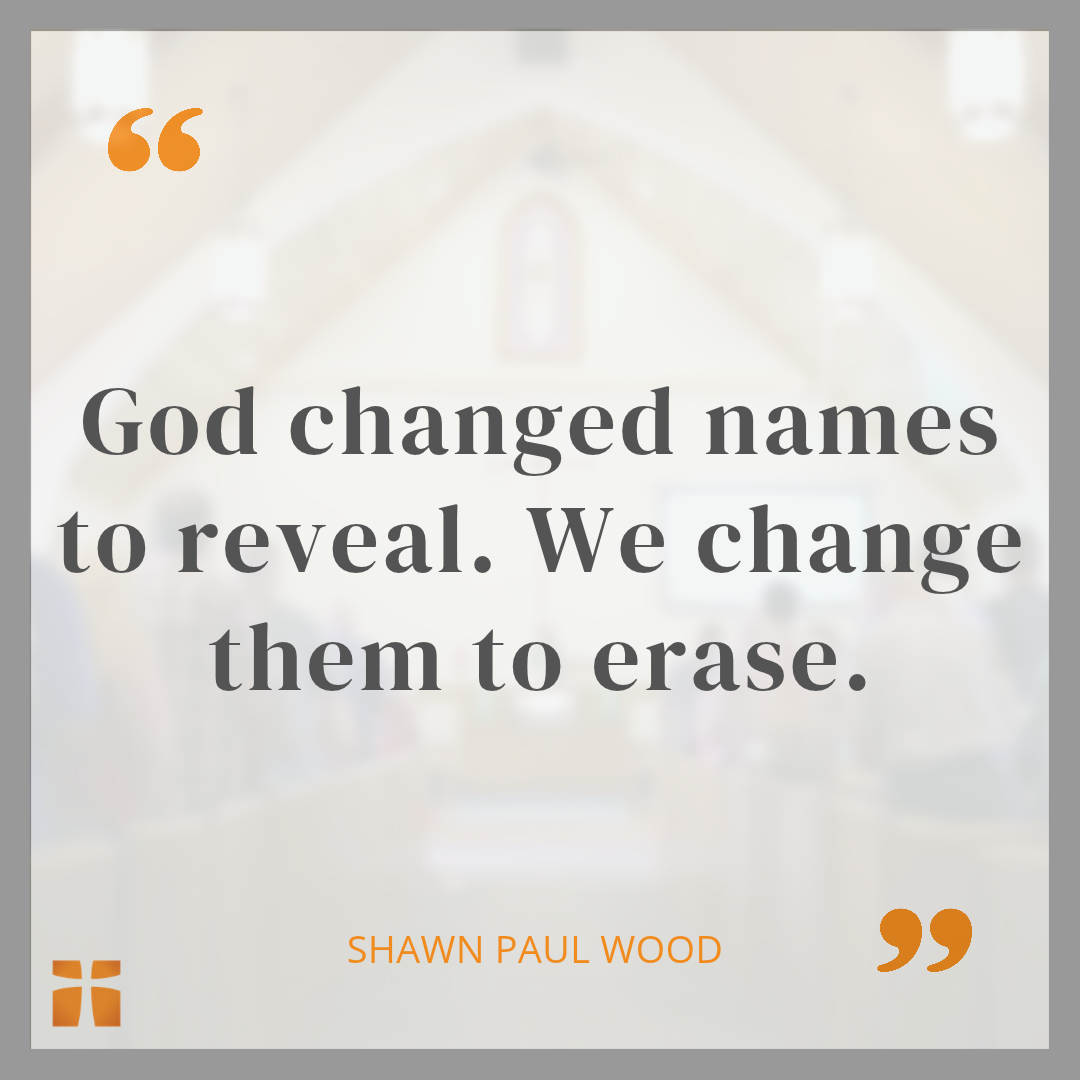
God changed names to reveal. We change them to erase.
That comparison has limits. A church or organization's name change isn't automatically cowardice, compromise, or bad theology. EPA doesn't need our permission to change its letterhead, but the public does have a say in how this change makes them feel.
The marquee or new logo isn't the concern. How quickly Christians surrender the meaning of our own language is.
What Happens When “Christian” Carries Cultural Baggage Too?
We can get this wrong in the other direction, too. Nobody gets into heaven because the church sign says Baptist. “Evangelical” is not the name above every name. Jesus never commanded His followers to protect a denominational brand.
Paul adapted his approach to the people he was trying to reach without changing the Gospel he preached (1 Corinthians 9:19-23).
When believers began turning toward “a different gospel,” he didn't suggest better branding.
He warned them about changing the message itself (Galatians 1:6-9).
Jude likewise urged Christians to “contend for the faith” entrusted to them (Jude 3).
God's Word has endured while our vocabulary keeps shifting around it. Our responsibility is to know the difference.
Even Christian wasn't born as a comfortable brand. The disciples were first called Christians at Antioch (Acts 11:26). Peter later wrote about suffering “as a Christian” (1 Peter 4:16).
What about our Savior? Jesus endured labels intended to diminish Him, too. His critics questioned His Nazarene identity (John 1:46). They called Him a friend of tax collectors and sinners (Matthew 11:19). Then, they accused Him of being demon-possessed (John 8:48).
None of it changed who He was.
Maybe you've never voted to rename a Christian organization. But perhaps you've hesitated to tell someone you're evangelical. Maybe you've said you're Christian and immediately added, “But not that kind of Christian.” Ever caught yourself explaining labels to people, before anyone even asked?
It’s not akin to denying Jesus three times, but you’re still caught up in that ballyhoo because there is a part of you that’s ashamed to stand with those Christians.
It’s okay, but don’t think for a moment Jesus didn’t see that. He did. Moreover, he gets it.
Which Name Should Matter Most to Christians?
Scripture says God gave Jesus “the name that is above every name” (Philippians 2:9-11), and Peter said there is “no other name under heaven given to mankind by which we must be saved” (Acts 4:12). There's power in the name because of the One the name represents.
If “evangelical” has come to mean something evangelicals don't believe, dropping the word is one response. Living so faithfully that people must reconsider what they thought it meant is another.
Sooner or later, though, we reach the name we cannot rebrand our way around.
“Christian.”
For plenty of people, that word already carries baggage. Some hear hypocrisy, politics, scandals, or judgment. If our answer to every damaged Christian identifier is replacement, eventually there's nowhere else to go.
Eventually, we run out of names to hide behind.
Then we're left with the harder work Jesus gave us in the first place: Let people see how we live and give them reason to glorify our Father in heaven (Matthew 5:16).
Maybe the church doesn't have a naming problem. Maybe we have a living problem. EPA members decide what to call their organization.
That's their decision, not mine. But the conversation they're having belongs to all of us. A label may tell someone what box to put us in, but a life faithfully lived has a funny way of refusing to stay there.
Maybe the best way to change what a name means isn't always to change the name. Let’s look at the heart first. After all, 1 Samuel 16:7 tells us that’s where God focuses anyway.
Frequently Asked Questions
Why did the Evangelical Press Association change its name?
The organization says its mission has expanded beyond traditional print media and that the word “evangelical” increasingly carries political, cultural, and sociological meanings that can obscure its intended theological meaning.
What is the Evangelical Press Association's new name?
Members voted in 2026 to rename the Evangelical Press Association the Christian Communicators Network.
What does “evangelical” mean?
The word is rooted in the Greek term associated with the gospel or good news. Today, evangelicalism also refers to a broad Protestant movement emphasizing Scripture, conversion, Christ's saving work, and sharing the gospel.
Is evangelical the same thing as Christian?
No. Evangelicalism is one movement within the broader Christian tradition. Christians come from many theological traditions and denominations, while evangelicals generally share particular convictions about Scripture, conversion, the gospel, and evangelism.
What should define a Christian's identity?
Denominational and theological labels can communicate important beliefs, but a Christian's deepest identity is found in Jesus Christ and should be demonstrated through faithful belief and living.
For Further Reading
- What Does the Term 'Evangelical' Really Mean? 10 Things to Know
- What Is an Evangelical?
- What Does It Mean to Say “I Am a Christian”?
- What Is the Great Commission and What Does It Mean for Us Today?
- Finding Your Identity in God When the World Tries to Define You
Photo Credit: ©Getty Images/Maskot

Originally published October 15, 2026.