Operation Brave Heart: Bringing Home the Last Hostage from Gaza


Listen or Read Below:

Audio By Carbonatix
Ran Gvili embodied heroism until his last moments. Despite awaiting shoulder surgery, which had him on disability from his job as a police officer in Israel, immediately following the Hamas attack on October 7, 2023, he rushed to defend and protect others during the assault, saving numerous lives. He was killed in action, and his body was kidnapped along with 250 others into Gaza. Last week, he became the last hostage to be brought out of Gaza after 843 excruciating days. That he rushed into action immediately, he has been described as “the first in and the last out.” Yet his return, something that many in Israel thought might be an impossibility, underscored Israel’s unwavering commitment to the principle of leaving no one behind—whether living or fallen.
His repatriation, codenamed “Operation Brave Heart,” marked a symbolic closing of one of the darkest chapters in modern Israel that began on that brutal day. It was the end of a mission accepted by hundreds of thousands of Israeli soldiers, to free all the hostages: Israelis, foreign nationals from over two dozen countries, Jews and non-Jews alike.
The operation itself was a masterpiece of military precision and moral resolve. Colonel Golan Vach, commander of the IDF’s elite Pladot unit, led the effort. He is a seasoned combat veteran and search-and-rescue expert inside Israel, and leads Israel’s rescue operations following many international disasters ranging from Florida to Haiti, Nepal, the Philippines, Turkey, and more. Col. Vach was severely injured in a 2024 Gaza tunnel collapse. In a recent conversation, he describes his near-death experience as a personal miracle: buried under tons of earth, an excavator (operated by one of his own men) struck his helmet, but created an air pocket that saved him. He shared how, while at the moment he thought he was going to die, but after being saved, he initially planned to retire. Then he returned to active duty and was called upon to lead this mission.
Vach described the intelligence that eventually pinpointed Gvili’s body in an old cemetery in the Shuja'iyya neighborhood of Gaza City —an area with deep historical resonance. Locals there trace ancestry to the Mamluks, who defeated Christian forces centuries ago. Vach described how, for them, October 7 represented a twisted continuation of that triumph over both Jews and Christians, and an element of ongoing persecution of Christians in Gaza. Ironically, the cemetery had become a mass burial site for over 1,000 Hamas operatives and others since the war began, making the location seem improbable to find an Israeli hostage. He explains that it was likely chosen by terrorists deliberately, to ensure Gvili’s body would never be found.
Planning the operation spanned months. Earlier IDF combat operations had unknowingly operated atop the very site, destroying nearby terrorist infrastructure without realizing Gvili lay beneath. When fresh intelligence from a captured Islamic Jihad terrorist elevated the cemetery from lowest-probability to the sole viable lead, preparations intensified. The challenge was immense: locate one specific body among hundreds in layered graves, under hostile conditions. The general to whom Vach reported referred to the operation as being a single bullet in the chamber: no other viable leads to find Gvili’s body, so it had to be a success.
Approximately 700 personnel participated, including roughly 400 combat soldiers providing multi-layered security for Vach’s team. During this time, four terrorists attempting an RPG attack were neutralized, underscoring that they were operating in a war zone where extra precautions needed to be taken. The Pladot unit—composed of highly experienced reservists skilled in “gentle” heavy machinery operation—excavated precisely mapped strips of the cemetery. Operators, trained to handle delicate urban demolitions and body recoveries without unnecessary destruction, worked methodically. After two days of careful digging amid Gaza’s punishing sun, Gvili’s remains were located early in the process—something many attributed to divine intervention, sparing the team prolonged exposure to decomposing bodies.
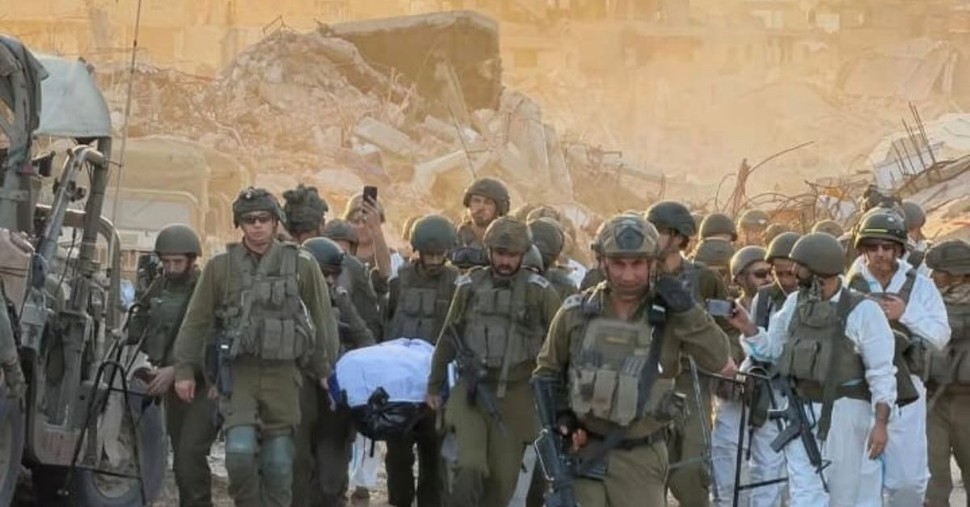
Identification occurred promptly via dental X-rays in a field setup with a team of dentists experienced in forensics. The moment of confirmation triggered a spontaneous and emotional gathering: hundreds of soldiers converged around the simple stretcher on which Gvili’s body lay, draped in the Israeli flag. Secular and religious soldiers alike sang the Hebrew song most known as a complete expression of faith, “Ani Ma’amin” (“I believe with perfect faith in the coming of the Messiah”) and other traditional songs, weeping, and embracing. The scene captured profound national catharsis—joy at fulfilling a sacred duty, grief for the cost, and affirmation of shared Jewish identity.
Before the return of Gvili’s body to Israel, the team respectfully reburied the several hundred Palestinian Arab bodies that had been exhumed. That was also part of the operation. The fact that they were reburied exactly where they had been disinterred showed the careful respect for the dead, even dead terrorists, and emphasized Jewish sanctity for human remains. Rabbis from the IDF’s search and rescue unit ensured sensitivity per Jewish law throughout. This reflected core IDF values: cherishing life, upholding human dignity even toward adversaries, and rejecting hatred as a motivating force.
Throughout the conversation, Vach and another IDF veteran, Shahak, referred to seeing God’s hand in many areas of this operation, and the war in general. They referred to many “coincidences” which were really Divine Appointments. In a fascinating and completely unscripted part of the conversation, Vach described how the honor of carrying Ran Gvili’s remains paralleled Moses and the Jewish people bringing Joseph’s remains out of Egypt, and the unique way in which God honored that.
Shahak, a longtime combat veteran, described the moral rarity of endangering one’s soldiers to honor enemy dead, contrasting it with other militaries, noting bluntly that there is no army in the world that would do this. As a point person coordinating with Genesis 123 Foundation for providing support and encouragement for soldiers, he praised the enduring support from Christians worldwide as evidence that this is a shared struggle of Judeo-Christian civilization against darkness.
The conversation closed with reflections on resilience, faith, and unity. After 28 months of war, the recovery of Ron Gvili offered partial closure while reinforcing Israel’s resolve. As Colonel Vach shared the last photo taken at the end of the operation: the ruined landscape of Shuja'iyya behind Gvili’s flag-draped coffin symbolized the terrorists’ self-inflicted destruction—and the enduring light carried forward by those who risk everything to bring their brothers home.
Ran Gvili’s body was kidnapped on October 7, along with 250 others, dead and alive. His was the 250th body to be checked until confirmation of his remains being recovered were made. Accordingly, it’s no “coincidence” that in Hebrew gematria, the numerical value of the letters that spell his name, Ran (רן), is precisely 250. It’s just another sign that even in the darkest times, God’s hand is ever-present.
Follow the full conversation with Col. Vach and Shahak on the “Inspiration from Zion” podcast HERE.
Related Article
Israel and Hamas Agree to Cease Fire, 20 Hostages Released Amid Renewed Hopes for Peace
Photo Credit: ©Col. Golan Vach.
The views expressed in this commentary do not necessarily reflect those of the Salem Web Network.

Jonathan Feldstein is president of the Genesis 123 Foundation (www,genesis123.co) whose mission is to build bridges between Jews and Christians and Christians with Israel. He was born and educated in the U.S. and immigrated to Israel in 2004. He is married and the father of six, and grandfather of four (so far).
Two sons and a son in law are currently serving in the IDF and have been involved in combat in Gaza and Lebanon since the October 7, 2023 Hamas massacre in Israel.
Jonathan is a leader working with and among Christian supporters of Israel, and shares experiences of living as an Orthodox Jew in Israel through his work, writing, and as host of the Inspiration from Zion podcast. Since the war began, he has authored more than 150 articles, and participated in a similar number of interviews, briefings, prayer events, and more.
Jonathan is working with Christian leaders all over the world to realize a true peace in Gaza, details of which can be found at www.SolutionforPeaceinGaza.com.
In 2023 he published the highly acclaimed book, Israel the Miracle (www.israelthemiracle.com), which makes a great gift for Chanukah and Christmas, and year round.

Originally published February 04, 2026.