Put Your Faith in Gods Sovereignty Not Worldly Leaders



A Moment of Cultural Alarm
I flew back into Dallas, Texas, this week from Africa—and what I heard in American Christian spaces troubled me more than the very culture we’ve been warning about.
It was just a few years ago that conservative Christians were sounding the alarm over what felt like a disturbing cultural drift. We spoke—and often complained—about our children being indoctrinated, confusion around gender identity, boys competing in girls’ sports, and young girls being forced to share locker rooms. We pointed to monuments like the White House being lit in bright pride colors—signs of what felt like a godless direction we struggled to reconcile.
And the cry was simple: Give us a government that will not stand against the Church, that will respect our traditional Christian values and not target our institutions. Give us space—space to worship freely and to declare Your Gospel throughout this land and beyond.
When the Prayer Is Answered
In many ways, that prayer has been answered.
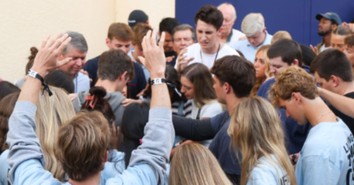
The environment has shifted. There is visible openness to faith—even to the point where public officials gather in the White House to pray openly. There is less hostility toward Christian institutions, more freedom to gather, and greater space to speak and preach without the same level of pressure.
At first, there was rejoicing—and rightly so.
But now the tone has changed.
From Relief to Expectation
The concern, increasingly, is not cultural hostility but personal imperfection. The concern is that the leader we prayed for is not “Christian enough.” His language, his temperament, and his inconsistencies trouble us. We measure him not by the relief he provides, but by the fruit he does not consistently display.
And yet, this raises an uncomfortable question: what exactly were we asking for?
Was it relief—or righteousness? Space to live out our faith—or a saint in high office?
If we believe that God has, in His providence, allowed a measure of relief, then rejecting it because the vessel is imperfect reveals something deeper. It suggests that our expectations may have shifted—from seeking opportunity to demanding perfection.
Scripture reminds us that God has often worked through unlikely and imperfect leaders to accomplish His purposes (Isaiah 45:1). The question is not whether leaders are flawless, but whether God is still sovereign.
The Misplaced Expectation
And I know that in today’s highly polarized climate, raising these questions invites criticism. But they are worth asking.
American Christians today often seem to expect faith to produce ideal governments and flawless policies. Yet Scripture offers no such promise. Faith was never meant to engineer systems or perfect leaders. Its aim is the transformation of the heart, not the control of the state.
In practice, our expectations can sound expansive: we want leaders who will end moral decay, eliminate injustice, stop exploitation, resolve economic pressures, and bring clarity to every social issue. Some even long for a government that reflects and enforces Christian belief.
In a word, we begin to drift toward the idea of a theocracy.
But the New Testament vision of the Church does not depend on political dominance. It depends on faithful witness.
A Biblical Framework for Power and Peace
History offers a sobering lesson. When faith and political power become too tightly fused, the result is often not renewal, but coercion—and at times, persecution.
The Apostle Paul provides a different framework in 1 Timothy 2:1–2:
“I urge, then, first of all, that petitions, prayers, intercession, and thanksgiving be made for all people, and for those in authority so that we may live peaceful and quiet lives in all godliness and holiness.”
The goal is not control, but peace. Not dominance, but space.
Paul’s instruction is remarkably modest—and profoundly strategic. Pray for those in authority so that conditions allow for the quiet, steady advance of the Gospel. Not advantage over others, but the freedom to live faithfully and proclaim Christ.
Peter echoes this posture when he writes, “Live as free people… show proper respect to everyone, love the family of believers, fear God, honor the emperor” (1 Peter 2:16–17). The Church’s strength has never been in its proximity to power, but in its clarity of witness.
Clarity, Not Control
This is where we must land—not in outrage, not in illusion, and not in the demand that government becomes what only Christ can be, but in clarity.
We are not here to engineer a perfect government. We are here to proclaim a perfect Gospel and to make disciples of all nations (Matthew 28:19–20).
That calling remains constant regardless of who holds office.
Stewarding the Window
So I say this to the American Christian: recognize the hour in which we live.
History reminds us that political conditions are never static. Governments rise and fall. Cultural pressures shift. What is granted in one season can be withdrawn in another.
It would be naïve to assume that current freedoms will remain indefinitely. The pendulum will swing again—as it always does.
Which is precisely why this moment matters.
If we fail to steward the space we have been given, we risk wasting the opportunity entrusted to us.
While It Is Still Day
As Jesus Christ reminds us in the Gospel of John 9:4:
“While it is day, we must do the works of Him who sent us. Night is coming, when no one can work.”
Jesus was not speaking merely of daylight, but of a limited window of opportunity—a season in which the work of God can be carried out before that opportunity closes.
We are living in such a window.
The question is not whether night will come. Scripture makes that clear (2 Timothy 3:1). The question is whether we will use the day we have been given.
Brothers and sisters, it is still day. Let us not squander this moment. Let us rise together and lift high the banner of the Lord Jesus Christ.
Related Article
How to Trust God with the Controls of Your Life
Photo Credit: ©iStock/Getty Images Plus/Ig0rZh

Originally published May 01, 2026.