What Retailers Rethinking Self-Checkout Reveals about Human Connection




Key Points
- Self-checkout can make shopping more convenient, but convenience cannot replace every form of human interaction.
- Scripture shows that God created people for relationship with Himself, family, friendship, and community.
- Technology serves us best when it supports relationships rather than quietly replacing them.
- Small everyday encounters can become opportunities to notice, honor, help, and love people made in the image of God.
- Christians can enjoy useful technology while intentionally making room for conversation, presence, hospitality, and unhurried time with God and others.
Why Are Retailers Rethinking Self-Checkout?
The self-checkout lane was supposed to make life easier.
Scan your groceries. Bag them yourself. Pay and go. No waiting for a cashier, no unnecessary conversation, and perhaps a few minutes saved in an already busy day.
Technology has given us countless conveniences like this, and many of them are genuinely helpful. We can order groceries without leaving home, text someone across the country in seconds, attend a meeting without driving across town, and accomplish tasks that once required considerably more time.
Yet as Walmart and other retailers continue reconsidering how much they rely on self-checkout in certain stores, the discussion raises a question larger than how we buy our groceries:
In our pursuit of convenience, are we quietly eliminating some of the human interaction God created us to need?
The answer doesn't begin at the grocery store. It begins in a garden.
Why Did God Create Us for Relationship?
The opening chapters of Genesis reveal something remarkable about our human story. Before there were cities, workplaces, churches, schools, neighborhoods, or grocery stores, there was God—and there were people He deliberately created for relationship with Himself. "Then God said, 'Let us make mankind in our image, in our likeness'" (Genesis 1:26).
The familiar picture of God walking in the garden in Genesis 3:8 reminds us that the Creator was not distant from His creation. God communicated with the people He had made. They knew His voice. He gave them freedom, boundaries, responsibilities, and commands by which to live.
Their first and most important relationship was with Him. Centuries later, when Jesus was asked which commandment was greatest, He brought everything back to relationship: "'Love the Lord your God with all your heart and with all your soul and with all your mind.'" Then He added, "'Love your neighbor as yourself'" (Matthew 22:37, 39). Love God. Love people.
Those two commands provide a framework for nearly every relationship in our lives.
Why Does Family Require Time and Presence?
After creating Adam, God made another declaration: "It is not good for the man to be alone" (Genesis 2:18). God created Eve, established the first family, and had already given humanity the beautiful instruction to "be fruitful and increase in number" (Genesis 1:28).
Creation would multiply through relationship—families, communities, generations, and within those relationships God instructed His people to impress His commands upon their children—to talk about them when they sat at home, walked along the road, lay down, and got up (Deuteronomy 6:7).
Teaching God's truth wasn't limited to a scheduled lesson. It happened while people were doing life together: sitting, walking, talking, listening. Those things take time.
Perhaps that is worth remembering in homes where family members can sit within a few feet of one another while each person is looking at a different screen. Technology can bring people together. It can also allow us to be physically close while relationally miles apart.
Why Does Friendship Need More Than Efficiency?
Technology has made friendship easier in many ways. I can communicate instantly with someone who lives hundreds or thousands of miles away. I can look at photographs of grandchildren, encourage a friend via text, or pray with someone over the phone.
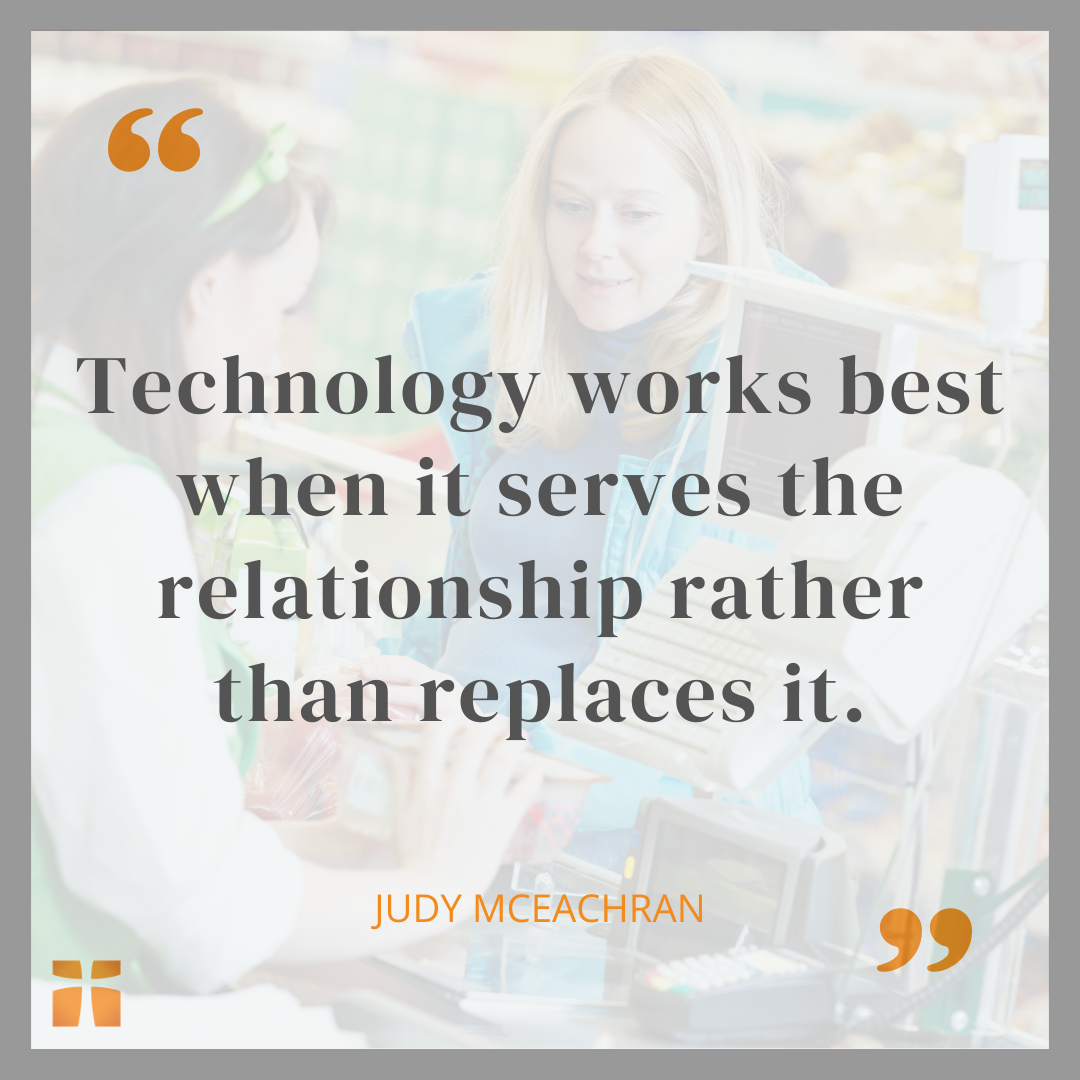
Those are gifts worth appreciating. But technology works best when it serves the relationship rather than replaces it.
Real friendship is rarely efficient. Perhaps the better word is friction.
"A friend loves at all times," Proverbs 17:17 tells us. Sometimes that means answering a phone call when we had planned to do something else. It means listening to a story we've heard before. It means sitting beside someone who is grieving when we have no words to fix the situation.
Friendship requires patience, as does marriage, parenting, church, and almost every relationship that matters. We often call those moments interruptions. But perhaps some of the friction we work so hard to eliminate from our lives is exactly where relationships grow.
What Do We Lose When We Stop Needing One Another?
That brings us back to the checkout lane. There is nothing spiritually superior about standing in a cashier's line instead of scanning your own groceries. Sometimes self-checkout is faster and easier. Technology itself isn't the problem.
But consider what disappears when more and more everyday tasks require no interaction with another person. No greeting or conversation. No asking for help, or opportunity to help. No moment of eye contact between two strangers whose paths may never cross again.
Those encounters may seem insignificant. But Scripture gives us a very different way of seeing the people around us. "Be devoted to one another in love. Honor one another above yourselves" (Romans 12:10).
Every employee stocking a shelf, every cashier scanning groceries, and every elderly shopper moving slowly ahead of us is someone created in the image of God. So is the impatient person standing behind us.
People are not obstacles between us and whatever we want to accomplish next. They are people God sees. And perhaps we should see them too.
What Can Jesus Teach Us about Being Available to People?
When we look at the life of Jesus, something else becomes striking. Jesus was frequently interrupted.
Jairus desperately needed Jesus to come to his dying daughter, but on the way, a suffering woman touched Jesus' garment. Jesus stopped. Children were brought to Him when His disciples apparently thought He had more important things to do. Jesus welcomed them. Bartimaeus cried out from the roadside while Jesus was traveling. Jesus stopped and called for him.
Again and again, Jesus gave people His attention. He saw individuals others overlooked. He listened. He touched. He spoke. He served.
People were not interruptions to His important work. People were the important work.
That challenges a culture increasingly organized around speed. I'm thankful for fast checkout, faster communication, quicker delivery, speedy answers. And there is nothing inherently wrong with saving time. The more important question may be: What are we saving the time for?
If technology gives us additional minutes but those minutes simply disappear into another screen, another task, or another hurried activity, have we actually gained very much?
How Can Christians Choose Connection Without Rejecting Convenience?
Perhaps the changing self-checkout lane is simply one small reminder of something much larger. We need one another. We need families where people put down their devices long enough to talk. We need friends who have time to listen. We need churches where we don't merely attend but know and care for one another. We need communities where strangers still notice each other.
But above all, we need the relationship for which we were first created—a relationship with God Himself that overshadows every other relational purpose in life.
Jesus summarized the priorities beautifully: love God and love your neighbor. Technology can help us do many things, but it cannot love God for us. It cannot sit beside a grieving friend. It cannot replace a parent's attentive presence, the warmth of genuine friendship, the fellowship of believers, or the simple dignity of one human being recognizing another.
What Are We Saving Our Time For?
So use the self-checkout when it helps. Send the text. Order online. Enjoy the convenience technology provides. But also sit at the table. Call the friend. Listen to the person who needs to talk. Speak to the neighbor. Look the cashier in the eye. Gather with other believers.
And above everything else, make room for unhurried time with the God who created us for relationship with Himself.
Convenience can save us time. The more important question is what—and whom—we are saving that time for.
Frequently Asked Questions about Self-Checkout, Technology, and Human Connection
- Why are some retailers changing self-checkout?
Some retailers have adjusted self-checkout because of theft, customer experience, staffing, and a desire to balance automated and staffed checkout options. - Is self-checkout wrong for Christians to use?
No. Self-checkout is simply a tool. The deeper question is whether convenience is helping us use our time well or slowly eliminating opportunities for presence and relationship. - Why does human connection matter to Christians?
Scripture teaches that people were created for relationship with God and one another, including family, friendship, fellowship, service, and care for others. - Can technology hurt relationships?
Technology can strengthen relationships when used wisely, but it can also replace conversation, attention, presence, and dependence on other people if convenience becomes the primary goal. - How can Christians practice greater human connection?
Christians can slow down, speak to people around them, practice hospitality, listen without rushing, gather with believers, spend time with family, and intentionally create room for relationships.
For Further Reading
- 6 Reasons Community Is Vital in Every Christian Life
- How to "Love Your Neighbor As Yourself" as in Mark 12:31
- What Does It Mean to Be Hospitable?
- How to Set God-Honoring Boundaries for Technology in Your Home
- What Gen Z’s Return to Movie Theaters Reveals about Our Hunger for Shared Experience
Photo Credit: CANVA/Industrial Photograph

Originally published September 23, 2026.