Abraham Lincoln: A Man of Justice and Moral Courage


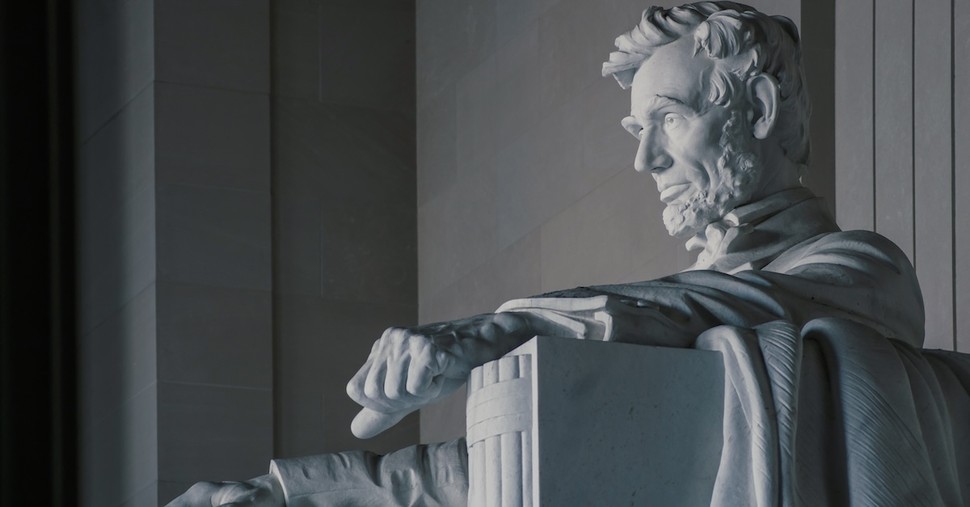
Listen or Read Below:

Audio By Carbonatix
Abraham Lincoln was fond of the Bible and knew it well. He was opposed to slavery, but denied being an abolitionist. During his time in government, Lincoln refused to vote for resolutions that defended slavery. Instead, he and a fellow member wrote out a protest in which they proclaimed that slavery was "founded on both injustice and bad policy,” but that “the promulgation of abolition doctrines tends rather to increase than abate its evils,” according to Britannica.
The Moral Courage to Endure and Fight for What’s Just and True
As a legislator, Lincoln introduced a bill that would gradually free the slaves, but no one took the bill seriously, and it never went anywhere. Lincoln continued to push for getting rid of slavery, and the famous line that he borrowed from the Bible about "A house divided against itself can't stand" was used in the context of half of the U.S. allowing slavery while the other half didn't. He wisely predicted that the U.S. would eventually allow slavery throughout or it would abolish it among all states.
When he finally became the president in 1861, not only did he usher in the emancipation of the slaves, but he also signed the Homestead Act of 1862 into law. This piece of legislation was intended to develop the western part of the United States and encourage settlers to take on the work to do it. If U.S. citizens who were 21 or older agreed to live on the land, work it for five years, and build a home on it, they could keep the land as long as they registered it with the U.S. Government, and there were two neighbors willing to sign a statement that all of the above requirements were met. There was also the option to buy the land from the U.S. Government after six months of setting it for $1.25 per acre.
This particular legislation offered many U.S. citizens who otherwise couldn’t afford homeownership a chance to step into that role. Today, there are some who would say that homeownership is the American dream, according to Investopedia. However, the more traditional version of the American dream is that the United States is the land of opportunity and freedom. Therefore, Americans are free to work toward obtaining their personal or family dreams. The American dream includes the idea that no matter what social class a person holds, America offers equality for all. So everyone has an equal shot to achieve their dreams if they have the determination to succeed, according to Britannica.
The Battle to Obtain and Retain Freedom
The colonists who originally came to America chose to start a new life here because they were deeply dissatisfied with the way their government was functioning. Some had experienced religious and/or political persecution. Others were born into poverty with no way to escape it or the stigma of their class. So the opportunity to have a fresh start in America was appealing. When England attempted to suppress the spirit of America, it eventually led to the Revolutionary War and Americans taking a stand to fight for their freedoms.
Then, in the Civil War, freedom was a part of the conflict once again, only it was an internal conflict involving the slaves. Some of them chose to fight with the northern soldiers for their freedom. When the Constitution was eventually written and signed, many will recall the iconic exchange between Benjamin Franklin and Elizabeth Willing Powel.
“Well, Doctor, what have we got, a republic or a monarchy?” Powel asked.
“A Republic, if you can keep it,” Franklin replied.
The idea of a Republic is connected to American freedom, and each generation receives the inheritance of that freedom. However, each generation also needs to make the choice whether or not they’re going to “keep it.”
The Foundation of Moral Courage and Justice
The Ten Commandments in the Bible were originally the core of America’s legal system. These were the moral compass by which right and wrong were decided, and justice was administered. A society that doesn’t have laws can’t function in peace, nor can it offer freedom and equality for all. In fact, the absence of government and laws is anarchy. In the Bible, Judges 21:25 speaks of a time in history when Israel had no king, and so “everyone did what was right in his own eyes,” a sort of “no absolute truths” mentality.
Another vivid example of a society that drifted into lawlessness is in Genesis 6:5-6, where it’s written, “Then the Lord saw that the wickedness of man was great in the earth, and that every intent of the thoughts of his heart was only evil continually. And the Lord was sorry that He had made man on the earth, and He was grieved in His heart.”
This led to the Lord’s decision to tell Noah to build an ark. Basically, God wiped out the human race and started over with Noah and his family, who had found favor in His eyes. Many more years down the road, there were two entire cities named Sodom and Gomorrah. The inhabitants of these two cities were so lawless and wicked, according to Genesis 19, that the Lord removed Lot and his family (who had the Lord’s favor) and completely decimated both cities.
There’s a price for biblical justice. Leaders and even every child of God must sometimes make hard decisions to stand up to the weeds of lawlessness and evil. It takes moral courage to refuse to allow principles that are contrary to God’s Word to take root. But once they take root, they are nearly impossible to remove. History illustrates that God won’t allow evil and lawlessness to go on forever. He will allow time for repentance, but eventually, justice will be administered. If repentance is chosen, He is faithful and willing to forgive (John 1:9), but that doesn’t necessarily mean sin’s consequences will be held back.
Related Video:
This article is part of Salem Media's Foundations of Freedom series.
Photo credit: ©GettyImages/Doug Armand

Originally published July 13, 2026.