A Presidents' Day Story for the Ages: George Washington and the Italian Painter Who Honored Him


It’s an utterly unlikely union. America’s Cincinnatus (George Washington) and America’s Michelangelo (painter Constantino Brumidi) never met. Washington was born in 1732, a 3rd generation Virginian. Brumidi was born in Rome in 1805 and emigrated to America in 1849, becoming a naturalized citizen soon after. Washington left his mark on the nation like no other military and political leader before or after, earning the honorific “America’s Indispensable Man.” Brumidi, who honed his craft painting frescoes and murals in Rome, would leave his mark throughout the nation’s most important building, earning the honorific “The United States Capitol’s Indispensable Artist.”
“Those beautiful hallways on the Senate side of the Capitol? Brumidi,” the United States Capitol Historical Society wrote in an essay on the man. “The historic committee rooms and fancy reception rooms? Brumidi. The decorative band wrapping around the Rotunda with the scenes from American history? That would be Brumidi, too.”
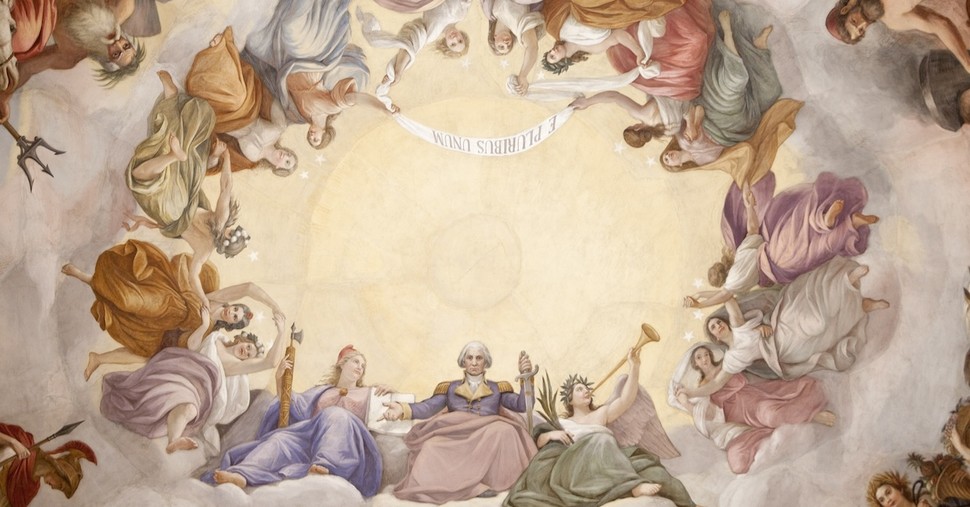
Brumidi’s crowning achievement – among many throughout the Capitol painted over a 25-year period – is the mural known as the “Apotheosis of Washington.” Painted in eleven months, not long after the new Capitol dome was completed in 1864, the magnificent fresco is suspended 180 feet above the Rotunda floor and covers an area of 4,664 square feet.
How did this Italian immigrant earn this commission? And why was George Washington chosen as the main subject of his masterpiece? To understand the answer to the former question, it’s best to answer the latter. And remind readers on President’s Day about the role Washington played in the formation of our country.
“Washington is the mightiest name of Earth,” Abraham Lincoln told an audience in Springfield, Illinois, in 1842. “To add brightness to the sun, or glory to the name of Washington, is alike impossible. Let none attempt it. In solemn awe pronounce the name, and in its naked deathless splendor, leave it shining on.”
Lincoln’s words were not hyperbole but rather an expression of a well-earned reverence. Washington not only led an upstart fighting force to victory over the mighty British Army, but resigned his commission not long after the big win. When told by the American artist Benjamin West that Washington was walking away from the power, King George III of England famously said, "If he does that, he will be the greatest man in the world.” Washington, the man who chose not to be a king, returned to Mount Vernon to pursue civilian life.
Duty called again when Washington was summoned to Philadelphia in the summer of 1787, where he served as president of the Constitutional Convention. Washington was then unanimously called upon to be our first president. Among his achievements, he signed the Northwest Ordinance of 1789 into law, which, among other things, precluded slavery in the new territories of the United States. After serving just two terms, Washington again walked away from power to return to Mount Vernon.
But who was Brumaldi? And how did he become the US Capitol’s most important painter? “As a boy in Italy, he studied at a famous arts academy, and learned how to fresco, painting on wet plaster so colors could become a permanent part of the wall,” the United States Capitol Historical Society wrote. In Rome, he would paint frescoes in palaces and chapels – and the Pope’s residence at the Vatican.
“Forced to flee the Italian Revolution in 1852, Brumidi came to America. Living in New York, he travelled extensively to paint private homes and churches, including a cathedral in Mexico City,” the Capitol Historical Society continued. “On his way back home, Brumidi stopped in Washington, D.C. to visit the Capitol. That side trip would forever change his life.”
It turns out the timing couldn’t have been better for Brumidi- and America: The Capitol had recently doubled in length to make room for larger chambers for the House and Senate. What was left after construction was a building filled with empty walls. Walls beckoning for an artist to bring them to life.
Brumidi was determined to win this commission, demonstrating his talents with a small painting in a Capitol meeting room. He passed the audition and would paint in the Capitol for the next twenty-five years. Indeed, few people could remember a day when Brumidi was not painting at the Capitol.
If Brumidi was a fixture there, so too was the scaffolding needed for his most memorable creation. “The enormous wooden scaffolding for the ‘Apotheosis of Washington’ mural raised Brumidi one hundred and eighty feet into the eye of the Dome,” the Capitol Historical Society explained. “Often, Brumidi would lie down on the platform, working flat on his back as he painted on the curved surface seventeen stories above the Rotunda’s floor.”
It was dangerous work, and people often gathered to watch him get pulled each day to the scaffolding’s peak. One fall nearly cost him his life, but for a watchful security guard who was able to save him. Injured, he would continue to paint for another year before his death in 1880.
The most memorable creation of Brumaldi’s career is his effort to honor our nation’s founding father. “In the central group of the fresco, Brumidi depicted George Washington rising to the heavens in glory, flanked by female figures representing Liberty and Victory/Fame,” notes Architect of the Capitol on its website “A rainbow arches at his feet, and thirteen maidens symbolizing the original states flank the three central figures. The figures in the painting, up to 15 feet tall, were painted to be intelligible from close up as well as from 180 feet below.”
What was the significance of this God-like rendition of Washington? “The fresco is less a deification of Washington than a creative recording of his achievements,” wrote Nayeli Riano. “Like any historical painting, it’s telling us a story about how we understand our nation and its identity.”
Should art like Brumidi’s show such admiration for its subject? “We might easily mistake such a work as blind reverence,” Riano noted. “Indeed, this is not the case. Brumidi’s fresco demonstrates, instead, the purpose of art: to lift our spirits and grant us something—an ideal—worth striving for.”
One of our great historians, the late David McCullough, agreed. “This isn't ancestor worship, this is reality, this is the truth," McCullough said not long before his death. "To be indifferent to people like Washington is a form of ingratitude. We ought to be down on our knees thanking God we're a part of this country, and we ought to know about the people who made it possible."
That’s precisely what Brumidi believed, expressing his reverence for Washington – and the nation that adopted him - not with a pen but paint and paint brush.
Washington died at his home on December 14, 1799, to worldwide accolades.
Brumidi died nearly eighty years later at his home in Washington, DC, in near anonymity, and with another important work left unfinished: the Capitol’s Frieze of American History.
Thus ended the mystical story of America’s Cincinnatus and America’s Michelangelo, forever connected in a fresco adorning the dome of the US Capitol. One the American people have admired for centuries – and will be admiring for centuries to come.
*Co-written by Ambassador Lee Rizzuto, the Ambassador to the Organization of American States, who served for decades as a senior executive at Con Air Corporation, and served on the board of the National Italian American Foundation.
This article was originally published on Newsweek; shared with permission.
Photo credit: ©GettyImages/Bloomberg / Contributor
Lee Habeeb is a Newsweek Columnist, Vice President of Content at Salem Media Group and host of "Our American Stories"
Originally published February 16, 2026.