5 Biblical Examples of “Turning the Other Cheek” That We Can Learn From



When someone hurts us, we’re often tempted to hurt that person back. But Jesus calls us to something much better than taking revenge. During his Sermon on the Mount in Matthew 5:38-39, Jesus tells us: “You have heard that it was said, ‘Eye for eye, and tooth for tooth.’ But I tell you, do not resist an evil person. If anyone slaps you on the right cheek, turn to them the other cheek also.”
At first glance, this sounds like we’re supposed to be weak people who let others take advantage of us. But turning the other cheek is actually about being strong through God’s power. It’s a call to break the cycle of retaliation. When we refuse to seek revenge, we’re choosing to trust God to make wrongs right, in his ways and in his timing.
We see the ultimate model for this in Jesus himself. During his trial, Jesus was mocked, spat upon, and struck in the face. The Son of God could have summoned legions of angels to wipe out his enemies immediately. Jesus was the only person in history who was truly innocent, yet he accepted the most shameful treatment to save us. The Apostle Peter, who witnessed these events, later wrote in 1 Peter 2:23: “When they hurled their insults at him, he did not retaliate; when he suffered, he made no threats. Instead, he entrusted himself to him who judges justly.”
When Jesus saved the world through his sacrifice on the cross, he showed the ultimate example of responding to hate with love. As we look at these 5 biblical examples of “turning the other cheek”, we’ll learn that turning the other cheek is a powerful way to reflect God’s light and find a peace that revenge could never provide.
Photo Credit: ©Getty Images / Thx4Stock
1. Abigail: Diffusing Anger with Humility

1. Abigail: Diffusing Anger with Humility
Abigail is one of the most courageous women in the Bible, and her story in 1 Samuel 25 shows us how she stepped in to stop a cycle of revenge before it started. The Bible contrasts her and her husband, Nabal, by saying in 1 Samuel 25:3: “She was an intelligent and beautiful woman, but her husband was surly and mean in his dealings…”. Nabal had insulted David’s men after they had protected Nabal’s shepherds. When David heard of the insult, he was furious. He was ready to take revenge with everything he had. David strapped on his sword and marched with 400 men to wipe out Nabal’s entire household. Abigail heard what was happening and didn’t wait for the disaster to strike. She didn’t defend her husband’s foolishness, but she also didn’t let David commit a sin he would regret. Abigail embraced humility when she rode out to meet David with a gift of lots of food.
Turning the other cheek as a peacemaker, Abigail fell at his feet and asked him to put the blame on her. In 1 Samuel 25:28, she tells David, “Please forgive your servant’s presumption. The Lord your God will certainly make a lasting dynasty for my lord, because you fight the Lord’s battles, and no wrongdoing will be found in you as long as you live.” Abigail turned the other cheek on behalf of her household. Her humility completely disarmed David’s rage. David realized she was right, saying in 1 Samuel 25:32-33: “Praise be to the LORD, the God of Israel, who has sent you today to meet me. May you be blessed for your good judgment and for keeping me from bloodshed this day and from avenging myself with my own hands.” Abigail teaches us that gentle humility is a powerful weapon. We can stop the momentum of anger by choosing to respond with a “soft answer” that turns away wrath (Proverbs 15:1).
Photo Credit: ©Getty Images/Boonyachoat
2. Joseph: Choosing Grace and Mercy
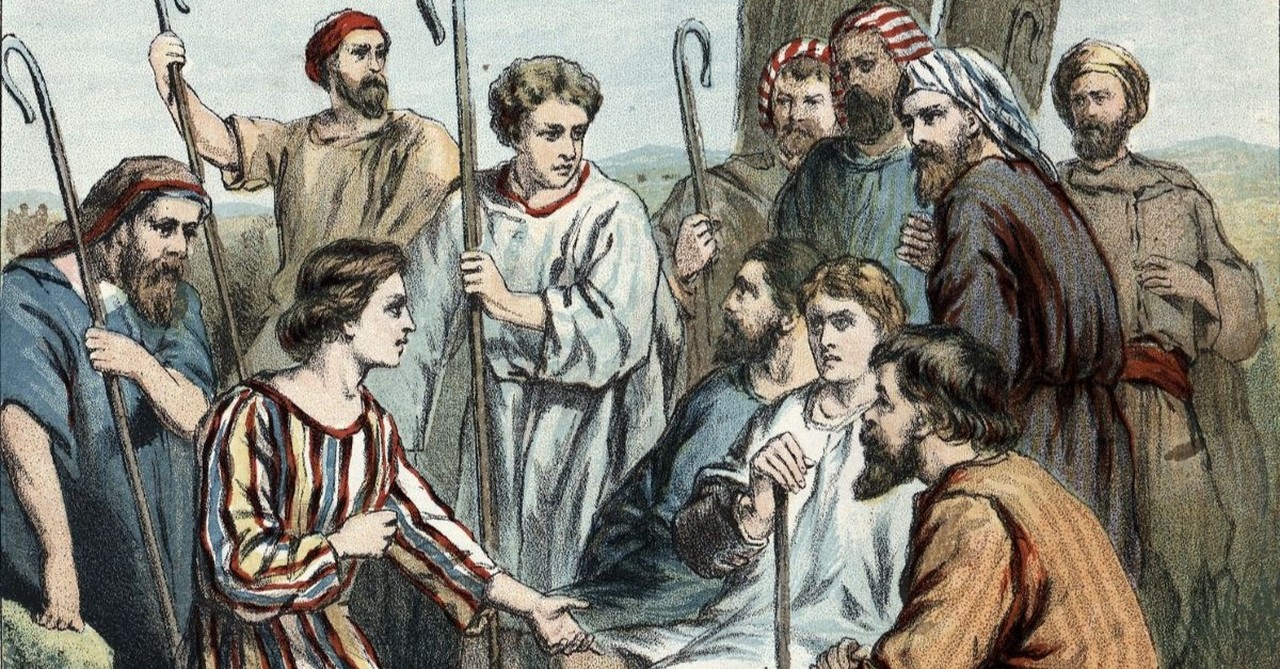
2. Joseph: Choosing Grace and Mercy
Joseph’s story in the Old Testament is a roller coaster of betrayal. His own brothers – the people who should have protected him – hated him so much they considered killing him, then settled for selling him into slavery. Imagine the years of trauma Joseph endured in Egypt, from being a servant to being falsely accused and thrown into prison. Decades later, during a famine, Joseph’s brothers showed up in Egypt looking for food. At this point, Joseph was the second most powerful man in the world. He had the legal right and the physical power to have them executed on the spot. He could have easily slapped them back for every year of pain they caused him. But instead of seeking revenge, Joseph chose to turn the other cheek to his brothers.
When Joseph finally revealed his identity, his brothers were terrified. Yet Joseph responded with grace and mercy. In Genesis 50:19-21, he tells them: “Don’t be afraid. Am I in the place of God? You intended to harm me, but God intended it for good to accomplish what is now being done, the saving of many lives. So then, don’t be afraid. I will provide for you and your children.” Instead of seeing himself as a victim of his brothers, Joseph saw himself as a servant of God’s plan. By refusing to retaliate, Joseph opened the door for God to work through him to save many lives. We can learn from Joseph that when we let go of the need to punish those who hurt us, we make room for God to work a miracle through us!
Photo Credit: ©GettyImages/duncan1890
3. David: Honoring God’s Timing

3. David: Honoring God’s Timing
For years, King Saul hunted David down to try to kill him, because Saul was driven by insane jealousy. David was forced to live in caves and forests, constantly looking over his shoulder to try to avoid danger. Then, in a cave at En Gedi, Saul happened upon the same cave where David and his men were hiding. Saul was unaware that David and his men were there, so David’s men said in 1 Samuel 24:4: “This is the day the Lord spoke of when he said to you, ‘I will give your enemy into your hands for you to deal with as you wish.’” David could have easily ended Saul’s life during that encounter. But David chose to turn the other cheek instead. He just cut off a corner of Saul’s robe, and even then, his conscience bothered him. He realized that Saul was still anointed by God (1 Samuel 10:1).
In 1 Samuel 24:12, David says to Saul, “May the Lord judge between you and me. And may the Lord avenge the wrongs you have done to me, but my hand will not touch you.” David chose to turn the other cheek by refusing to take matters into his own hands. He recognized that if he used violence to take the throne, his kingdom would be built on blood rather than God’s promises. This shows us that turning the other cheek often means waiting on God’s timing. When we’re tempted to move forward on our own by taking revenge, we can remember David. He knew that waiting on God to make things right at the right time.
Photo Credit: ©GettyImages/anthonyjhall
4. Stephen: Praying for His Enemies

4. Stephen: Praying for His Enemies
Stephen, the first martyr of the early church, was “a man full of God’s grace and power” (Acts 6:8), but his message about Jesus enraged the local religious leaders. As they dragged him out of the city to stone him, Stephen didn’t curse his executioners. Instead, as the stones were falling, he looked up to heaven and saw the glory of God. His final words were an echo of Jesus’ own words on the cross. Acts 7:60 tells us: “Then he fell on his knees and cried out, ‘Lord, do not hold this sin against them.’ When he had said this, he fell asleep.” Stephen’s act of turning the other cheek was also an act of praying for his enemies. He used his final breath to ask God to give his killers mercy.
Jesus urges us in Matthew 5:44 to “pray for those who persecute you.” When we pray for someone who has wronged us, it changes our perspective, so we can love our enemies as God calls us to. Stephen’s faithful choice to turn the other cheek, even to the people who were murdering him, likely inspired a young man named Saul who was standing right there, watching. That man would later become the Apostle Paul.
Photo Credit: ©GettyImages/BlackSalmon
5. Hannah: Responding to Provocation with Prayer

5. Hannah: Responding to Provocation with Prayer
Hannah was stuck in a painful situation: she was unable to have children in a culture where not having any children was considered shameful. Not only that, but her husband’s other wife, Peninnah, took every opportunity to mock her. The Bible reports in 1 Samuel 1:6-7: “Because the Lord had closed Hannah’s womb, her rival kept provoking her in order to irritate her. This went on year after year. Whenever Hannah went up to the house of the Lord, her rival provoked her till she wept and would not eat.” Hannah could have responded to Peninnah’s constant irritation by arguing with her constantly. But instead, Hannah turned the other cheek by taking her pain to God in prayer.
The Bible says in 1 Samuel 1:10-11: “In her deep anguish Hannah prayed to the LORD, weeping bitterly. And she made a vow, saying, ‘LORD Almighty, if you will only look on your servant’s misery and remember me, and not forget your servant but give her a son, then I will give him to the LORD for all the days of his life…’” Hannah’s example teaches us that it’s important to take our pain to God instead of to the person who hurt us. By refusing to retaliate against Peninnah and turning the other cheek instead, Hannah stayed focused on God and was able to use her pain to do something – pray – that could help change her situation. Eventually, God answered her prayer with the birth of Samuel. Prayer always helps us, no matter how God chooses to answer our prayers. When we choose not to strike back at the people who provoke us, we can stay focused on God and welcome God’s blessings into our lives.
In conclusion, as we reflect on these stories, let’s remember that turning the other cheek is a powerfully positive choice. When we stop trying to fight back at those who fight us, we can welcome God’s justice into those situations – and God will always make wrongs right, at the right times. The same God who empowered Abigail, Joseph, David, Stephen, and Hannah is with us today, offering us the strength to choose love in every painful situation!
Photo Credit: ©iStock/Getty Images Plus/kieferpix

Originally published February 23, 2026.